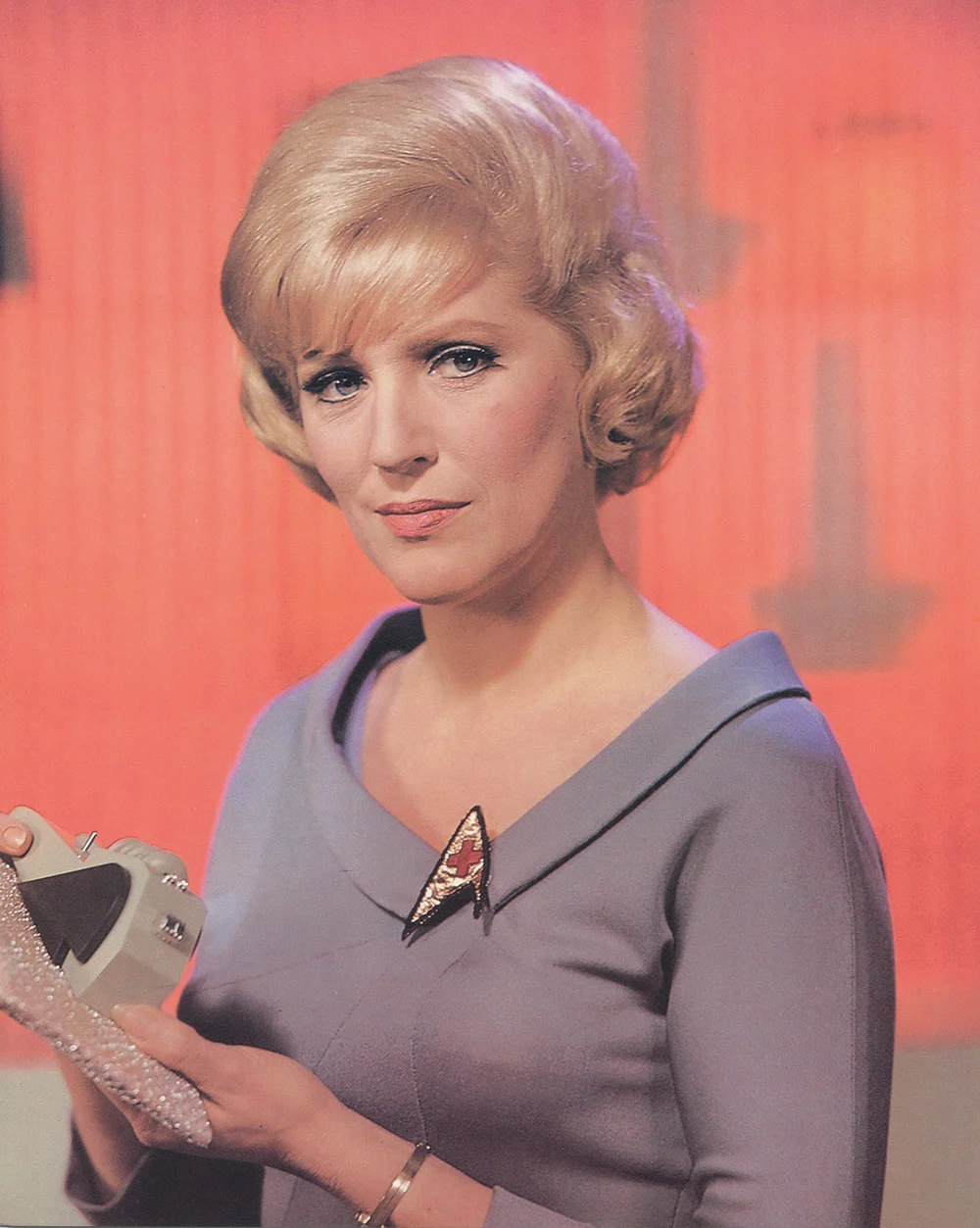
Majel Barrett Roddenberry, a figure described as statuesque, regal, and poised, stands as the undisputed First Lady of Star Trek, whose indelible mark extends across the franchise’s sixty-year history. Her contributions were multifaceted, encompassing not only her remarkable acting career with four recurring roles throughout Star Trek films and series, but also her vital role as an ambassador to its massive fan community and as the devoted wife of visionary creator Gene Roddenberry. She was, in essence, the very heart of the Star Trek universe.
A Pioneering Presence in Early Hollywood
From Ohio to the Silver Screen
Born Majel Leigh Hodak in Cleveland, Ohio, Barrett Roddenberry embarked on her journey to Hollywood in the late 1950s, quickly establishing a promising acting career. Her early filmography included appearances in notable productions such as Will Success Spoil Rock Hunter? and television series like Bonanza, The Untouchables, and Leave It to Beaver. This period saw her become a familiar face within the Desilu Productions stable, where she even received comedy tutelage from the legendary Lucille Ball herself.
The Genesis of a Sci-Fi Icon and a Lasting Partnership
Meeting Gene Roddenberry
A pivotal moment in Barrett Roddenberry’s life and career occurred in 1964 during her work on an episode of the military drama The Lieutenant. There, she met Gene Roddenberry, the show’s creator and executive producer. A man of diverse experience, Gene was a war veteran, former Pan Am pilot, and ex-cop—a background strikingly similar to Majel’s own late father. He was then on the cusp of launching his next, far more ambitious venture for Desilu: the groundbreaking, intellectually rigorous, and deeply metaphorical science fiction series that would become Star Trek.
The Bold Vision of Number One
In the initial pilot for Star Trek, titled "The Cage," Majel Barrett was cast in the groundbreaking role of Number One, the serious, efficient, and highly capable second-in-command of the starship Enterprise. This portrayal represented a landmark example of a woman in a significant position of authority, a truly revolutionary concept for mid-1960s television. Her son, Eugene "Rod" Roddenberry, affirms that his father saw these leadership qualities in her as a human being, stating, "She deserved that role. That was her."
Navigating Studio Resistance and Personal Stakes
The "Too Intellectual" Pilot and Executive Objections
Despite its innovative premise, Desilu executives found "The Cage," which starred Jeffrey Hunter, to be intriguing but ultimately "too intellectual" for television audiences of the era. They also took exception to another aspect of Gene’s vision: the strong female character of Number One. Jonathan Frakes, a Star Trek: The Next Generation actor and director, recalled the prevailing attitudes, noting, "Apparently the executives — ironically, Lucy may have been among them — didn’t want a strong woman in that part. That’s how dated and behind the times we were back in ’66. It’s kind of embarrassing."
A Pivotal Choice and a Transformative Recasting
Adding to the studio’s discomfort was Majel Barrett’s blossoming romantic relationship with Gene Roddenberry, whose first marriage was simultaneously dissolving as his professional star ascended. Some executives openly objected to casting "the producer’s girlfriend" in such a pivotal role. In an unprecedented move, Desilu granted Gene a second chance at a pilot but presented him with a stark choice: jettison either the enigmatic, pointy-eared alien Spock, played by Leonard Nimoy, or the female commander. Gene famously chose Spock, transferring Number One’s cool, dispassionate traits and command duties to the Vulcan science officer, thus shaping the course of television history.

However, Majel Barrett was far from out of the picture. Jonathan Frakes recounted, "When Number One didn’t work out and the first pilot got shit-canned, he recast her as Nurse Chapel." With a transformative honey-blonde dye job, she secured a recurring role as Nurse Christine Chapel, the Enterprise‘s compassionate head nurse, burdened by a barely concealed longing for the remote Spock. In addition to this on-screen role, Barrett Roddenberry also lent her voice, dropping it to a lower, more robotic tone, to the ship’s then-innovative interactive computer, a role she would famously reprise throughout the franchise.
Beyond the Screen: A Life Partner and Businesswoman
An Enduring Partnership
As their creative and personal bond deepened, Majel Barrett and Gene Roddenberry’s relationship solidified. Shortly after Star Trek‘s controversial cancellation in 1969, they married in a traditional Shinto ceremony, complete with kimonos, during a getaway to Japan. This marked the beginning of an enduring partnership. Frakes observed Gene’s unwavering loyalty: "Where he went, she went." Their son, Rod, further emphasized the profound connection, stating, "The number one thing I can say about my mother is she loved my dad in a way that I don’t know if I’ve ever seen before."
While supporting her husband, Majel also pursued her own interests, including raising their son. She took on the responsibility of overseeing Lincoln Enterprises, a pioneering mail-order business that sold Star Trek merchandise long before the franchise became a licensing behemoth under Paramount with its 1979 film revival. She would occasionally reprise her role as Nurse Chapel in films and animated series, alongside other acting engagements, such as a memorable turn as a robotic brothel owner in the original Westworld.
Embracing the "Broad" Persona
Majel Barrett Roddenberry was anything but a passive figure. Roddenberry recalled his mother positively reveling in the designation "broad," a term also used by Jonathan Frakes to describe her with pride. Far from the icy demeanor of Number One or Chapel’s longing, friends and colleagues remembered Majel as a boisterous, brassy, and take-no-prisoners presence. Marina Sirtis, who played Deanna Troi on Star Trek: The Next Generation, aptly described her as "a force of nature. You definitely knew when she entered a room."
Rod Roddenberry shared an anecdote illustrating his mother’s spirited independence: she defied the men-only lounge rule at their golf club. "She said, ‘Eff that,’" he recounted with a laugh. "She would hang out with the boys, because she could tell the dirty jokes… She was a bit of a sailor in her own right."
The Resurgence of an Acting Bug and a Beloved Matriarch
Lwaxana Troi: A Career Highlight
Much of Majel Barrett Roddenberry’s formidable, funny, and larger-than-life personality found its way into her fourth significant Trek role: Lwaxana Troi. Portraying Counsellor Deanna Troi’s "Auntie Mame"-esque, "man-eating diplomat mother," Lwaxana became a recurring guest star on The Next Generation and Deep Space Nine. This role allowed Barrett Roddenberry ample space for both uproarious comedy and, on occasion, deeply moving dramatic moments.
Jonathan Frakes remembered, "I think she shocked Sir Patrick Stewart — he wasn’t quite ‘Sir’ then — with how wonderfully brassy she was." Gene Roddenberry himself would frequently visit the set when Majel was filming, a rare occurrence he reserved for Klingon fight scenes or his wife’s performances, highlighting his admiration. Frakes also noted Majel’s palpable delight in having a plum acting opportunity after years largely supporting Gene away from the soundstage.
Mentorship and Maternal Bonds
Marina Sirtis initially felt nervous around Majel, recognizing her as "the boss’s wife" amidst a "rowdy" TNG cast. However, the two quickly formed an extraordinarily close bond, with Sirtis embraced by Majel’s warm, maternal side. Sirtis, who had just arrived from London, found a surrogate family in the Roddenberrys. "When my own mother passed away, I remember saying to Majel that she had to live a very long time because she was the only mum I had left," Sirtis shared, underscoring the depth of their connection.

Legacy: Steward of the Future and Voice of Tomorrow
Post-Gene Roddenberry Era
Following Gene Roddenberry’s death in 1991, Majel Barrett Roddenberry continued to serve as a tireless steward for both his Star Trek interests and his unrealized projects, which eventually blossomed into successful series such as Earth: Final Conflict and Andromeda. Her commitment to his vision was unwavering. Shortly before her own passing in 2008, she recorded her final role: the familiar voice of the Enterprise computer in J.J. Abrams’ acclaimed 2009 reboot film, Star Trek. In a poignant and fitting tribute in 2024, the cremated remains of both Majel and Gene Roddenberry were launched into deep space together, forever traversing the cosmos they helped envision.
Inspiring Artificial Intelligence
Majel Barrett Roddenberry’s iconic computer voice would ultimately provide inspiration for tech teams developing early artificial intelligence projects in subsequent years. Indeed, Amazon’s early Alexa model was famously code-named "Majel." Rod Roddenberry revealed that his mother had, at one point, declined an offer to be the voice of an upcoming computer system. Realizing the significance, he ensured she professionally recorded her voice, and working with the company OTOY, he has since created a working model he hopes to make available free to fans. "My intention was never to profit off it, for it to just get out there," he stated. "I wouldn’t be giving them the voice of the computer. I’d be giving them a voice of Majel Roddenberry."
A Continuing Influence: Strange New Worlds
Reviving Iconic Roles
Today, Paramount+’s prequel series Star Trek: Strange New Worlds pays homage to Majel Barrett Roddenberry by reviving and expanding two of her original roles: Nurse Chapel and Number One. The series deliberately pushes these characters beyond the social and cultural restraints of their mid-1960s origins. Jess Bush, who portrays Nurse Chapel, drew inspiration from both Majel’s original performance and her vibrant off-screen persona. Bush observed, "I know that she was kind of disappointed with what she was really able to do with Nurse Chapel and the material that she was given to play with, but you can still see this kind of underlying, sometimes saltiness and sarcasm." Bush aimed to "reverse-engineer it into a more bright-eyed, bushy-tailed, more naive version of that energy."
Rebecca Romijn, cast as SNW‘s Number One, had even less original footage to study, noting, "Only 13 minutes of screen time! That’s all I’ve had to go on." Nevertheless, she was determined to honor both the character and the actress who originated her.
Rectifying History and Honoring a Pioneer
Romijn shared a telling discovery from a signed, original script for "The Cage" that Rod Roddenberry showed her at San Diego Comic-Con International. "She had written copious notes in all of her scenes," Romijn recounted. "And I guess this script had been written for a man, because in all of the stage directions, it still said, ‘He passes to the left. He sits down. He picks up a thing,’ and she crossed out every single one and wrote her, she. And I hope they reprinted that script for her. ‘Not him. Her.’"
Marina Sirtis expressed deep admiration for Majel’s remarkable lack of complaint regarding Number One’s initial fate, despite the unfairness of the situation. Rod Roddenberry further highlighted his mother’s "humble quality when it came to Star Trek and fandom," and her profound respect for the fans who consistently kept Trek alive during periods of uncertainty. At conventions, she preferred to engage directly with fans at her table, eschewing the typical signing room setup. "She wouldn’t just sign, collect money and walk away. She would engage with just about everyone who came by," Rod explained. He concluded that his mother understood that "without an audience, without people there kicking and screaming and saying, ‘We want this,’ it wouldn’t be here today. She knew that, and she gave the fans almost as much love as she gave my father."
Majel Barrett Roddenberry’s enduring legacy is a testament to her pioneering spirit, her versatility as an actress, and her unwavering dedication to the Star Trek universe and its devoted followers. Her strength, independence, and profound impact on science fiction continue to resonate, ensuring her place as a true icon.