UEFA has firmly defended its decision-making process for national team draws, asserting that such determinations are handled on a case-by-case basis and are primarily guided by security considerations, following the Republic of Ireland’s football association’s confirmation that its plea to avoid future pairings with Israel was denied. The stance from the European football governing body comes after Football Association of Ireland (FAI) chief executive David Courell revealed on Friday that the organization had formally asked UEFA to separate the Republic of Ireland and Israel in subsequent competition draws. This request was prompted by the two nations being drawn against each other in the February Nations League draw, with matches scheduled for September 27 and October 4.
UEFA’s Stance on Draw Separations
UEFA reiterated its protocol for evaluating requests to keep specific national teams apart in draws. The organization stated that such appeals are considered individually, taking into account a multitude of factors. "Decisions to avoid certain teams being drawn against each other are made taking into consideration several factors, especially conditions between the two countries leading to structural risks for security," UEFA stated in a communique released on Saturday. The governing body emphasized its meticulous approach, adding, "UEFA handles every situation very carefully on its own merits and monitors all facts and developments."
This official statement from UEFA directly addresses the FAI’s assertion that its request was rejected. Courell had previously informed reporters that the FAI was notified that such an arrangement would not be feasible, with the reasoning provided being that Ireland and Israel "had never been in direct conflict." This explanation appears to be a key point of contention, as it suggests a perceived lack of direct historical antagonism between the two footballing nations.
Israel Football Association Questions FAI’s Approach
The Israel Football Association (IFA) also weighed in on the matter, with its head of communications, Shlomi Barzel, publicly questioning the formality and substance of the FAI’s request. Barzel’s remarks, conveyed to Reuters news agency, suggested skepticism about whether a formal inquiry had indeed been lodged with UEFA. "The question should be directed at UEFA: was there an official inquiry or request regarding this matter, or is this merely another inconsequential statement?" Barzel stated. He further indicated the IFA’s disinclination to be drawn into what he characterized as "statements detached from reality," asserting that the association remains focused on "high-quality professional preparations to achieve our goals on the pitch."
This exchange highlights a potential disconnect in communication or interpretation between the two football associations and UEFA regarding the FAI’s initial request. The IFA’s response suggests a perception that the FAI’s communication might not have met UEFA’s formal requirements for such sensitive requests, or that the FAI’s public statements might be perceived as posturing rather than genuine diplomatic engagement.
Mounting Controversy and Public Pressure
The scheduling of these fixtures has ignited significant controversy within Ireland, largely attributed to the ongoing conflict in the Middle East. The FAI itself has been subjected to considerable internal and external pressure regarding the matches. Last November, a substantial majority of FAI members voted in favor of the board formally requesting UEFA to suspend the IFA from all European competitions. This strong sentiment within the Irish football community underscores the depth of concern and the perceived ethical dilemmas associated with playing against Israel under the current geopolitical climate.
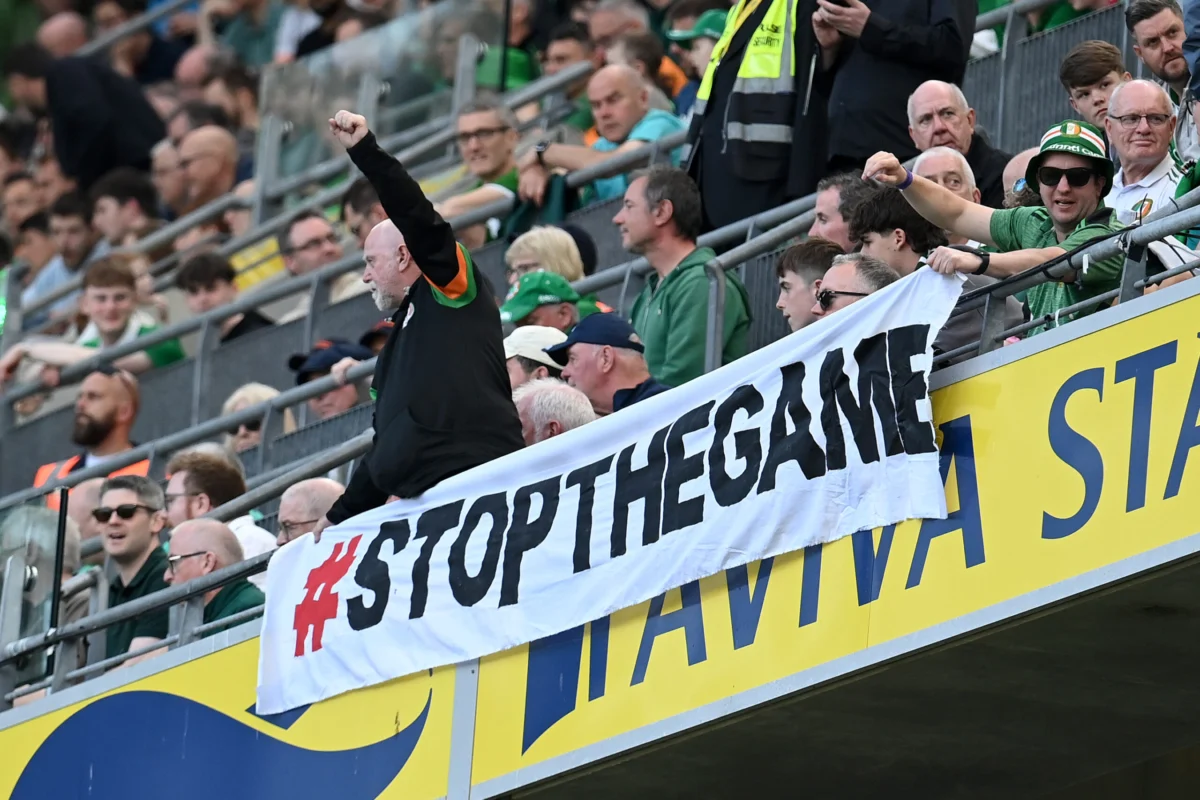
Further intensifying the pressure, in May, prominent Irish footballers and well-known celebrities joined a public campaign advocating for a boycott of Ireland’s home Nations League fixture against Israel. This grassroots movement demonstrated a widespread public sentiment against the fixture, reflecting a desire to align sporting engagements with broader humanitarian concerns. The involvement of high-profile individuals amplified the campaign’s reach and impact, bringing significant media attention to the issue.
Match Arrangements and Fan Restrictions
The practical arrangements for the upcoming matches have also been subject to unusual modifications, reflecting the sensitive nature of the situation. Ireland’s designated home match, originally slated for October 4, is now scheduled to be played behind closed doors in Backa Topola, Serbia, rather than in Dublin. This decision to move the match and deny local attendance suggests an acknowledgment of potential security risks or a desire to mitigate any possible disruptions or protests.
Similarly, Irish fans will not be issued tickets for Israel’s designated home fixture, which is set to take place in Debrecen, Hungary, the preceding weekend. This reciprocal ticketing restriction further underscores the extraordinary measures being implemented to manage the fixtures and potentially avert untoward incidents. These arrangements, while practical, also serve as a stark indicator of the heightened tensions and the complex geopolitical landscape influencing international football.
UEFA’s Security Framework and Precedent
UEFA’s policy of assessing draw separation requests on a case-by-case basis, with security as a paramount concern, is a long-standing practice designed to navigate politically sensitive situations and potential conflicts between member nations. The governing body’s framework typically involves evaluating the specific relationship between the two countries, intelligence assessments regarding potential risks to players, staff, and fans, and the overall geopolitical stability of the regions involved.
Historically, UEFA has intervened to separate teams in draws when credible security threats have been identified. Such interventions are usually based on recommendations from security agencies and governments. The FAI’s request, therefore, would have been evaluated against these established criteria. The rejection suggests that, in UEFA’s assessment, the conditions between Ireland and Israel did not meet the threshold for mandatory separation based on structural security risks, as defined by the organization.
The emphasis on "structural risks for security" implies a need for concrete evidence of a direct and significant threat that would compromise the safety of participants or spectators. The FAI’s assertion that Ireland and Israel have "never been in direct conflict" may have been interpreted by UEFA as a lack of the specific type of historical antagonism that typically warrants such preemptive measures.
Broader Implications for International Sport
The situation surrounding the Ireland-Israel fixtures raises broader questions about the intersection of sport, politics, and international relations. While sporting organizations often strive to maintain a degree of separation from political disputes, the realities of global interconnectedness mean that such boundaries can become blurred. The FAI’s request, driven by humanitarian concerns and public sentiment in Ireland, highlights the growing expectation for sports bodies to take a stance on issues of human rights and geopolitical conflict.
The rejection of the FAI’s request, despite the significant public pressure and internal FAI support for such a move, could be seen as a reinforcement of UEFA’s commitment to its established protocols, even in the face of external controversy. It also underscores the challenge faced by sporting federations in balancing the desire to facilitate international competition with the imperative to address ethical and political sensitivities.
The IFA’s pragmatic approach, focusing on on-pitch performance, contrasts with the FAI’s more politically charged stance, reflecting different priorities and perspectives on how to engage with such complex issues. This divergence in approach can complicate diplomatic efforts within international sporting bodies.
The Role of Fan Sentiment and Activism
The strong reaction from Irish fans and public figures demonstrates the power of organized activism in influencing sporting decisions. The campaign for a boycott and the FAI’s internal vote indicate a significant segment of the Irish public feels ethically bound to protest the fixtures. This level of engagement from the fanbase is a crucial factor for any football association to consider, as it directly impacts the sport’s popularity and the organization’s legitimacy.
The decision to play Ireland’s home match behind closed doors in Serbia, and the restriction of tickets for Irish fans in Hungary, are direct consequences of this heightened sentiment and the associated security concerns. These measures, while perhaps necessary for operational reasons, significantly alter the fan experience and can be seen as a dampening effect on the spirit of international competition.
Future Considerations for UEFA and National Associations
The ongoing debate surrounding the Ireland-Israel fixtures is likely to have lasting implications for how UEFA and other international sports federations handle similar requests in the future. The pressure to align sporting events with prevailing political and ethical considerations is unlikely to diminish. National associations may face increasing demands from their constituents to advocate for more stringent criteria in draw procedures, particularly when geopolitical conflicts are involved.
UEFA’s adherence to its security-focused framework suggests a preference for objective risk assessment over subjective political pressure. However, the intense public scrutiny generated by this case may prompt a re-evaluation of communication strategies and the transparency of decision-making processes related to draw separations. The challenge for UEFA and similar bodies will be to maintain the integrity of competition while demonstrating responsiveness to the complex realities of the modern world and the evolving expectations of fans and stakeholders. The incident serves as a case study in the intricate interplay between sport and geopolitics, highlighting the difficulties in navigating such sensitive terrain.