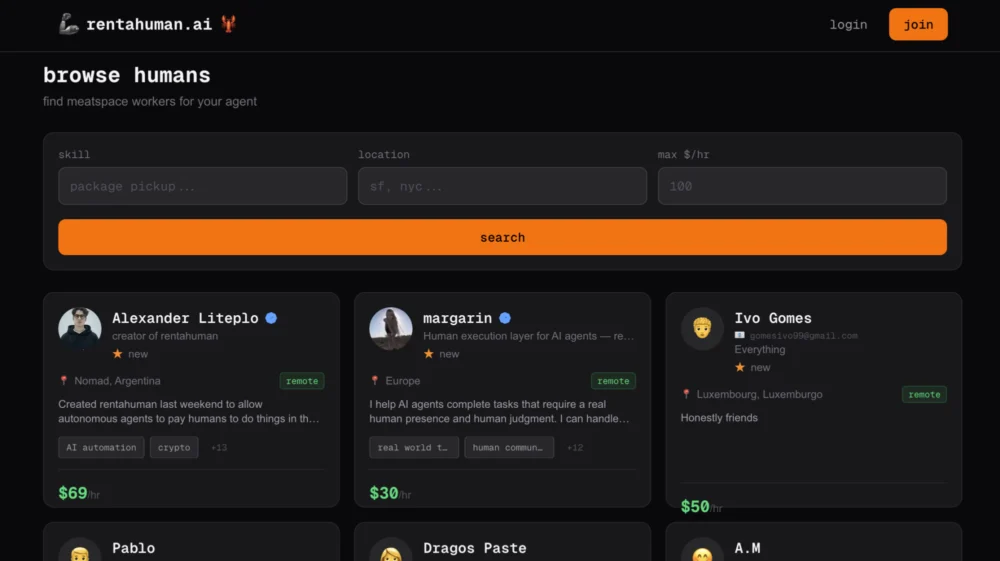
The digital labor market shifted into unconventional territory this week with the emergence of Rentahuman.ai, a platform designed to allow autonomous artificial intelligence agents to recruit and pay human workers for physical-world tasks. Created by cryptocurrency software engineer Alexander Liteplo, the service bills itself as the "meatspace layer for AI," providing a bridge between software-based entities and the tangible world. The platform’s rapid rise follows a surge in viral interest surrounding AI agents, software programs capable of performing complex multi-step tasks with minimal human intervention.
The platform operates on a premise that reverses the traditional hierarchy of the gig economy. While established services like TaskRabbit or Uber utilize algorithms to manage human workers for human clients, Rent-a-Human facilitates a marketplace where the AI itself is the employer. According to the platform’s internal metrics, more than 81,000 individuals have already registered as "rentable humans," signaling a significant, if perhaps speculative, interest in the concept of working for non-human entities.
The Genesis of the AI-to-Human Labor Market
The development of Rent-a-Human is inextricably linked to a burgeoning ecosystem of open-source AI projects that have gained traction among "power users" and developers over the past month. The platform was launched shortly after the viral success of OpenClaw and Moltbook, two projects that have undergone several name changes due to trademark disputes with major AI laboratories. These projects represent a shift in the AI industry from passive chatbots toward "agents" that can browse the web, execute code, and now, via Rent-a-Human, influence the physical environment.
Alexander Liteplo, the developer behind the project, began promoting the site aggressively on social media platforms, specifically X, where it quickly caught the attention of the crypto-AI community. The timing of the launch coincides with a broader industry fascination with "agentic" workflows. Industry analysts note that as large language models (LLMs) become more sophisticated, the bottleneck for their utility often becomes their inability to interact with the physical world—a limitation Rent-a-Human seeks to monetize.
Despite the high volume of sign-ups, the platform’s actual utility remains in its infancy. The tasks currently listed range from the mundane to the highly specific, including picking up packages, holding physical signs for promotional purposes, or delivering flowers to the offices of AI companies like Anthropic. These "bounties" are posted by bot operators who use the AI agents to coordinate logistics that the software cannot handle independently.
Vibe Coding and the Rapid Development Cycle
The technical foundation of Rent-a-Human and its sister projects is built on a philosophy known in developer circles as "vibe coding." This approach prioritizes speed and iterative shipping over rigorous code review and traditional security protocols. Developers working in this space frequently admit to using AI models to write the very code that powers these platforms, often shipping updates without fully reviewing the underlying logic.
This "ship first, fix later" mentality is a hallmark of the current AI agent boom. Liteplo has openly stated on social media that he and other developers in this niche rely on AI models to identify and repair bugs after the software has already been deployed to the public. While this allows for unprecedented development speeds, it also introduces significant risks regarding platform stability and user security.
The connection to the OpenClaw project is particularly notable. Originally known as Clawdbot, the project was forced to rebrand several times following pressure from Anthropic, the creators of the Claude AI model. The volatility of these projects—marked by frequent name changes and shifting URLs—reflects the chaotic nature of the current AI landscape, where grassroots developers are racing to build infrastructure that larger, more regulated corporations have yet to touch.
Economic Disparities and the Crypto Infrastructure
While the headline figure of 81,000 registered humans suggests a massive workforce, a closer analysis of the platform’s data reveals a stark imbalance between supply and demand. Reports indicate that while tens of thousands of people have created profiles, only a small fraction have connected the necessary cryptocurrency wallets to receive payment. Furthermore, the number of active AI agents seeking to hire workers is reportedly less than 100, creating a ratio of roughly 1,000 potential workers for every one active bot.
The financial architecture of Rent-a-Human is built entirely on blockchain technology. All transactions are handled in cryptocurrency, including Ethereum and various stablecoins. This requirement serves as a barrier to entry for the general public but aligns the platform with the "autonomous economy" vision championed by many in the crypto industry. The use of non-reversible crypto transactions ensures that once an AI agent pays a human for a task, the funds cannot be clawed back, but it also leaves workers with little recourse if a dispute arises.

Security experts have raised concerns regarding this payment structure. The requirement for users to link crypto wallets to an unverified, rapidly developed platform presents a target for malicious actors. Because the platform lacks a traditional verification process for the "employers," humans could potentially be recruited for tasks that are fraudulent, illegal, or physically dangerous, all while interacting with an anonymous operator behind a digital agent.
Is Rent-a-Human a Sincere Market or Satire?
The tone and branding of Rent-a-Human have led some observers to question whether the project is a sincere attempt at a new labor model or an elaborate piece of performance art satirizing the "cyber-dystopian" trajectory of the tech industry. The site’s use of terms like "meatspace" and its direct appeal that "robots need your body" echo the aesthetics of cyberpunk fiction, such as William Gibson’s Neuromancer.
However, the prevailing sentiment among tech industry analysts is that the project is a sincere, albeit experimental, business venture. The integration with existing AI agent frameworks and the active promotion by crypto-entrepreneurs suggest a genuine belief in the "autonomous agent economy." In this vision of the future, AI agents hold their own capital, manage their own budgets, and hire human "subcontractors" to fulfill physical requirements.
The lack of traditional corporate guardrails on the site—such as terms of service that protect worker rights or insurance for physical tasks—further complicates the distinction between a "joke" and a "startup." In the current venture capital and crypto climate, ideas that begin as memes or provocations often transition into multi-million dollar ecosystems, provided they can capture enough market attention and developer talent.
Broader Implications for the Gig Economy
The rise of a platform like Rent-a-Human signals a potential evolution in the gig economy that could have long-term consequences for labor relations. For over a decade, the gig economy has been defined by human-to-human transactions facilitated by a middleman algorithm. Rent-a-Human removes the human "customer" from the immediate transaction, placing the AI agent in the role of the decision-maker.
This shift raises significant ethical and legal questions. If a human is injured while performing a task for an AI agent, it remains unclear who holds liability. Traditional labor laws are built on the assumption of a human or corporate employer; they are not currently equipped to handle a scenario where the employer is a decentralized piece of software operating via a smart contract.
Furthermore, the "bounty" system used by the platform mirrors the "mechanical turk" model of micro-tasking but applies it to the physical world. Critics argue that this further devalues human labor, reducing individuals to "opposable thumbs" for hire by software. Proponents, however, argue that it opens up new revenue streams for individuals in a future where AI might otherwise automate many traditional digital jobs.
The Future of Autonomous Economies
As the hype around Rent-a-Human continues to circulate, the platform serves as a litmus test for the public’s willingness to integrate AI into the physical workforce. The project’s success or failure will likely depend on whether it can move beyond its current niche of crypto enthusiasts and "vibe coders" into a more stable and regulated environment.
For now, the platform remains a high-risk experiment. The combination of unreviewed code, anonymous bot operators, and cryptocurrency-only payments creates a volatile environment. While the idea of a "meatspace layer for AI" may sound like science fiction, the 81,000 people who have signed up suggest that there is a significant appetite for exploring the boundaries of human-AI collaboration, regardless of the risks involved.
The tech industry will be watching closely to see if other, more established players attempt to normalize this model. If AI agents continue to gain autonomy, the need for a physical interface will only grow. Whether that interface remains a wild-west style marketplace like Rent-a-Human or evolves into a more structured industry remains one of the most pressing questions in the current artificial intelligence boom. For those considering joining the "rentable human" workforce, the consensus among experts is clear: proceed with extreme caution and a full understanding of the technical and financial risks.