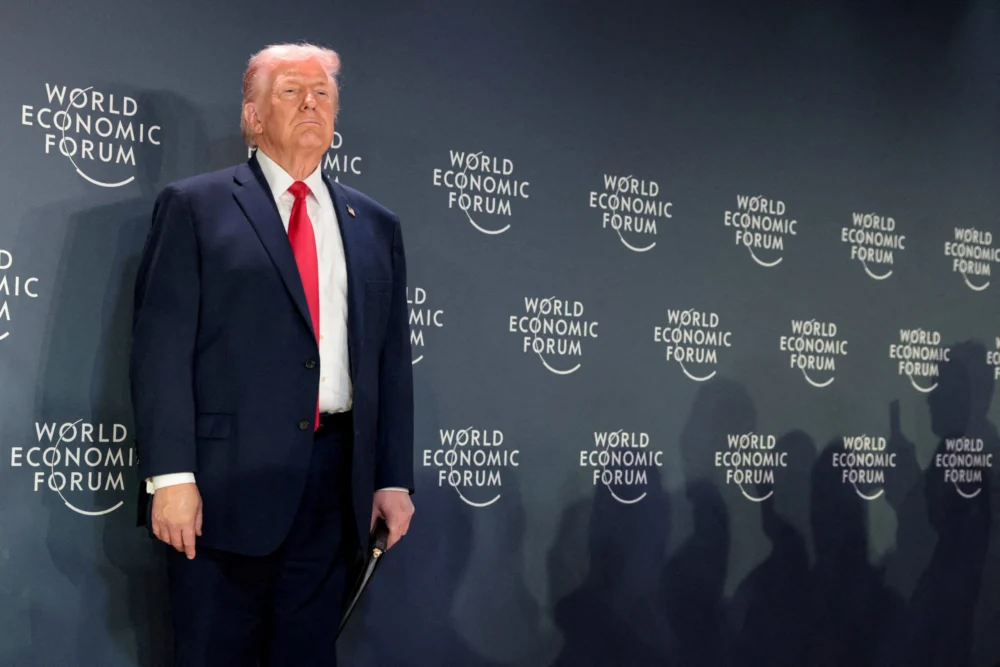
President Donald Trump’s recent high-profile appearances and assertive policy actions signal a deliberate effort to reshape the global economic and political landscape, moving away from established international norms toward a system prioritizing national interests, state coercion, and direct geopolitical competition. His participation in the World Economic Forum in Davos, for instance, was widely interpreted as a direct challenge to the global elite, a declaration that under his leadership, American capitalism was undergoing a fundamental shift. As his then-Commerce Secretary Wilbur Ross stated at the summit, "With President Trump, capitalism has a new sheriff in town."
This assertion of authority was underscored by a series of provocative actions leading up to and following the Davos summit. The heightened rhetoric and pressure applied to Western allies regarding issues like Greenland, coupled with ongoing trade disputes and interventions in regions such as Venezuela, collectively suggest a departure from the traditional, market-driven global order. These moves indicate an emerging model of capitalism that relies less on established international rules and more on the assertive use of state power and strategic geopolitical maneuvering.
Canadian Prime Minister Justin Trudeau, in a notable address, characterized Trump’s approach as a "rupture, not a transition," acknowledging the inherent hypocrisies and double standards within the existing international rules-based order. While this U.S.-dominated economic framework had provided a degree of stability for countries like Canada, Trudeau argued that this long-standing bargain was no longer tenable in the current climate. This sentiment reflects a broader unease among global leaders about the erosion of predictable international economic structures.
The Trump administration’s approach signals a deliberate attempt to fundamentally alter the international order and, by extension, the prevailing models of capitalism. For decades, the global economy has largely operated under a neoliberal framework, theoretically based on free-market principles. However, critics argue that this system often devolved into a highly monopolistic structure, with critical economic decisions concentrated in the hands of a shrinking group of powerful business leaders and wealthy investors. This model has been linked to unprecedented levels of economic inequality, environmental degradation, and a significant weakening of democratic institutions.
Historical Echoes of Economic Transformation
The current global economic dynamics bear historical resemblances to periods of significant upheaval. In the late 19th century, a globalized "free market" economy also led to vast wealth disparities, dominated by a select few industrialists and financiers often referred to as "robber barons." As these powerful business empires collaborated with nation-states to expand their global reach, the stage was set for increased international conflict.
In some nations during that era, the rise of fascist leaders saw the consolidation of power, the suppression of democratic opposition, and the forging of an aggressive nationalist agenda. These regimes often merged state power with corporate monopolies, mobilizing industrial capacity for territorial expansion and profit, and eliminating democratic economic oversight. This fusion of state and corporate power represented, in many respects, the ultimate manifestation of monopoly capitalism.
Trump’s "America First" Economic Doctrine
Trump’s actions and rhetoric appear to echo elements of these historical precedents, employing economic and, at times, military leverage to achieve his objectives. His administration has demonstrably utilized state power to benefit major corporations, increasing subsidies and protections to levels not seen in decades. This approach suggests a departure from the hands-off regulatory philosophy often associated with neoliberalism.
Crucially, Trump does not appear to be a figure controlled by established business interests. Instead, his actions suggest an intent to reorient how these businesses operate, aligning them more closely with his political agenda. His frequent clashes with corporate leaders, particularly those perceived as embracing progressive social stances, can be seen as an attempt to bully them into conformity with his "America First" vision, mirroring tactics employed by authoritarian leaders in the past.
Strategic Interventions and Resource Control
Trump’s foreign policy interventions, often viewed as perplexing by some in the business community, underscore this strategic reorientation. His stated rationale for intervention in Venezuela, for instance, was centered on oil, yet many major oil companies expressed reservations about increased investment in the region. Similarly, his ambassador to the United Nations cited control over critical minerals in Greenland as a key interest, essential for high-tech and military production, even if the immediate economic viability for extraction was uncertain for many businesses.
While some analysts suggest Trump’s focus is primarily on enriching his immediate circle of speculators, the underlying motivations appear more profound. Trump perceives the global landscape as one of intense great power rivalry, with China as the primary competitor, but also with Europe needing to recognize its place. To maintain American dominance, securing control over vital resources, including those with long-term strategic value, becomes paramount, especially to prevent rivals from acquiring them.
A New Paradigm of Geopolitical Capitalism
Trump’s strategy, while often erratic and contradictory, appears to advocate for a world order where international law is superseded by the principle of power politics. This approach is partly a reaction to what he perceives as unsustainable dynamics within the global economy. Consequently, his influence and the paradigm he represents are likely to persist beyond his presidency, suggesting that electoral politics alone may not be sufficient to counter this shift.
The Search for an Alternative Global Framework
In response to these trends, figures like former Bank of England Governor Mark Carney have proposed the formation of a coalition of "middle powers" to reduce reliance on the United States. This initiative is significant but represents only one facet of a potential solution. Carney’s vision for such a coalition often emphasizes the pursuit of deregulatory, free-market trade agreements, effectively proposing a different iteration of globalization rather than a fundamental departure from its core principles.
Moving Beyond Neoliberalism Towards Democratic Economics
The challenge facing Western leaders and the international community is to recognize that confronting what some characterize as "fascist economics" cannot be achieved through a renewed embrace of neoliberalism. A genuinely democratic economic model is required, one that prioritizes public investment, democratic accountability, and economic sovereignty over unchecked corporate power and speculative finance. Such a transition is achievable; by pushing back against Trump’s policies and diversifying away from U.S. economic dependence, nations can begin to rewrite the rules of the global economy.
Retaliation against Trump’s economic policies should extend beyond tit-for-tat tariffs. Limiting U.S. corporate access to procurement contracts, challenging intellectual property agreements, and implementing robust regulations on finance and technology could significantly impact Trump’s allies while simultaneously fostering sovereign economic policies that benefit ordinary citizens. These ideas are not entirely novel; discussions around the European Union’s "trade bazooka," initially threatened in response to the Greenland issue, have touched upon such potential measures.
The adoption of such policies would signify a genuine departure from the status quo. While Trump’s rise is concerning, it also presents an opportunity to transition towards a more democratic economic system, address widening inequality, and reverse environmental damage. Trump’s political movement is not an isolated incident but rather a symptom of deep-seated failures within the existing global economic order. Embracing a more equitable and democratic economic future is essential to preventing the rise of authoritarianism, as economic systems that concentrate power and wealth inevitably create fertile ground for authoritarian rule.