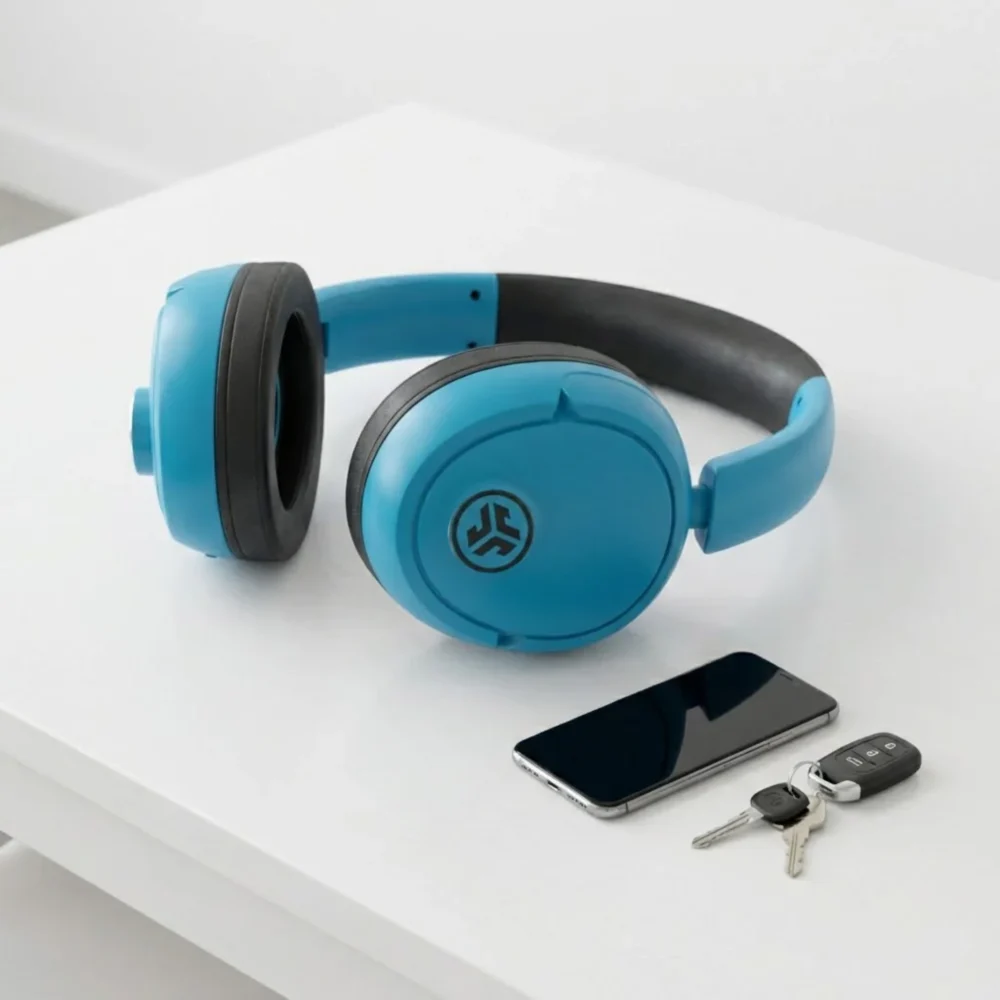
JLab, the California-based audio manufacturer known for its presence in the budget-friendly consumer electronics sector, has officially released a specialized audio device that blurs the line between personal listening and public broadcast. The product, titled the Blue XL Speaker Headphones, arrived on the market as a limited-edition wearable that adopts the physical aesthetic of oversized over-ear headphones but functions exclusively as a portable Bluetooth speaker system designed to be worn around the neck.
The launch, which took place on Feb. 4, introduces a hardware configuration that avoids traditional ear-cup placement, instead projecting sound upward toward the user from a resting position on the shoulders. Priced at $99.99, the device represents a strategic move by JLab to capitalize on the growing trend of "neck-worn" audio while maintaining the brand’s identity as a provider of accessible technology.
Technical Specifications of the JLab Blue XL Speaker Headphones
The internal architecture of the Blue XL Speaker Headphones distinguishes them from standard personal audio equipment. Each unit is equipped with dual 2.5-inch drivers, a size significantly larger than those found in traditional headphones, which typically range from 40mm to 50mm. These drivers are optimized for external projection, providing a soundstage that is intended to be shared with those in the immediate vicinity or used for personal ambient listening without obstructing the ear canal.
Power management for the device is handled by an internal battery capable of providing up to 20 hours of continuous playtime on a single charge. According to company specifications, a full recharge of the lithium-ion battery requires approximately three hours. The device utilizes Bluetooth 5.4 technology, the latest standard in wireless connectivity, ensuring stable pairing and improved power efficiency compared to older protocols.
Despite their function as speakers, the Blue XL units retain the comfort features of high-end headphones. The frames are outfitted with faux leather ear cushions, which in this context serve as ergonomic padding for the user’s collarbone and neck area. Furthermore, the devices are compatible with the proprietary JLab smartphone application, allowing users to manipulate Equalizer (EQ) settings and customize the audio output to suit specific environments or genres.
Marketing Strategy and the 2025 Birmingham Bowl
The public introduction of the Blue XL Speaker Headphones was integrated into a high-profile sports marketing campaign. JLab served as the title sponsor for the 2025 Birmingham Bowl, a prominent college football matchup between Georgia Southern and Appalachian State. This partnership provided a platform for the company to demonstrate the "statement piece" nature of the hardware.
During the event, JLab produced exclusive, shiny golden versions of the Blue XL Speaker Headphones, which were presented to key playmakers. Following their victory, every player on the Georgia Southern Eagles roster received a pair of the devices. The retail version of the product features an aqua-toned colorway, which inspired the "Blue XL" nomenclature.
By aligning the product launch with a major athletic event, JLab positioned the wearable portable speakers as a lifestyle accessory for athletes and fans alike. The timing of the retail release was also coordinated with the lead-up to the professional football championship weekend, further cementing the device’s association with sports culture and public celebration.
The Evolution of Wearable Portable Speakers in Consumer Tech
The concept of wearable portable speakers is not entirely new, but the execution found in the JLab Blue XL Speaker Headphones represents a shift toward "ironic" or "maximalist" design. Historically, neck-worn speakers—often referred to as "neckbands" or "around-the-neck speakers"—have been marketed by companies like Bose and Sony as utilitarian tools for home office workers or individuals who dislike the pressure of in-ear or over-ear headphones.
The JLab iteration differs by intentionally mimicking the silhouette of traditional headphones. This design choice serves as a visual conversation starter, playing on the expectation that the user is listening to private audio when they are, in fact, broadcasting sound. Industry analysts suggest that this design language targets a younger demographic that values both novelty and brand-driven aesthetics.

If a user finds the wearable aspect of the Blue XL too bold for certain settings, the company notes that the device is structurally balanced to sit upright on a flat surface. This dual-purpose functionality allows it to transition from a wearable accessory to a standard tabletop Bluetooth speaker, providing versatility for various social or professional scenarios.
Comparative Analysis: JLab Blue XL vs. TDM Neo Hybrids
The release of the Blue XL Speaker Headphones follows closely behind the 2025 Consumer Electronics Show (CES), where the "hybrid audio" category saw significant innovation. One notable competitor in this emerging space is the TDM Neo Hybrid, a device that offers a different solution to the speaker-headphone crossover.
Unlike the JLab Blue XL, which is exclusively a speaker, the TDM Neo Hybrids are designed to function as both high-quality headphones and external speakers. Through a mechanical twisting motion, the Neo Hybrids can flip their drivers outward, transitioning from a private listening mode to a public broadcast mode. The Neo Hybrids are slated for a Kickstarter launch with a projected retail price of $249, more than double the cost of the JLab offering.
The price disparity highlights JLab’s commitment to the budget market. While the Neo Hybrids offer more complex engineering and dual-functionality, the JLab Blue XL Speaker Headphones focus on a singular, simplified use case at a sub-$100 price point. This positioning allows JLab to attract consumers who are interested in the "speaker-as-wearable" trend without the financial commitment required for premium hybrid devices.
Impact on the Audio Industry and Consumer Behavior
The introduction of wearable portable speakers like the Blue XL reflects a broader shift in how consumers interact with their environments. As "open-ear" audio becomes more popular—driven by products like bone-conduction headphones and audio glasses—the market is seeing a move away from total isolation.
Wearable speakers allow for "situational awareness," a term used to describe the ability to hear one’s surroundings while still enjoying media. This is particularly relevant for outdoor activities, such as cycling or hiking, where blocking out ambient noise can pose safety risks. However, the Blue XL’s oversized design and high-volume capability also raise questions regarding "audio pollution" in public spaces.
The social acceptance of wearable portable speakers remains a topic of debate. While they offer a hands-free, ear-free alternative for the user, they inevitably project sound into the personal space of others. JLab’s marketing suggests the Blue XL is intended for social settings, tailgating, and celebratory environments where shared audio is expected rather than discouraged.
Future Outlook for JLab’s Limited-Edition Lineup
As a limited-edition release, the Blue XL Speaker Headphones serve as a litmus test for JLab’s future product development. If the "speaker headphones" concept proves successful among the brand’s core audience, it could lead to a permanent fixture in their catalog or the development of more refined, multi-functional versions in the coming years.
The company’s ability to integrate high-spec components—such as Bluetooth 5.4 and large-format drivers—into a $99 package continues to put pressure on premium competitors. By leveraging sports sponsorships and viral-friendly designs, JLab is moving beyond its reputation as a mere "budget alternative" and into the realm of a lifestyle brand that dictates trends rather than just following them.
For now, the Blue XL Speaker Headphones remain a niche offering for those who want the look of classic over-ear gear with the communal experience of a portable speaker. As the supply for this limited run diminishes, the audio industry will be watching closely to see if this "huge headphone" aesthetic becomes a mainstay in the evolving landscape of wearable technology.