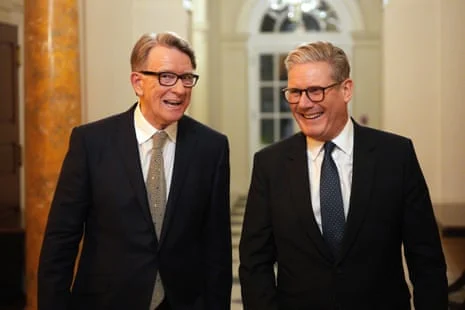
British Work and Pensions Secretary Pat McFadden has publicly called for former diplomat Peter Mandelson to return a taxpayer-funded exit settlement or donate the sum to a victims’ charity following revelations regarding Mandelson’s ties to the late sex offender Jeffrey Epstein. The demand comes as the British government faces intense scrutiny over the terms of Mandelson’s departure from his role as the United Kingdom’s ambassador to the United States. McFadden, a senior figure in the current administration, suggested that the public would find the retention of the funds unacceptable given the circumstances of the dismissal.
During a televised interview on Sky News, McFadden stated that Mandelson, a long-time fixture of the Labour Party and a key architect of the "New Labour" movement, should consider the moral implications of keeping the payout. When asked if the former ambassador should hand back the money or donate it to a charitable cause, McFadden replied that he "probably should," suggesting that a charity focused on combating violence against women and girls would be an appropriate recipient. The minister’s comments reflect a growing consensus within the government that the financial settlement has become a political liability.
The controversy centers on a reported five-figure payout Mandelson received after being removed from his diplomatic post in Washington last September. While the exact figure has not been officially confirmed by the Foreign Office, reports suggest the settlement could be as high as £55,000 ($69,000), representing approximately three months of salary. The position of US ambassador is among the highest-paid roles in the British diplomatic service, with annual salaries typically ranging between £155,000 and £220,000.
Ethical Concerns Over Taxpayer-Funded Exit Packages
The decision to grant a significant exit package to a high-ranking official dismissed for cause has sparked a national debate over accountability and the use of public funds. Under standard Civil Service HR protocols, employees are often entitled to notice pay or severance unless specific contractual breaches are proven. However, the Foreign Office has confirmed that it is currently reviewing the payout in light of "further information" that has come to light since Mandelson’s termination.
McFadden acknowledged that while he did not know the exact amount Mandelson was entitled to under his contract, the moral optics were clear. "I think taking a payoff in these circumstances—I don’t think the public will think much of that," McFadden said. The minister emphasized that the settlement was a matter of negotiation between Mandelson and his former employers, but he underscored the government’s shift toward a more critical stance on the matter.
The pressure on Mandelson is part of a broader push for transparency regarding the vetting processes used for top-tier diplomatic appointments. Critics have questioned how Mandelson was cleared for the prestigious Washington post despite his well-documented historical acquaintance with Epstein. The current administration is now tasked with explaining why a substantial financial settlement was authorized if the dismissal was based on a fundamental breach of trust or professional conduct.
The Epstein Connection and the 2008 Financial Crisis
The calls for the return of the US ambassador payoff are rooted in recently disclosed documents from the Epstein files. These documents appear to show that Mandelson, while serving as Business Secretary under former Prime Minister Gordon Brown, sent emails to Epstein containing confidential government information. The correspondence reportedly occurred during the height of the 2008 global financial crisis, a period when the British government was orchestrating a massive bailout of the banking sector.
According to the disclosures, Mandelson allegedly provided Epstein with "live" updates on the government’s internal deliberations and strategies to prevent a total economic collapse. At the time, Epstein was already a convicted sex offender, having pleaded guilty to charges in Florida in 2008. The suggestion that sensitive state secrets regarding the stability of the global economy were shared with a foreign private citizen under such circumstances has caused profound alarm in both London and Washington.
McFadden, who served as a junior minister under Mandelson at the Department for Business during the 2008 crisis, expressed personal shock at the allegations. He recalled the atmosphere of the era as a "terrible tale" of banks and businesses collapsing while ordinary citizens feared for their homes. The idea that Mandelson was sharing information with Epstein during that high-stakes period was described by McFadden as "shocking" and a betrayal of the public interest.
A Political Relationship Fractured by Betrayal
The public condemnation of Mandelson by McFadden is particularly significant given their long-standing professional relationship. The two men have worked together within the Labour Party for three decades. McFadden’s willingness to distance himself and the government from Mandelson illustrates the severity of the scandal’s impact on internal party dynamics.

"How I feel is a mixture of bewilderment, anger, and a sense of… this is somebody I’ve known on a political level for 30 years," McFadden remarked. He noted that in the world of politics, individuals can maintain close professional ties without ever knowing the "entire other side" of a colleague’s life. He stated that his personal feelings were secondary to the feelings of the victims involved in the broader Epstein case, whom he placed at the center of the controversy.
The sense of betrayal described by McFadden is echoed by other allies of Prime Minister Keir Starmer. Several high-ranking officials have suggested that the peer’s continued retention of the payoff serves as a distraction from the government’s policy agenda. By framing the return of the money as a moral obligation, the administration is attempting to shift the burden of responsibility back onto Mandelson himself.
Parliamentary Demands for Transparency
The British Parliament has taken formal steps to ensure that the full details of Mandelson’s tenure and his subsequent dismissal are made public. Members of Parliament recently backed a motion calling for the disclosure of all government papers relating to Mandelson’s appointment and the terms of his exit settlement. The Cabinet Office is currently coordinating a response to this motion, with a full report expected to be presented to the House of Commons in the coming weeks.
A spokesperson for the Foreign Office stated that Mandelson’s employment was originally terminated in accordance with legal advice and the specific terms and conditions of his contract. However, the spokesperson added that "normal civil service HR processes" were being re-examined. The government has signaled that it will provide a comprehensive update to lawmakers, potentially revealing whether Mandelson sought a larger sum than he eventually received.
Unconfirmed reports from the Sunday Times suggest that Mandelson initially lobbied for a significantly higher settlement before agreeing to the current figure. If true, these reports could further inflame public anger. The disclosure of these documents is seen as a crucial step in determining whether the vetting process failed or if the government ignored red flags in favor of political expediency.
The Political Future of Prime Minister Keir Starmer
The Mandelson scandal has created a difficult political environment for Prime Minister Keir Starmer. Questions have been raised regarding the Prime Minister’s judgment in appointing Mandelson to the US ambassador role in the first place, given the long-standing rumors surrounding his associations. Opposition leaders have seized on the controversy, suggesting that the appointment was an example of "cronyism" that has now backfired spectacularly.
Speculation regarding Starmer’s future has intensified as the government struggles to manage the fallout. The Prime Minister has maintained that he acted on the best available information at the time of the appointment, but the "live downloading" of financial data to Epstein has made that defense increasingly difficult to sustain. The scandal has threatened to overshadow the administration’s efforts to strengthen the "Special Relationship" with the United States under a new presidential administration.
As the review of the US ambassador payoff continues, the political cost for the Labour Party remains high. The administration is eager to move past the Epstein-related headlines, but the pending parliamentary disclosures ensure that the story will remain in the spotlight for the foreseeable future. The demand for Mandelson to return the funds is viewed by many analysts as a necessary tactical move to insulate the Prime Minister from further criticism.
Reviewing the Foreign Office Diplomatic Appointment Process
Beyond the immediate controversy surrounding Peter Mandelson, the incident has prompted a wider review of how the Foreign, Commonwealth & Development Office (FCDO) handles high-level diplomatic appointments. There are calls for more rigorous background checks and a move away from political appointees in favor of career diplomats for sensitive posts like the ambassadorship in Washington.
The revelation that a former minister could allegedly share confidential state information with a private individual without immediate detection has raised serious concerns about national security protocols. Security experts have called for an audit of communication logs from the 2008 era to determine if other sensitive data was compromised. The outcome of the Foreign Office review could lead to new legislation or civil service reforms governing the conduct of ministers and the transparency of their external relationships.
In the interim, the focus remains on the "moral basis" for the exit payment. By urging Mandelson to hand back the US ambassador payoff, Pat McFadden and the Cabinet have set a precedent for how the government intends to handle ethical breaches among its senior ranks. Whether Mandelson will comply with the request or if the government will find a legal mechanism to recoup the funds remains the central question in a scandal that continues to rock the foundations of the British political establishment.