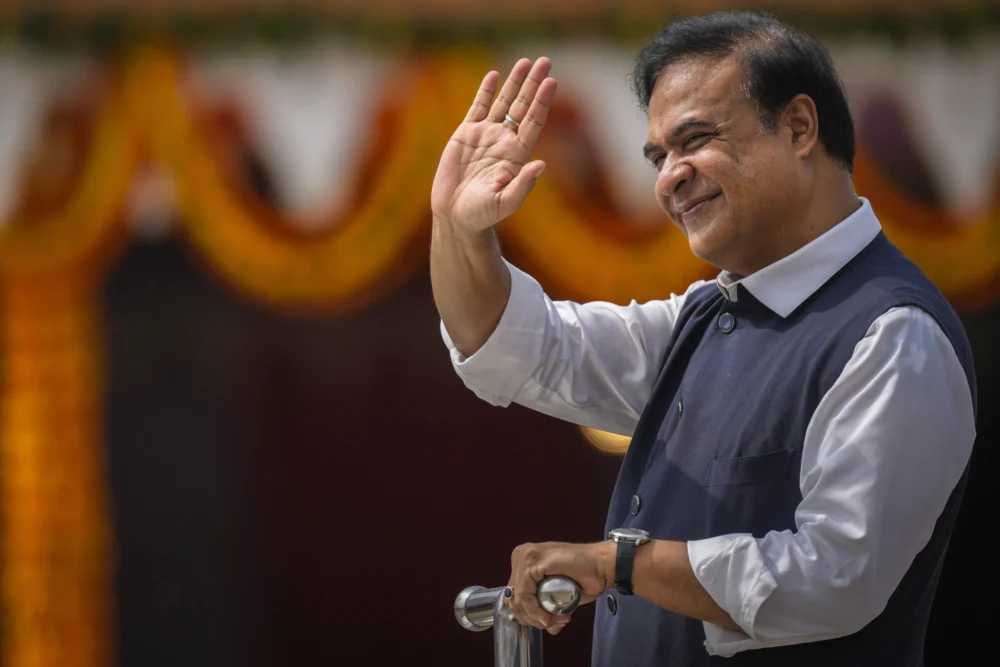
An artificial intelligence-generated video depicting Assam Chief Minister Himanta Biswa Sarma appearing to shoot at Muslims has ignited widespread condemnation across India, prompting its swift removal from social media platform X. The controversial clip, shared by the state’s Hindu nationalist Bharatiya Janata Party (BJP) unit, surfaced on Saturday and circulated rapidly, sparking public outrage and sharp criticism from opposition politicians. The incident underscores escalating tensions and divisive rhetoric targeting minority communities in the northeastern state, home to over 12 million Muslims, who constitute roughly one-third of its population.
AI-Generated Violence and Political Fallout
The 17-second video, initially titled "point blank shot," reportedly merged actual footage of Chief Minister Sarma handling a rifle with AI-generated imagery showing him firing at two Muslim men under the stark caption "No Mercy." Further compounding the inflammatory nature of the content, the clip also featured Sarma in a cowboy-like pose, aiming a pistol, with superimposed text proclaiming "Foreigner free Assam." This visual depiction of violence against a religious minority has been widely denounced as deeply offensive and a dangerous incitement to hatred.
The Assam unit of the BJP, which has been accused of employing anti-Muslim rhetoric, has not issued an official statement regarding the video’s origin or content. Ranjib Kumar Sarma, a local BJP leader, offered a terse response to Indian Express, stating, "There is no comment. It has been deleted. There is nothing to say." This reticence from the party has done little to quell the storm of criticism.
Escalating Rhetoric and Historical Context
The AI video emerges against a backdrop of increasingly strident rhetoric from Chief Minister Sarma, particularly targeting Muslims of Bengali origin in Assam. He has repeatedly linked this demographic to issues of migration, crime, and demographic shifts within the state. Sarma has controversially portrayed these communities as "outsiders," a characterization that critics argue fuels stigma and exacerbates communal tensions.
In a recent instance, last month, Sarma urged residents of Assam to give "Miya Muslims"—a derogatory term for Bengali-speaking Muslims—a "hard time." He suggested that even minor inconveniences, such as paying less fare for rickshaw rides, would contribute to hardships that might ultimately lead them to leave Assam. Such statements have drawn severe criticism for their discriminatory nature and potential to incite prejudice.
The demographic landscape of Assam is significant in this context. Only the federally administered territories of India-administered Kashmir and the Lakshadweep islands have a higher percentage of Muslims in their population than Assam. This demographic reality makes the targeting of the Muslim community particularly sensitive and potentially destabilizing.
Opposition Voices and Calls for Judicial Intervention
Opposition leaders have been vocal in their condemnation of the AI-generated video. Aman Wadud, a leader from the Indian National Congress in Assam, described the clip as "deeply disturbing" and accused the BJP of demonstrating a "complete lack of regard for law or even basic decency." Wadud suggested the video reflected the BJP’s "desperation" and predicted a defeat for "this politics of hatred and division" by the "wise people of Assam."
The Congress party issued a statement characterizing the video as an "incitement to mass violence and genocide." Meanwhile, Mahua Moitra, a prominent leader from the All India Trinamool Congress, directly appealed to India’s Supreme and High Court judges to take notice of the video. She questioned what further actions would be required for the judiciary to "wake up" to the severity of the situation.
A Pattern of AI-Generated Content and Anti-Muslim Sentiment
This is not the first instance of the Assam BJP employing AI-generated content to propagate anti-Muslim narratives. In September, the party’s Assam unit released another AI-generated video titled "Assam without BJP." This previous clip depicted the state being overrun by Muslims, who were portrayed as "illegal immigrants." Such tactics highlight a strategic use of advanced technology to amplify and disseminate polarizing messages.
The rise in anti-Muslim sentiment in Assam is part of a broader pattern within India, characterized by a "culture war" against Muslims, who comprise approximately 14% of India’s 1.4 billion population. The Hindu-majoritarian ideology, which underpins the ruling BJP, often frames Muslims as "outsiders." This narrative is particularly directed at Muslim asylum seekers and refugees from neighboring Bangladesh and Myanmar, who are frequently labeled as "infiltrators."
The Citizenship Amendment Act of 2019, which amended existing laws to provide a pathway to Indian citizenship based on religious identity, notably excluded Muslims. This legislation, enacted by the federal government, has been criticized for undermining India’s secular fabric and discriminating against a minority community.
Broader Implications for Minority Rights in India
Since Prime Minister Narendra Modi’s election in 2014, instances of violence and discrimination against Muslims have been a growing concern. Dozens of Muslims have been lynched on suspicion of consuming beef or transporting cattle, which are considered sacred by many Hindus. While discrimination in employment and education has a long history, human rights organizations argue that under the current BJP government, the situation for Muslims has deteriorated as Hindu nationalist parties have increasingly "weaponized" laws against them.
Human rights groups have documented an alarming surge in hate speech and violence targeting Muslims in recent years. A report by the India Hate Lab, a project of the Washington D.C.-based Center for the Study of Organized Hate, revealed that India recorded 1,318 hate speech events in 2025, averaging more than three per day. The report explicitly stated that at least 98% of these events targeted Muslims, with 1,156 cases directly identifying the community.
Prime Minister Modi himself has faced accusations of employing inflammatory language against Muslims to galvanize Hindu voters. A report by Human Rights Watch published in August 2024 indicated that Modi and other party leaders frequently used hate speech against Muslims and other minorities during the 2024 general election campaign, inciting discrimination, hostility, and violence.
This context is further amplified by Modi’s past. He was previously denied a U.S. visa due to his alleged links to the 2002 anti-Muslim riots in Gujarat, his home state, where he served as chief minister. These riots resulted in the deaths of over 1,000 people, the majority of whom were Muslims, marking one of the most severe outbreaks of anti-Muslim violence since India’s independence in 1947. Despite this history, Modi has since visited the U.S. on multiple occasions as Prime Minister.
The incident involving the AI-generated video in Assam serves as a stark reminder of the prevailing political climate and the potential for technology to be employed in the propagation of divisive and harmful ideologies. The outrage it has generated highlights the ongoing struggle for minority rights and the challenge of combating hate speech in contemporary India. The swift removal of the video, while a necessary step, does not erase the impact of its dissemination or the underlying issues it represents. The political and social ramifications of such incidents are likely to continue to be a focal point in India’s evolving landscape.