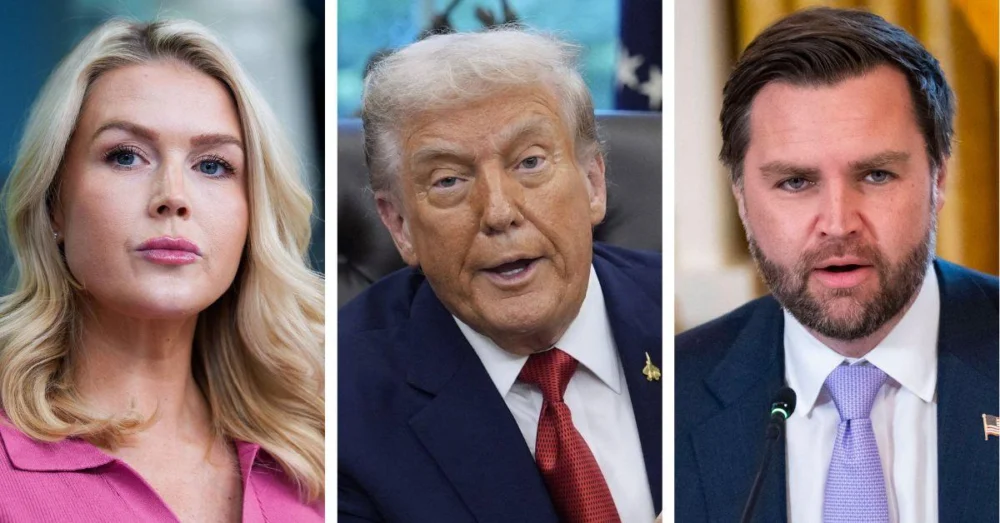
White House Press Secretary Karoline Leavitt faced intense scrutiny from reporters regarding a series of controversial social media posts originating from within the administration, highlighting a perceived "social media problem" for the current leadership. The challenging press briefing centered on a racially charged meme shared by former President Donald Trump and a tweet from Vice President J.D. Vance acknowledging the Armenian Genocide, a stance that diverged from the administration’s stated policy. These incidents have fueled questions about internal oversight, communication protocols, and the potential for significant political and diplomatic fallout.
The press conference on Tuesday, February 10, quickly escalated as Agence France-Presse correspondent Danny Kemp directly questioned Leavitt, 28, about the string of digital missteps. Kemp pressed the Press Secretary on whether the White House was grappling with an "auto-posting problem" or a systemic lack of proper oversight, particularly in light of posts going live without apparent review. Leavitt, in her defense, pushed back against the notion of a pervasive systemic issue, despite the mounting evidence of high-profile digital blunders.
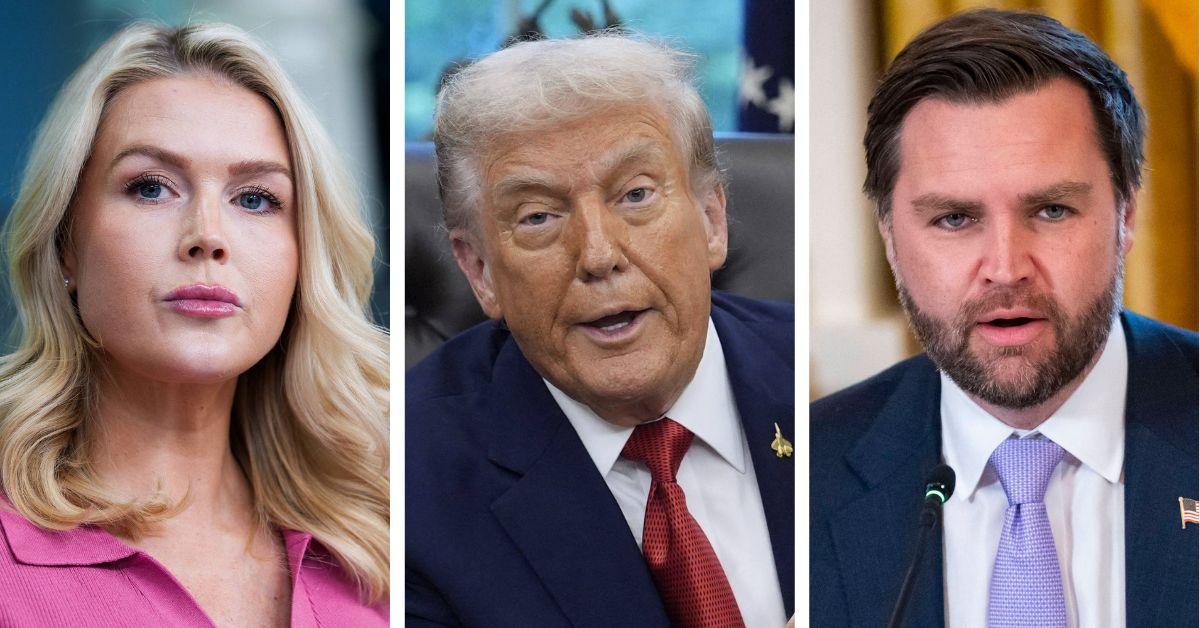
The Racially Charged Obama Meme Controversy
One of the most incendiary incidents involved a video posted to Donald Trump’s Truth Social account depicting former President Barack Obama and former First Lady Michelle Obama with ape faces. The meme, which circulated for approximately 12 hours before its removal, drew immediate and widespread condemnation for its overt racist undertones. Critics pointed to a long and painful history of dehumanizing racial caricatures, particularly the use of ape imagery against Black individuals, underscoring the deep offense caused by the post.
Upon its removal, the White House attributed the post to an unnamed staffer, with Trump himself denying direct involvement. He claimed to review "thousands of things" and suggested that he had only seen the beginning of the video, which he deemed "fine." Trump later asserted that if the full content had been seen, "probably would have had the sense to take it down." However, when later pressed on whether he regretted the posting, Trump maintained a defiant stance, stating, "No, I didn’t make a mistake."
Press Secretary Leavitt offered a controversial defense of the meme, characterizing it as an "internet meme video depicting President Trump as the King of the Jungle and Democrats as characters from The Lion King." She urged reporters to "stop the fake outrage and report on something today that actually matters to the American public," a statement that itself generated further criticism for downplaying the gravity of the racist imagery and deflecting legitimate journalistic inquiry. Civil rights organizations and political commentators swiftly denounced both the original post and Leavitt’s explanation, labeling them as irresponsible and deeply offensive.

J.D. Vance’s Armenian Genocide Tweet and Policy Rift
Simultaneously, the administration faced another social media crisis stemming from Vice President J.D. Vance’s official X (formerly Twitter) account. A tweet, which was subsequently deleted, showed Vance and Second Lady Usha Vance participating in a wreath-laying ceremony at an Armenian Genocide memorial. Crucially, the accompanying text explicitly acknowledged the Armenian Genocide, directly contradicting the Trump administration’s carefully worded and historically evasive policy on the matter.
The U.S. government’s recognition of the Armenian Genocide has been a contentious diplomatic issue for decades. While President Joe Biden’s administration formally recognized the atrocities as genocide in 2021, the Trump administration, like many before it, had consistently avoided using the term to maintain delicate diplomatic relations with Turkey, a key NATO ally that vehemently denies the historical classification of genocide. Instead, the Trump White House on Armenian Remembrance Day had referred to the events as the "Meds Yeghern," an Armenian phrase meaning "Great Crime," a subtle but significant linguistic distinction.
An official from the Vice President’s office quickly clarified that Vance’s tweet was "posted in error" by a staffer who was not traveling with the Vice President at the time. This explanation, while attempting to distance the administration from the policy deviation, did little to quell the controversy. The Armenian National Committee of America (ANCA) issued a scathing rebuke, characterizing the deletion as "a denialist action consistent with Trump’s shameful retreat from honest American remembrance of a crime recognized by all 50 states, the US Congress, the White House and more than a dozen of our NATO allies." The incident reignited frustrations among Armenian American communities and human rights advocates, who have long pushed for unequivocal U.S. recognition.

Broader Implications of White House Social Media Management
The confluence of these two high-profile incidents casts a harsh spotlight on the Trump administration’s overall approach to digital communication and its capacity for message control. The repeated explanations of "staffer error" or misinterpretation suggest either a severe lack of internal vetting processes for official accounts or a deliberate strategy to test boundaries and gauge public reaction to controversial content. In the highly scrutinized environment of the White House, such explanations often fall short of satisfying critics who demand accountability and consistency in official messaging.
The "social media problem" raised by reporters points to a deeper systemic challenge. In an era where political discourse is heavily shaped by instantaneous digital platforms, every post from a high-ranking official or the presidential account carries immense weight. The ability to quickly and accurately disseminate information, while avoiding gaffes or policy contradictions, is paramount for any modern administration. The incidents involving Trump and Vance suggest a potential disconnect between various arms of the White House communication apparatus, or a willingness to permit controversial content to circulate, at least temporarily.
For Karoline Leavitt, the challenges of her role as Press Secretary are amplified by these events. Her position demands defending the administration’s actions and policies, even when those actions are met with widespread criticism or appear to contradict established norms. Her defense of the Obama meme and her reiteration that there was "no change of policy" regarding the Armenian Genocide, despite Vance’s now-deleted tweet, underscore the difficult tightrope walk required in political damage control. The persistent questioning from the press corps reflects a broader concern about the reliability and integrity of official communications emanating from the highest levels of government.
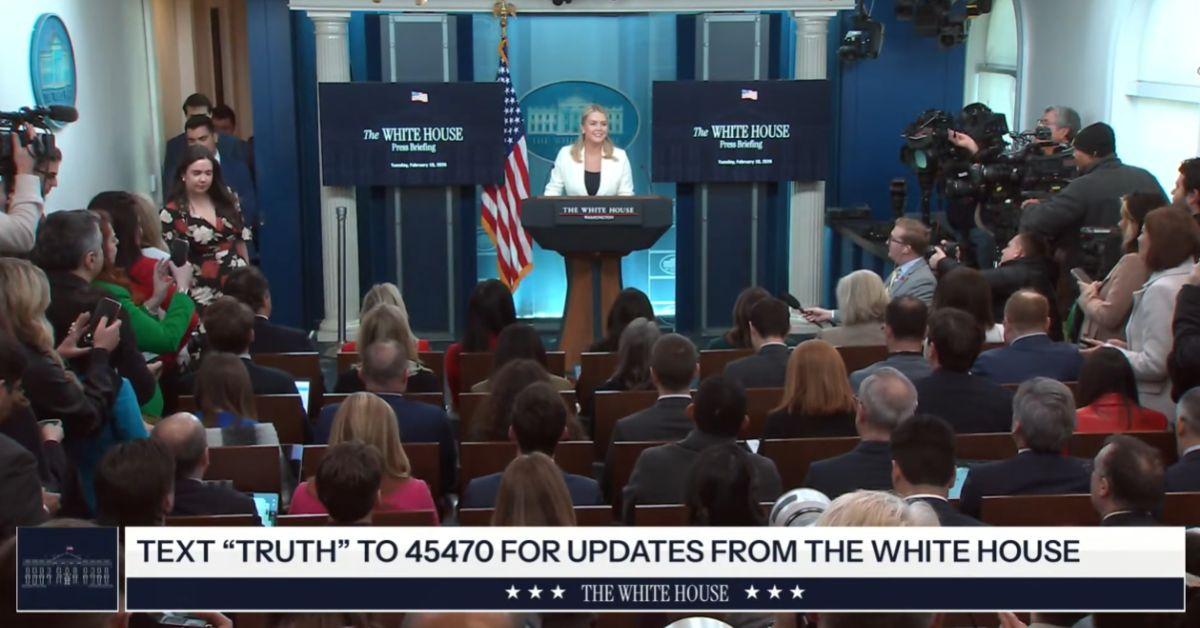
Public Impact and Political Ramifications
The impact of these social media controversies extends beyond immediate press briefings. Racist imagery disseminated from a presidential account can normalize hateful rhetoric, embolden extremist elements, and inflict significant emotional harm on targeted communities. The meme depicting the Obamas as apes taps into a dark vein of American history and racial prejudice, prompting condemnation from civil rights leaders and advocates who warn against the dangerous erosion of respectful public discourse. The incident also reignited speculation about Trump’s temperament and judgment, particularly given his unrepentant stance.
The Armenian Genocide tweet, while deleted, highlighted a persistent tension in U.S. foreign policy and humanitarian advocacy. The White House’s official denial of a policy shift, despite the Vice President’s initial acknowledgment, sends mixed signals to international allies, human rights groups, and the Armenian diaspora. Such diplomatic tightrope walking, while often pragmatic, can be perceived as morally ambiguous and inconsistent, potentially straining relationships and undermining American credibility on human rights issues globally.
Adding to the complexity, the series of "erratic" and "confusing" Truth Social posts by Donald Trump has fueled ongoing speculation about his health and mental acuity. Biographer Michael Wolff, for instance, claimed to have spoken with White House insiders who suggested Trump might be "off his meds," a serious accusation that, whether substantiated or not, contributes to a narrative of instability surrounding the former president. Such speculation, combined with the controversial posts, adds another layer of public concern regarding the fitness and judgment of those in leadership.
Looking Ahead: Accountability and Oversight
These recent episodes underscore a critical need for robust internal protocols governing social media use by high-ranking officials and their staff. The repeated assertion of "staffer error" raises questions about accountability and whether adequate training and oversight are in place to prevent similar incidents. Without clear and consistently enforced guidelines, the potential for further gaffes, policy misstatements, and politically damaging content remains high.
The ongoing challenges faced by Karoline Leavitt highlight the intensifying pressure on White House press secretaries in the digital age. Navigating a landscape where every word and image can go viral instantly requires an unprecedented level of precision, strategic communication, and rapid response capabilities. The public and the press will continue to demand transparency and accountability, ensuring that any perceived "social media problem" remains a central point of contention for the administration.