The nonpartisan Congressional Budget Office (CBO) has issued a stark projection for the coming decade, forecasting a significant deterioration in the United States federal deficit and a substantial rise in national debt. The outlook, released Wednesday, indicates that increased spending, particularly on entitlement programs like Social Security and Medicare, coupled with escalating debt service payments, will be the primary drivers of this fiscal slide. This updated 10-year forecast presents a modestly more concerning fiscal picture than the agency’s analysis from the previous year.
The CBO’s analysis reveals that the deficit for fiscal year 2026, which marks President Donald Trump’s first full fiscal year in office, is anticipated to hover around 5.8% of the Gross Domestic Product (GDP). This figure is expected to be largely consistent with the fiscal year 2025 deficit, which was projected to reach $1.775 trillion. However, the concerning trend accelerates thereafter, with the US deficit-to-GDP ratio projected to average 6.1% over the next ten years. By fiscal year 2036, this ratio is forecast to climb to 6.7%, a level far exceeding the approximately 3% target advocated by Treasury Secretary Scott Bessent for a sustainable fiscal path.
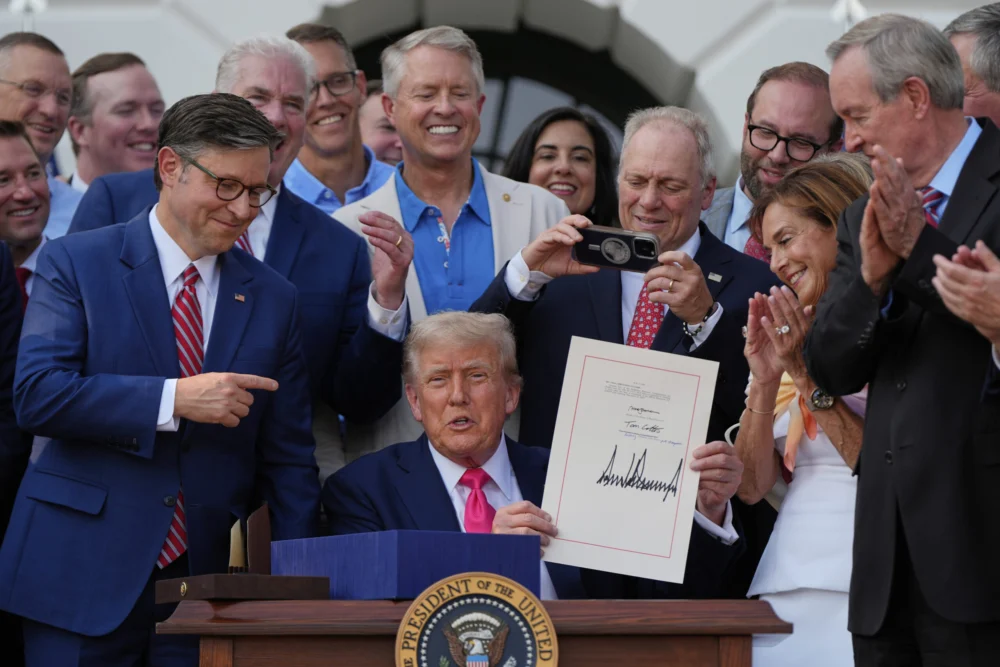
Several significant policy decisions and economic shifts enacted or anticipated over the past year have been incorporated into the CBO’s latest calculations. These include the Republican-backed tax and spending legislation, colloquially referred to as the "One Big Beautiful Bill Act," alongside anticipated increases in tariffs and a more stringent approach to immigration enforcement, which could involve substantial deportations. These measures collectively contribute to the revised fiscal outlook.
The inclusion of these recent developments has led to an upward revision of deficit projections. The projected deficit for fiscal year 2026 is now estimated to be approximately $100 billion higher than previously forecast. Cumulatively, the total deficits from fiscal year 2026 through 2035 are expected to be $1.4 trillion larger. Consequently, the national debt held by the public is projected to surge from its current level of around 101% of GDP to a daunting 120% by 2035, a figure that would surpass all historical benchmarks.
Impact of Tariffs and Inflationary Pressures
Interestingly, the CBO report acknowledges that higher tariffs, while contributing to increased revenue, also introduce complexities. These tariffs are estimated to partially offset some of the deficit increases by generating an additional $3 trillion in federal revenue. However, this revenue gain comes at a cost, as it is also projected to fuel higher inflation between fiscal years 2026 and 2029. This inflationary pressure could erode purchasing power and complicate the Federal Reserve’s monetary policy objectives.
The persistent rise in national debt and the associated debt service payments carry significant economic implications. When the government borrows heavily, the interest it must pay to investors diverts funds that could otherwise be allocated to critical public services. This crowding out effect can hinder government investments in essential areas such as infrastructure development, education, and scientific research, all of which are crucial for fostering long-term economic growth and competitiveness.
Economic Growth Projections Diverge
A key divergence in the CBO’s analysis compared to administration projections lies in its economic growth forecasts. The CBO anticipates a more modest pace of economic expansion, projecting real GDP growth at 2.2% for fiscal year 2026 on a fourth-quarter annualized basis. This growth rate is then expected to decelerate to an average of approximately 1.8% for the remainder of the decade.
This outlook stands in contrast to the more optimistic growth predictions put forth by Trump administration officials. In recent weeks, administration figures have projected robust growth in the 3-4% range for 2026, with some recent forecasts suggesting first-quarter growth could even exceed 6%. These optimistic projections are often linked to anticipated increases in investments, particularly in manufacturing facilities and artificial intelligence data centers. The CBO’s more conservative assumptions underscore a fundamental disagreement on the trajectory of future economic performance.
Long-Term Fiscal Assumptions
The CBO’s forecasts are predicated on the assumption that current tax and spending laws, as well as tariff policies in place as of early December, will remain in effect for the entire ten-year period. The US government’s fiscal year commences on October 1st each year. While the report notes that revived investment tax incentives and increased individual tax refunds could provide a short-term boost in 2026, this positive impact is expected to be tempered by the drag of larger fiscal deficits and a slower-growing labor force, partly due to reduced immigration.
Expert Concerns Over Soaring Deficits
The persistent and growing federal deficits are drawing significant concern from fiscal policy experts. Jonathan Burks, executive vice president of economic and health policy at the Bipartisan Policy Center, described the current situation as "large deficits are unprecedented for a growing, peacetime economy." Despite the gravity of the projections, Burks also offered a note of optimism, stating that "the good news is there is still time for policymakers to correct course." This sentiment highlights the urgency for proactive fiscal management.
Historical Context and Policy Responses
Lawmakers have, in recent years, grappled with the escalating federal debt and deficits through a variety of measures. These have included targeted spending caps, the suspension of debt limits, and the deployment of "extraordinary measures" when the nation approached its statutory borrowing limit. However, these interventions have often been accompanied by new, substantial spending initiatives or tax policies that have, in effect, perpetuated high deficit levels.
The Trump administration has also made efforts to address fiscal challenges. At the outset of a potential second term, there was discussion of establishing a "Department of Government Efficiency" with a stated goal of balancing the budget by identifying and cutting $2 trillion in waste, fraud, and abuse. However, independent budget analysts have estimated that the actual savings achieved through such initiatives, largely through workforce reductions, have been considerably smaller, ranging between $1.4 billion and $7 billion.
An "Urgent Warning" for Policymakers
Michael Peterson, CEO of the Peterson Foundation, characterized the CBO’s latest budget projections as "an urgent warning to our leaders about America’s costly fiscal path." He emphasized the critical juncture the nation faces, particularly in an election year. "This election year, voters understand the connection between rising debt and their personal economic condition. And the financial markets are watching. Stabilizing our debt is an essential part of improving affordability, and must be a core component of the 2026 campaign conversation," Peterson stated.
Broader Economic Implications of Rising Debt
The sustained increase in the national debt has far-reaching consequences for the U.S. economy. A higher debt-to-GDP ratio can lead to increased borrowing costs for the government, potentially translating into higher interest rates for consumers and businesses. This can stifle investment, slow economic growth, and reduce the government’s fiscal flexibility to respond to future economic downturns or national emergencies. Furthermore, a perception of fiscal instability could undermine confidence in the U.S. dollar and its role as the world’s primary reserve currency.
The Role of Entitlement Spending
A significant portion of the projected deficit growth is attributable to the escalating costs of Social Security and Medicare. As the U.S. population ages and life expectancies increase, the number of beneficiaries for these programs grows, while the tax base supporting them faces demographic pressures. Addressing the long-term solvency of these programs is widely recognized as a critical, albeit politically challenging, component of any comprehensive fiscal reform effort. Without significant reforms, these mandatory spending programs will continue to exert upward pressure on deficits.
The Path Forward: Policy Choices and Their Ramifications
The CBO’s projections serve as a critical data point for policymakers, highlighting the fiscal challenges ahead. The choices made in the coming years regarding taxation, government spending, and the management of entitlement programs will have profound impacts on the nation’s economic future. The report underscores that inaction or insufficient action will lead to a trajectory of ever-increasing debt, with potential ramifications for economic stability, national security, and the fiscal well-being of future generations. The upcoming fiscal years will likely be characterized by intense debate and difficult policy decisions as lawmakers confront the implications of these sobering projections.