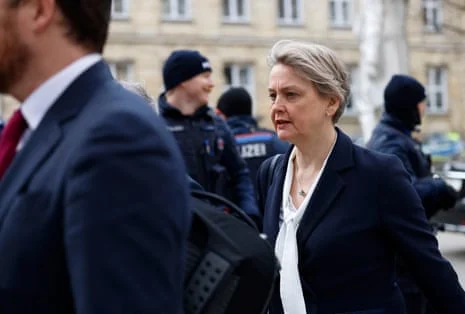
British Foreign Secretary Yvette Cooper has mounted a public defense of her previous decision to ban the activist group Palestine Action under terrorism laws, even after the High Court of Justice ruled the move was unlawful and disproportionate. Speaking from the Munich Security Conference on February 15, 2026, Cooper argued that her actions as Home Secretary were guided by high-level security advice regarding public safety and the risks of political violence. The controversy comes at a volatile time for the Labour administration, which is currently navigating a series of legal setbacks, internal ethics scandals, and a major diplomatic revelation involving the Russian state.
The High Court’s ruling, delivered last week, represented a significant judicial rebuke to the Home Office. The presiding judges determined that the proscription of Palestine Action—a group known for targeting defense contractors—did not meet the legal threshold for terrorism. According to the court, the scale and persistence of the group’s activities, while often involving property damage, did not constitute the level of violence required to justify a total ban under the Terrorism Act 2000. Furthermore, the court found that Cooper had failed to follow her own department’s established policies when implementing the ban during the summer of 2025.
Cooper Defends Palestine Action Ban Amid Judicial Setback
Despite the court’s finding that the proscription was a "very serious interference" with the right to protest, Cooper maintained that her decision-making process was rigorous. In an interview with Sky News, she stated that she followed "clear advice and recommendations" from multiple intelligence agencies and the police. She emphasized that the proscription was the result of a "serious process" designed to mitigate risks to the public.

"The court has also concluded that this is not a normal protest group," Cooper said, attempting to pivot the narrative toward the group’s history of direct action. She claimed the group had "promoted violence" and was "not simply in line with democratic values." When pressed to disclose the specific intelligence that prompted the ban, Cooper declined, citing the sensitivity of evidence related to public safety. She argued that a Home Secretary who ignores professional advice regarding security risks is failing to uphold the responsibilities of the office.
The current Home Secretary, Shabana Mahmood, has already signaled the government’s intent to appeal the High Court’s decision. For the time being, the proscription remains in legal limbo. While the Metropolitan Police have announced they will stop arresting individuals for simply holding signs of support for the group, they will continue to gather evidence of membership as long as the appeal is pending.
Legal and Corporate Implications of the Palestine Action Proscription
The legal battle over Palestine Action has highlighted the tension between national security legislation and civil liberties in the United Kingdom. Palestine Action co-founder Huda Ammori hailed the court’s decision as a "monumental victory" for the right to protest. Ammori argued that the ban was never truly about counter-terrorism but was instead a political favor to defense firms. She specifically noted that the group’s disruption of Elbit Systems, Israel’s largest private weapons manufacturer, had cost the corporation millions in lost profits and contracts.
Under the terms of the proscription, belonging to or supporting Palestine Action became a criminal offense punishable by up to 14 years in prison. Since the ban was enacted, more than 2,500 people have been arrested in connection with the group, with nearly 700 facing terrorism-related charges. None have been convicted of terrorism to date, but the legal uncertainty has left hundreds of activists in a state of judicial purgatory. The High Court’s ruling suggests that while property damage is a crime, it does not automatically equate to terrorism under the current statutory framework.

International Tensions and the Navalny Poisoning Reveal
The domestic controversy over the Palestine Action ban coincided with a major shift in the UK’s foreign policy stance toward Moscow. During the same Munich summit, Cooper confirmed that British and European intelligence agencies have uncovered "definitive evidence" that Russian opposition leader Alexei Navalny was killed using a rare toxin. The assessment, conducted by the UK, France, Germany, Sweden, and the Netherlands, identified the substance as epibatidine, a lethal toxin derived from the skin of South American dart frogs.
"Only the Russian regime had the motive, the means, and the opportunity to administer this lethal poison while he was in prison," Cooper told reporters. Navalny died in February 2024 at a remote Arctic penal colony, a death the Kremlin has consistently attributed to natural causes. The revelation of a biological agent has prompted the European coalition to report Russia to the Organization for the Prohibition of Chemical Weapons (OPCW) for a breach of international conventions.
Cooper framed the exposure of the "barbaric Kremlin plot" as a fulfillment of Navalny’s own plea to "spread the truth." The findings have intensified calls for more stringent measures against the Russian economy, which continues to find ways to bypass existing Western sanctions.
Political Pressure Mounts Over Starmer’s Appointments
While Cooper manages the fallout from the Palestine Action ban and the Navalny investigation, Prime Minister Keir Starmer is facing a deepening crisis within his own ranks. The administration has been hit by a wave of high-profile departures and ethics complaints that have led to accusations of a "chaotic" Downing Street. In less than two years, the Prime Minister’s team has cycled through four directors of communications and two chiefs of staff.

The most recent firestorm centers on the appointment of Peter Mandelson as the UK’s Ambassador to the United States. Starmer has admitted he was aware of Mandelson’s past friendship with the late sex offender Jeffrey Epstein before making the appointment. Cooper admitted on the BBC’s Sunday with Laura Kuenssberg that she felt "quite angry" about the situation, suggesting that the focus should remain on Epstein’s victims rather than political maneuvering.
Simultaneously, the government is dealing with the suspension of Matthew Doyle, a former senior aide to Starmer who was recently elevated to the House of Lords. Doyle lost the Labour whip after it was revealed he had campaigned for Sean Morton, a former councillor who admitted to possessing indecent images of children. Cooper described the Doyle situation as a "significant process failure" and noted that a full review is underway to determine how such a vetting oversight occurred.
Economic Disparities and the Debate Over Absolute Poverty
The political discourse in the UK has also shifted toward the country’s struggling economy and the definition of poverty. Zia Yusuf, the head of policy for Reform UK, sparked a debate this morning by claiming that "absolute poverty" only exists in "very, very small pockets" of the country. Yusuf argued that left-wing politicians use "relative poverty" as a statistical tool that obscures the lack of social mobility in Britain.
Yusuf specifically pointed to Wales as an area of concern, citing low PISA educational rankings as a symptom of deeper systemic failure. However, data from the Joseph Rowntree Foundation (JRF) paints a grimmer picture than Yusuf’s "small pockets" theory suggests. According to the JRF, over 700,000 people in Wales—including 200,000 children—are living in poverty. Recent analysis indicates that the UK’s poorest families are entering "very deep poverty," where household incomes are insufficient to cover basic necessities like food, clothing, and heating.

Conservative Reactions and the ‘Axis of Authoritarianism’
The Conservative opposition has found itself in the unusual position of supporting the Labour government on certain security issues while attacking its domestic competence. Shadow Foreign Secretary Priti Patel stated she was "appalled" by the High Court’s ruling on Palestine Action and fully supports the government’s attempt to reinstate the ban. Patel argued that the group’s tactics are "on par with how terrorist organisations conduct themselves" and that the public expects the full force of the law to be applied.
Patel also called for a more aggressive stance toward Russia, urging the government to "cut off the head of the snake" by targeting the financial lifelines that prop up the Kremlin. She identified Russia as part of an "axis of authoritarianism" alongside China, Iran, and North Korea. Patel’s comments reflect a growing consensus in Westminster that Europe must "step up to the plate" regarding its own security, especially as the United States shifts its strategic focus away from the continent.
As the Labour government prepares its appeal against the Palestine Action ruling, it must balance its commitment to national security with the need to restore public trust in its internal standards. The coming weeks will likely see intensified legal arguments in the Court of Appeal, even as the administration grapples with the fallout of its diplomatic and ethical choices on the world stage. The intersection of these domestic and international crises continues to test the resilience of Starmer’s leadership in a rapidly shifting political landscape.