Baz Luhrmann’s latest cinematic endeavor, EPiC: Elvis Presley in Concert, transcends the conventional concert film, offering a vibrant reanimation of the King of Rock and Roll that serves as a compelling follow-up to his critically acclaimed 2022 bio-drama, Elvis. This ambitious project plunges deep into previously unseen archival footage and unheard recordings, presenting an immersive experience designed to electrify both longtime devotees and new generations discovering Presley’s legendary stage presence. The film aims not merely to memorialize a pop culture icon but to resurrect his raw vitality and flamboyant showmanship for a contemporary audience.
The Genesis of EPiC: Elvis Presley in Concert
The ambition behind EPiC: Elvis Presley in Concert draws parallels to groundbreaking musical reintroductions, such as Dutch DJ Tom Holkenborg’s (Junkie XL) 2002 remix of Elvis Presley’s relatively obscure 1968 track, "A Little Less Conversation." Holkenborg transformed a minor movie tune into a global phenomenon, topping charts in over 20 countries by infusing it with an unrelenting backbeat, punchy guitars, and funk-driven drums. This act of reanimation, rather than simple remembrance, set a precedent for revitalizing classic material. Four years after his opulent Elvis film, Luhrmann channels a similar transformative magic, doubling down on his inherent connection with Presley’s maximalist aesthetic and boundless energy. The Australian director orchestrates what feels like a cinematic séance, awakening Elvis from the annals of history with an outsized energy rarely captured, even among the living.
Unearthing the King: An Archival Odyssey
The journey to create EPiC: Elvis Presley in Concert began with Luhrmann’s relentless pursuit of rumored concert footage from the 1970s, material believed to have been shot for the films Elvis: That’s the Way It Is (1970) and Elvis on Tour (1972) but never utilized. What ensued was an archaeological expedition into film history. Researchers ultimately located an astonishing 69 boxes of film negative, totaling 59 hours of material, buried deep within Warner Bros. film vaults, preserved in underground salt mines in central Kansas. This monumental discovery formed the backbone of the project.
Further enhancing the narrative, additional Super 8 footage, previously only circulated in poor-quality bootlegs, was unearthed from the Graceland Archives. Crucially, a forgotten recording of Presley himself, speaking expansively and candidly about his life and career, also came to light. These combined finds provided an unprecedented treasure trove, allowing for a fresh and intimate perspective on one of music’s most enigmatic figures. The meticulous process of discovery underscores the dedication to authenticity that defines EPiC: Elvis Presley in Concert.
A First-Person Journey: Elvis in His Own Words
The unearthed audio recordings, coupled with existing known interviews, allowed Luhrmann to construct EPiC: Elvis Presley in Concert as a unique first-person account. This narrative choice sidesteps traditional documentary formats, foregoing talking heads or external commentators. Instead, Elvis Presley himself guides the audience through pivotal moments of his personal history and meteoric rise to stardom. His narration is marked by a compelling blend of candor, self-deprecating humor, and a surprising humility, offering an unfiltered glimpse into the mind of the global icon.
This direct narrative approach allows for a more immediate and authentic connection with Presley, enabling viewers to experience his journey from his own perspective. It provides a rare intimacy, peeling back the layers of celebrity to reveal the man behind the myth. The choice to let Elvis tell his own story not only enriches the film but also serves as a testament to the power and revelatory nature of the archival material discovered.
Reimagining the Legend: Luhrmann’s Vision
Baz Luhrmann’s signature maximalist style, characterized by kaleidoscopic montages and a relentless pace, finds a natural synergy with Elvis Presley’s flamboyant persona and continuous motion on stage. His 2022 bio-drama Elvis garnered both critical acclaim and some contention, particularly regarding accusations of beatifying its subject and glossing over complex issues, such as Presley’s public neutrality on civil rights despite his deep debt to Black music influences like gospel and R&B. While EPiC: Elvis Presley in Concert is unlikely to sway those specific critics, Luhrmann’s meticulous selection of images and calculated edits subtly illuminate the pervasive control exerted by Colonel Tom Parker over the public image Elvis presented to the world.
Luhrmann’s defense of portraying iconic figures as "prisoners of their fame" – a narrative often applied to stars like Marilyn Monroe, James Dean, or Judy Garland – remains consistent. He emphasizes that EPiC: Elvis Presley in Concert makes no claims to be a definitive biographical exposé, but rather a celebratory tribute to a legendary entertainer operating at the zenith of his powers. The film’s focus is squarely on the spectacle and artistry of Elvis, allowing his performances to speak for themselves while subtly acknowledging the external pressures that shaped his career.
The Vegas Spectacle Reborn
Historically, Elvis Presley’s Vegas residency at the International Hotel from 1969 to 1976 has sometimes been viewed as a period past his creative peak, shadowed by narratives of prescription drug abuse, weight gain, and health crises. However, EPiC: Elvis Presley in Concert meticulously intercuts footage from these template-setting shows with tour dates and rehearsal studio sessions, presenting a powerful counter-narrative where any such adverse effects appear negligible in the context of his electrifying performances.
To achieve this stunning visual and sonic resurrection, Luhrmann collaborated with Peter Jackson’s renowned sound and picture restoration facilities in New Zealand. This partnership leveraged cutting-edge technology to present performances with astonishing crisp definition, lush colors, and crystalline sound. The result is an immersive, "you-are-there" quality that rivals the most celebrated concert films, drawing comparisons to Jonathan Demme’s Stop Making Sense and Spike Lee’s American Utopia. The painstaking restoration ensures that the audience experiences the raw power and intricate detail of Elvis’s concerts as never before, truly bringing the King back to life on the big screen.
An Unfiltered Glimpse: Performance and Fan Dynamics
The film deftly navigates the intensity of Elvis’s stage presence, even touching upon the pearl-clutching controversy his gyrations caused. With a characteristic blend of humor and slight evasion, Presley quips, "Some people wonder why I can’t stand still while I’m singing. I’ve tried it and I can’t do it." This candidness highlights his intrinsic connection to the music, mirroring Luhrmann’s own directorial impulses for continuous motion and dynamic visual storytelling.
While quick biographical recaps cover key periods – the conservative backlash against rock and roll, his teen idol phase in formulaic movies, his media-frenzied drafting into the U.S. Army, and his subsequent floundering attempts at a serious acting career – the dominant focus of EPiC: Elvis Presley in Concert remains the live shows. Luhrmann and editor Jonathan Redmond deliberately allow key numbers to play out at length, pulling back on the director’s usual propensity for rapid-fire cuts. This decision underscores Elvis’s generosity as a performer, holding nothing back in primal-energy concerts that leave him drenched in sweat and audiences breathless.
The Vegas residency footage particularly shines, vividly depicting the extraordinary bond between the idol and his fans. Scenes capture Elvis captivating audiences with velvet-vibrato seduction, pulsing like a turbo generator, striking dramatic karate poses, and ascending to massive finishes with powerful gospel anthems like "How Great Thou Art." His roof-raising rendition of Simon & Garfunkel’s "Bridge Over Troubled Water" is especially breathtaking. Hilarious snippets show shrieking young women, their iconic hairdos a testament to the era, engaging in fervent fan interactions—from a sweet peck on a child’s cheek to a more aggressive embrace from an older sister, swiftly intervened by her mother. A sign reading "Kiss Me I Quiver" encapsulates the innocent yet charged adoration of the time. The spontaneous feel of these shows, never appearing slick or over-rehearsed, suggests an intentional looseness that adds to their magnetic appeal, highlighting the joyous interplay between Elvis, his musicians, and his backup singers.
Beyond the Stage: Rehearsals and Style
EPiC: Elvis Presley in Concert benefits from a strategic song selection that largely sidesteps over-exposed monster hits like "All Shook Up" or "Hound Dog." Instead, it favors live staples such as the rousing "Poke Salad Annie," "Little Sister" (with detours into "Get Back"), and "Never Been to Spain," showcasing the breadth of his live repertoire. Canonical tunes like "Suspicious Minds" and "Burning Love" inject undeniable excitement, while ballads such as "Are You Lonesome Tonight" and "I Can’t Stop Loving You" shift into a more intimate mode. "Always On My Mind" adds a layer of poignant depth, offering a brief, emotional acknowledgment of his complex relationship with Priscilla Presley, whose story was tenderly explored in Sofia Coppola’s recent bio-drama.
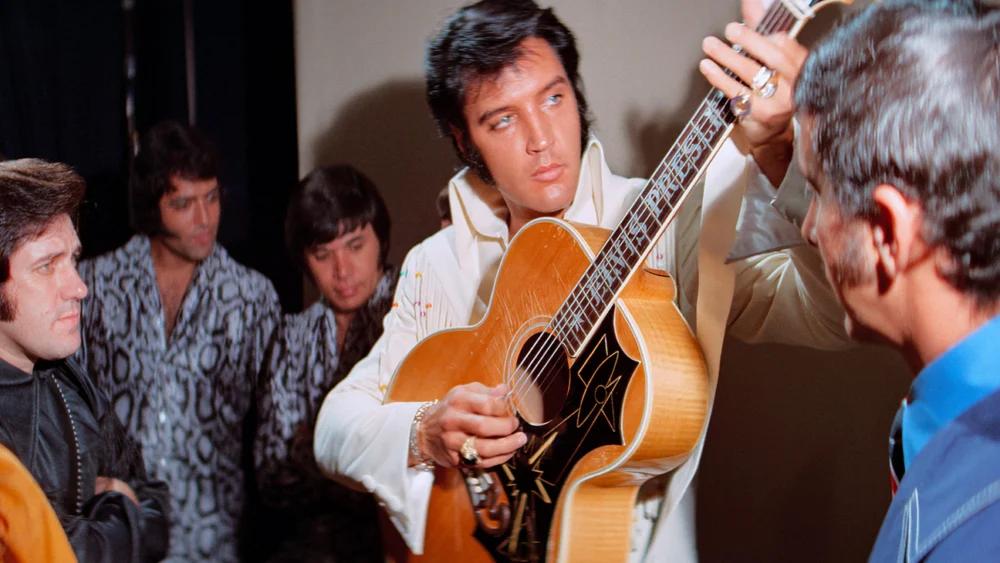
Beyond the electric stage sequences, the film offers captivating glimpses into the rehearsal studio, where much of the material for the Vegas act took shape. Here, Elvis is seen in super-cool chrome aviator sunglasses and an amazing iridescent psychedelic print shirt, exuding an air of casual genius as he dips into Beatles covers like "Yesterday" and "Something." These intimate moments reveal a different facet of the icon, comfortable and creatively engaged among his trusted musicians. The fashions throughout the film are spectacular, none more so than the custom-designed jumpsuits that became his Vegas signature. These outlandish creations—featuring lace-up chest closures, Napoleonic collars, half-capes, bell-bottom pants, and colossal belts embellished with gems, rhinestones, rivets, and fringes—are presented not as mere costumes but as extensions of his larger-than-life persona.
The Enduring Echo of a Legend
One of the most remarkable achievements of EPiC: Elvis Presley in Concert is its ability to transcend the kitsch often associated with Elvis’s later career, preventing the film from feeling like a frozen museum piece. Instead, it delivers a pulse-pounding, foot-tapping, body-quaking testament to a consummate performer whose energy feels as vibrant and immediate today as it did decades ago. Luhrmann’s profound reverence for his subject is evident in every frame, crafting a cinematic experience that is ecstatically alive.
The film successfully reanimates Elvis Presley, reaffirming his status not just as a historical figure but as a dynamic cultural force whose impact continues to resonate. It is a powerful reminder of his unique ability to connect with audiences, to entertain, and to move them, both physically and emotionally. To paraphrase Ed Sullivan, who famously limited his cameras to shooting Elvis only from the waist up, EPiC: Elvis Presley in Concert is, without a doubt, "a really big show," a triumphant return for the King that ensures his legend endures with unparalleled vitality.