Anthony Chen, the acclaimed director, has returned to his native Singapore with his latest feature, We Are All Strangers (Wo Men Bu Shi Mo Sheng Ren), concluding what he terms his "Growing Up" trilogy. Following excursions in Greece with Drift and China with The Breaking Ice, Chen’s new film offers a poignant and deeply observed look into the lives of a Singaporean family, garnering critical acclaim for its nuanced portrayal of ordinary existence. The film, described as a "minor-key magical" experience, has been praised for its rich texture and satisfying narrative, much like the Hokkien noodles depicted within its scenes.
Anthony Chen’s Cinematic Trilogy Culminates in Singapore
We Are All Strangers marks the culmination of Chen’s long-running thematic exploration of maturation and familial bonds, building upon the foundations laid by his earlier works, Ilo Ilo and Wet Season. Ilo Ilo, a poignant domestic drama, first introduced audiences to Chen’s keen eye for intimate human dynamics, earning him the Camera d’Or at the Cannes Film Festival in 2013. This was followed by the melancholic intergenerational romance, Wet Season, further cementing his reputation for sensitive and realistic portrayals of personal struggles.
The trilogy shares a distinctive artistic fingerprint: a meticulous attention to the "ebb and flow" of daily life, the subtle details that define individuals, and the complex interplay of disappointments and rewards within both biological and chosen families. These films collectively craft a fresco-like depiction of human experience, grounding grand emotional narratives in the minutiae of everyday existence. Chen’s return to Singapore with We Are All Strangers brings his thematic focus full circle, deepening his exploration of the challenges and quiet triumphs inherent in growing up, both for individuals and the collective spirit of a nation.
Unflashy Elegance: Singapore as a Character
Filmed with an "unflashy elegance" by cinematographer Teoh Gay Hian, We Are All Strangers establishes a profound sense of place, allowing Singapore itself to emerge as a central character. The intimate stories of its inhabitants unfold against the expansive backdrop of a bustling city, subtly revealing its inherent complexities. The narrative navigates the unspoken class divisions, the widening wealth gap, and the constant friction between rapid urban transformation and the erosion of traditional values.
Despite these grand societal themes, the film maintains the quality of a chamber piece, focusing intensely on its four principal characters. Chen masterfully achieves emotional resonance through naturalistic performances and a narrative approach that minimizes sentimentality. The careful selection of music, such as Cat Stevens’ "Father and Son" for the end credits, serves as an organic extension of the film’s emotional depth, rather than a heavy-handed declaration. This choice underscores the evolving roles within the family, where relationships pull apart, intersect, and ultimately merge.
An Homage to Taiwanese Cinema’s Master
Chen’s cinematic style in We Are All Strangers draws clear inspiration from the late Taiwanese auteur Edward Yang, particularly his masterpiece, Yi Yi. Yang’s profound exploration of family dynamics, characterized by sprawling, character-based storytelling, set a benchmark that Chen evidently strives to emulate. The film echoes Yang’s lucidity and compassion in conveying struggles, conflicts, and comforts, always contextualizing individual observations within the broader social fabric and physical environments of the city.
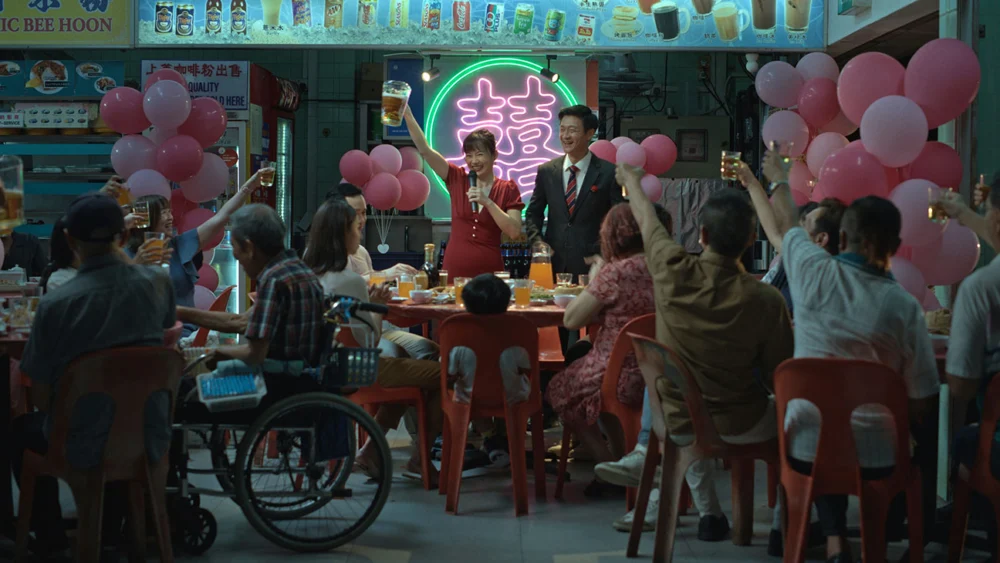
A specific shot within Chen’s movie, depicting a wedding celebration adorned with pink balloons and a prominent "Double Happiness" neon sign, appears as a direct homage to Yi Yi. Furthermore, Chen adopts Yang’s preference for a leisurely running time, with We Are All Strangers extending to two hours and thirty-seven minutes. This extended duration, while a significant investment for the viewer, is generously repaid through deep character development and intricate narrative layering, a testament to the influence of films like Yang’s four-hour epic, A Brighter Summer Day.
The Intertwined Lives of a Singaporean Family
The narrative centers on Boon Kiat (Andi Lim), a hardworking but uncomplaining owner of a cheap and cheerful streetside Hokkien noodle stall. Despite the relentless climb of living costs in Singapore, Boon Kiat has not raised his prices in a decade, reflecting his modest business acumen. His 21-year-old son, Junyang (Koh Jia Ler), is on the cusp of completing his compulsory military service, harboring aspirations for a more lucrative and less arduous life than his father’s.
Junyang’s primary focus lies with his high school sweetheart, Lydia (Regene Lim), who comes from a considerably more affluent background. Lydia’s haughty mother, who insists on speaking only English, openly expresses disdain for her daughter’s boyfriend. Lydia herself is diligently preparing for her college-entrance A Levels and an upcoming piano recital exam, her future seemingly set on a trajectory distinct from Junyang’s working-class ambitions.
New Beginnings and Unexpected Turns
An unforeseen development drastically alters Junyang and Lydia’s future, accelerating their path to adulthood and responsibility, sidelining Lydia’s academic and musical plans. Simultaneously, Boon Kiat, the gentle-natured noodle seller, develops a shy affection for Bee Hwa (Yeo Yan Yan), a brassy and tough hostess pushing beer at tables outside his stall. Bee Hwa, a Malaysian national seeking to establish a life in Singapore, is older than her colleagues, earning her the affectionate moniker "beer auntie."
Initially, Bee Hwa feigns indifference to Boon Kiat’s solicitous attentions, such as his insistence that she rest and eat, or his idea of an affordable date – an air-conditioned public bus ride across the city. However, subtle traces of a smile hint at her growing fondness. Her roaring laughter when he proposes marriage is followed by a telling silence, indicating a potential acceptance. The observation of this oddly matched courtship emerges as one of the film’s most enchanting elements. Boon Kiat’s unsophisticated but unwavering care slowly melts Bee Hwa’s brittle, wise-ass demeanor, revealing a blossoming affection and a growing role as a supportive figure to Junyang and Lydia.
Navigating Modern Singaporean Life
Before long, the two couples find themselves living together in a modest public housing apartment, a household soon expanded by the arrival of Junyang and Lydia’s child. Junyang’s persistent immaturity creates significant friction for the young couple, fueling Lydia’s regret over abandoning her studies. His attempts at gainful employment prove challenging; he quits a food delivery service due to the perceived fussiness of wealthier Singaporean customers. Later, he is convinced he has found a "sure thing" in luxury waterfront condo sales, taken on by a slick real estate developer with minimal training.
The film then introduces a series of escalating challenges for the nascent family unit. Tragedy strikes with a medical diagnosis, Junyang’s real estate venture crashes, Boon Kiat’s financial naivety attracts threats from loan sharks, and an ill-conceived "get-rich-quick" scheme leads to legal complications. Amidst this turmoil, Bee Hwa unexpectedly shines, revealing herself as a natural on TikTok and a surprisingly gifted salesperson, a performance for which Yeo Yan Yan has been particularly lauded. The story unfolds with a "beautiful lilting rhythm," constantly shifting its focus among the four principal characters and revealing unforeseen dimensions of their personalities.
Captivating Performances and Character Evolution
The ensemble cast delivers captivating performances, with particular note given to Koh Jia Ler and Yeo Yan Yan, both of whom have been integral to Chen’s trilogy since Ilo Ilo. Koh, discovered by Chen at age 11, masterfully portrays Junyang’s journey. He renders the character as almost reprehensibly naive, yet crucially, more foolish than arrogant, preventing him from ever becoming unsympathetic. Even when adopting the cooler name "Steve" (like Steve Jobs) to impress foreign buyers, Junyang’s ambition stems more from a pipe dream than genuine cockiness. His eventual humbling missteps force him to scale down his grand aspirations, leading not to resignation or defeat, but a newfound level-headedness and inner strength.
This arc resonates with a rare piece of fatherly advice from Boon Kiat earlier in the film, who cautions Junyang that lofty dreams can be a trap and that being grounded is preferable, suggesting that "too much happiness, not enough suffering" can unbalance a life. Lydia, portrayed by Regene Lim, takes on the most muted role, finding herself a person far removed from her youthful aspirations. Her sadness never curdles into bitterness; instead, she remains receptive to Junyang’s gestures of love and proactively works to improve her situation without compromising her roles as a mother and wife.
The true revelation is Andi Lim as Boon Kiat, a former television actor in his first feature role. Lim imbues Boon Kiat with restraint, warmth, kindness, and an endearing hint of unworldliness. A particularly memorable scene depicts Boon Kiat insisting on following a drunken Bee Hwa home to ensure her safety, a moment of pure, unassuming affection. Even when faced with crushing sadness, Boon Kiat maintains a disposition of calm acceptance, never losing his gratitude for Bee Hwa’s love.
The Power of Connection in a Fragmented World
The title, We Are All Strangers, initially applies to all the characters, including father and son, underscoring the initial disconnect and evolving relationships. The film deftly navigates potential pitfalls of winsome cuteness through Chen’s "limpid naturalism," ensuring that its emotions feel honest and genuinely earned. The director meticulously observes the "tiniest moments" – a glance, a gesture, a shared meal – that possess the power to alter a day, shift an outlook, or redirect a life’s trajectory.
Ultimately, We Are All Strangers is a profound cinematic statement on the human capacity for connection. It illustrates how even the most seemingly ill-suited individuals can forge a family, finding solace, support, and profound nourishment within these unexpected bonds. Chen’s film serves as a powerful reminder of the beauty and poetry that can be found in the often-overlooked tapestry of everyday lives, especially within the complex, evolving landscape of modern Singapore.