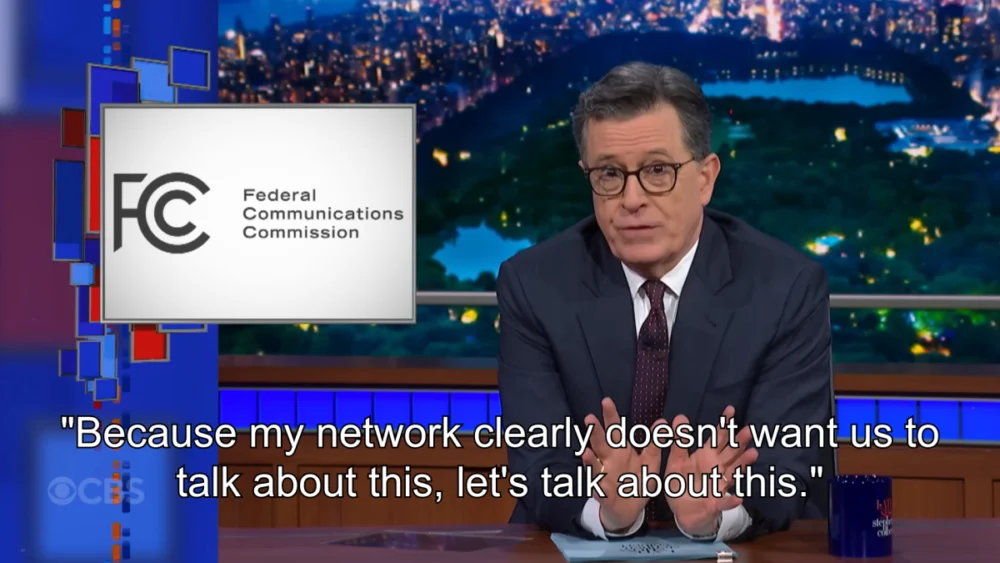
The Late Show host Stephen Colbert publicly challenged his network, CBS, during a recent broadcast, alleging that corporate executives blocked a pre-recorded interview with Texas State Representative James Talarico. The comedian accused the network of "pre-emptively capitulating" to regulatory pressure from the Federal Communications Commission (FCC) and the executive branch. During an eight-minute monologue, Colbert detailed the internal conflict, claiming that CBS lawyers issued a mandate prohibiting the appearance of the Texas lawmaker on the network’s airwaves.
The controversy centers on a shifting interpretation of federal broadcasting regulations that have governed American television for decades. Colbert informed his audience that CBS management had not only banned the interview but had also initially instructed him not to mention the cancellation on air. Defying these directives, Colbert utilized his platform to explain the legal and political mechanisms he believes are being used to silence specific political voices on broadcast television.
The Decision to Block the Talarico Interview
According to Colbert, the decision by CBS to pull the segment was a direct response to recent signals from FCC Chairman Brendan Carr. Carr has publicly suggested that the commission is considering the elimination of the long-standing "talk show exemption" to the equal time rule. This rule, found in Section 315 of the Communications Act, requires broadcast stations to provide equivalent airtime to opposing candidates if they permit one candidate to appear on their programming.
For over sixty years, news programs, documentaries, and late-night talk shows have operated under an exemption that classifies their interviews as "bona fide news" or "news interview" segments. By removing this exemption, the FCC would essentially require a network like CBS to offer equal time to every primary or general election opponent of a guest like Talarico. Colbert argued that the administrative burden of such a requirement would effectively end political interviews on broadcast late-night television.
The Late Show host noted that while the FCC has not yet formally codified the removal of the exemption, CBS has begun enforcing the potential rule change as if it were already law. Colbert characterized this as a financial and strategic decision by the network to avoid potential litigation or regulatory hurdles during a period of heightened government scrutiny of the media.
Understanding the FCC Equal Time Rule and the Talk Show Exemption
The equal time rule was established to ensure that broadcast airwaves, which are considered a public resource, are not used to unfairly favor one political candidate over another. Under the existing framework, broadcast stations—which include local affiliates of CBS, NBC, and ABC—must provide "equal opportunities" to all legally qualified candidates for any public office if they allow one candidate to use their station.
In 1959, Congress amended the Communications Act to include four specific exemptions to the equal time rule: bona fide newscasts, bona fide news interviews, bona fide news documentaries, and on-the-spot coverage of bona fide news events. Late-night programs like The Late Show with Stephen Colbert have historically qualified under the "news interview" category. This allowed hosts to interview sitting politicians and candidates without the network being forced to host dozens of minor-party or opposing candidates in the following days.
The current debate initiated by Chairman Brendan Carr suggests a narrowing of these definitions. Carr has argued that the exemption has been stretched too far, allowing late-night programs to become partisan platforms under the guise of entertainment and news. However, critics of Carr’s proposal point out that broadcast television is the only medium facing such restrictions, as cable news networks and streaming platforms are not subject to FCC oversight regarding equal time.
Brendan Carr and the Regulatory Shift
The role of Brendan Carr in this dispute is central to Colbert’s critique. Carr, a Republican appointee to the FCC, has become a prominent figure in the debate over media bias and government regulation of tech and broadcast companies. Colbert alleged that Carr’s interest in the equal time rule is motivated by a desire to protect the current administration from critical coverage.
During his monologue, Colbert pointed to a perceived double standard in Carr’s regulatory philosophy. He cited reports indicating that Carr has expressed little interest in applying similar "equal time" pressures to talk radio, a medium that is traditionally dominated by conservative voices. Colbert argued that the selective enforcement of these rules suggests a partisan motive rather than a genuine concern for broadcast neutrality.
"I think you are motivated by partisan purposes yourself," Colbert said, addressing Carr directly through the camera. He further claimed that the Trump administration’s broader goal is to stifle dissent on broadcast television, noting the president’s well-documented habit of monitoring television coverage and reacting to media portrayals of his administration.
James Talarico: The Guest at the Center of the Controversy
The guest whose interview sparked the blackout, James Talarico, is a prominent Democrat from Texas known for his progressive stance and his frequent critiques of religious nationalism. Talarico has gained national attention for his ability to frame political issues through a moral and theological lens, often challenging his Republican colleagues in the Texas Legislature on their own terms.
The interview was expected to cover Talarico’s legislative work and his views on the intersection of faith and politics in the United States. Because Talarico is a candidate for office, his appearance triggered the internal alarms at CBS Legal. The network’s refusal to air the segment highlights the increasing vulnerability of state-level politicians who seek national platforms but find themselves caught in the crosshairs of federal regulatory battles.

Colbert noted that the ban on Talarico was absolute. He claimed he was told he could not show pictures of the representative, use his name in a promotional capacity, or provide direct links to the interview on the network’s digital platforms. The host responded to these restrictions with satire, at one point replacing Talarico’s image with a "tasteful nude" of Brendan Carr to mock the perceived absurdity of the network’s caution.
Anticipatory Obedience and Corporate Media Strategy
The decision by CBS is being viewed by media analysts as a case of "anticipatory obedience." This occurs when a corporation or individual limits their own behavior to avoid potential punishment from a powerful entity, even before any official action has been taken. In this case, CBS appears to be prioritizing its relationship with federal regulators over its editorial independence.
Broadcast networks are particularly sensitive to FCC pressure because their business models rely on the periodic renewal of broadcast licenses for their local affiliates. These licenses are granted based on the "public interest, convenience, and necessity." A hostile FCC could theoretically complicate these renewals or levy significant fines if a network is found to be in violation of federal rules.
Furthermore, CBS’s parent company, Paramount Global, is operating in a volatile economic environment characterized by mergers, acquisitions, and intense competition from streaming giants. Maintaining a smooth relationship with government regulators is often seen as a prerequisite for securing approval for large-scale corporate transactions. Colbert alluded to this, stating that the decision to block Talarico was made for "purely financial reasons."
The Digital Pivot: How to Watch the Interview Anyway
Despite the broadcast ban, the interview with James Talarico was not permanently suppressed. In a move that highlights the limitations of FCC oversight in the digital age, the segment was uploaded to The Late Show‘s official YouTube page. While CBS is a broadcast entity subject to FCC rules, YouTube is a private digital platform that operates outside the jurisdiction of the equal time rule.
"The network says I can’t give you a URL or a QR code, but I promise you, if you go to our YouTube page, you’ll find it," Colbert told his viewers. This workaround allowed the content to reach a global audience, arguably generating more interest due to the controversy than it would have as a standard broadcast segment. Within hours of the monologue, the YouTube video garnered millions of views, with many commenters citing the "Streisand Effect"—where an attempt to hide or censor information has the unintended consequence of publicizing it more widely.
The incident underscores a growing divide between the regulations governing traditional "over-the-air" television and the unregulated frontier of the internet. As more viewers migrate to digital platforms, the FCC’s ability to control political discourse through broadcast rules is increasingly seen as an archaic tool that targets a shrinking segment of the media landscape.
Broader Implications for Free Speech and Late-Night Comedy
The standoff between Colbert and CBS raises significant questions about the future of political satire and late-night comedy. For decades, these programs have served as a vital part of the American political conversation, offering a mix of entertainment and commentary that often reaches viewers who do not watch traditional news programs.
If the talk show exemption is indeed eliminated, the logistical challenge of hosting any political figure would likely lead networks to ban them entirely. This would strip late-night hosts of their ability to interview governors, senators, and presidential candidates, fundamentally altering the nature of the genre. Critics argue that this would result in a less informed public and a chilling effect on political speech.
The controversy also highlights the precarious position of hosts who operate within large corporate structures. While Colbert has significant leverage due to his show’s ratings and cultural impact, he remains an employee of a network that must answer to shareholders and government officials. The public airing of this internal dispute suggests a rare breach in the normally polished relationship between a star and their network.
Reactions and the Future of Broadcast Regulation
The FCC has not issued a formal response to Colbert’s specific allegations, though Chairman Carr has remained active on social media, continuing to advocate for what he describes as "neutrality" in broadcasting. Proponents of Carr’s view argue that the media landscape has become so polarized that strict enforcement of the equal time rule is the only way to ensure fairness.
Conversely, free speech advocates and media organizations have expressed concern that the weaponization of the equal time rule is a form of soft censorship. They argue that by creating a "regulatory minefield," the government is forcing private companies to silence specific viewpoints to avoid legal risk.
As the 2026 election cycle approaches, the debate over the equal time rule and the talk show exemption is expected to intensify. The outcome will likely determine whether broadcast television remains a viable platform for political engagement or if the medium will be forced to retreat into purely apolitical entertainment to survive. For now, the Colbert-Talarico incident serves as a high-profile example of the tensions between government power, corporate interests, and the constitutional right to free expression.