
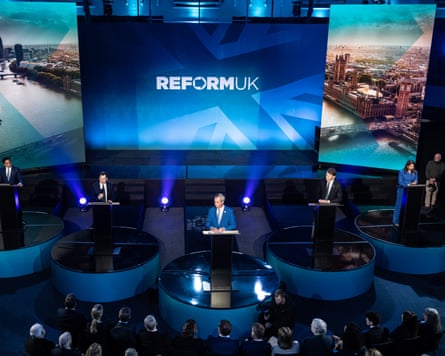
Nigel Farage, the leader of Reform UK, introduced the inaugural members of his party’s frontbench team during a high-stakes press conference in London, signaling a strategic transition from a personality-driven movement to a structured political organization. While the move was intended to demonstrate the party’s growing depth and professionalization, Farage accompanied the appointments with a stern ultimatum, asserting that he would not tolerate internal opposition or lack of discipline among his high-profile colleagues.
The announcement marks a pivotal moment for Reform UK as it seeks to capitalize on its recent momentum in national polling. By appointing senior figures to specific portfolios, Farage is attempting to counter long-standing criticisms that his party is a "one-man band" entirely dependent on his personal brand and media presence. The new lineup includes veteran politicians and fresh ideological voices, aimed at presenting a coherent alternative to both the governing Labour Party and the embattled Conservatives.
Nigel Farage Unveils Reform UK Frontbench Team and Warns Over Dissent to Solidify Party Structure
The composition of the new frontbench highlights Reform UK’s success in poaching high-profile talent from the Conservative Party. Among the most notable appointments are Robert Jenrick and Suella Braverman, both of whom recently defected to Farage’s camp. Jenrick, a former cabinet minister, has been tasked with the Treasury portfolio, a role that will require him to articulate the party’s fiscal and economic strategies. Braverman, a former Home Secretary known for her hardline stance on social issues, has been placed in charge of education, skills, and equalities.
Richard Tice, the deputy leader of Reform UK and a foundational figure in the party’s development, was assigned a consolidated brief covering business, trade, and energy. Tice had previously been expected to handle the Treasury role, but the arrival of Jenrick prompted a reshuffling of responsibilities. Rounding out the primary quartet is Zia Yusuf, the party’s head of policy. Yusuf, who does not currently hold a seat in Parliament, was granted the home affairs and migration brief, a central pillar of Reform UK’s platform.
Farage emphasized that this rollout is merely the first phase of a broader organizational expansion. He told reporters that the emergence of a specialized team should put to rest the notion that Reform UK is a singular entity revolving solely around his leadership. "This is about creating a machine for government," Farage stated, arguing that the party has successfully bridged the gap between his personal popularity and the public’s recognition of the Reform brand.
Farage Warns Over Dissent as He Moves to Professionalize Party Operations
Despite the emphasis on teamwork, Farage remained characteristically assertive regarding his ultimate authority over the party’s direction. When questioned about potential friction or "internal upset" resulting from the distribution of roles—particularly the displacement of Tice from the Treasury brief—Farage was dismissive. He noted that no dissent had been voiced to him thus far and added a blunt warning for those who might consider breaking ranks.

"If there is [upset]? Tough. We’re not mucking about here. We haven’t got time," Farage said. He underscored that while the new frontbenchers are encouraged to develop policy within their respective departments, he retains the final say on all major decisions. His rhetoric suggested a low-tolerance policy for the kind of internal squabbling that has historically plagued the Conservative Party. "Very simple. If people mess about, behave badly, or are disloyal, we’re not going to put up with it," he added.
This uncompromising stance was on full display during the press conference. Farage frequently intervened to answer questions directed at his colleagues or prevented certain inquiries from being addressed at all. In one notable exchange, he dismissed a reporter from the Financial Times, telling her to "just write some silly story" rather than engaging with her question. This dynamic suggests that while Reform UK is expanding its roster, Farage intends to maintain tight control over the party’s messaging and public image.
High-Profile Defectors Join the Reform UK Frontbench Team and Reshape Policy
The inclusion of Jenrick and Braverman is seen by analysts as a double-edged sword for Reform UK. While they bring significant experience and name recognition, they also carry the baggage of their tenures in Conservative governments that Farage himself has frequently labeled as failures. Farage defended the appointments by arguing that both individuals were distinct from the "failing" establishment because they had either resigned on principle or been forced out for their convictions.
Braverman, who was dismissed twice as Home Secretary under different Conservative prime ministers, used the event to preview a radical policy agenda. She announced that if Reform UK were to take power, her first act would be to abolish her own equalities brief and repeal the Equality Act of 2010. She argued that the legislation has fostered a culture of grievance and bureaucracy that hinders national progress.
Furthermore, Braverman targeted the education system, condemning what she described as the "prevalence of liberal ideology" in British schools. She proposed a major shift in higher education policy, suggesting that the current goal of having 50% of young people attend university should be abandoned. In its place, she advocated for a target where 50% of young people would enter vocational training for trades such as electrical work and carpentry, arguing that the economy is currently over-saturated with graduates and under-served by skilled laborers.
Economic Strategy and the Reform of Oversight Bodies
Robert Jenrick is scheduled to provide a more detailed breakdown of the party’s economic platform in a separate briefing. Early indications suggest that Reform UK intends to project a sense of fiscal responsibility to reassure international investors and markets. Jenrick is expected to confirm that a Reform-led government would maintain the Bank of England’s independence regarding interest rate decisions, a move aimed at avoiding the market volatility often associated with populist economic shifts.
However, the party does intend to overhaul the Office for Budget Responsibility (OBR). While Reform UK will not abolish the watchdog, Jenrick is set to announce plans to introduce "outside experts" to the body to ensure a "diversity of opinion." Critics of the OBR in right-wing circles have long argued that the institution is beholden to "orthodox" economic thinking that stifles growth-oriented policies. By diversifying the OBR’s personnel, Reform UK hopes to challenge the status quo of British economic forecasting.
This focus on the OBR and the Bank of England reflects a broader effort by Reform UK to position itself as a credible alternative for voters who are frustrated with the economic performance of the traditional major parties. With Reform currently leading or placing highly in several national polls, the party is under increasing pressure to demonstrate that its proposals are more than just populist rhetoric.
Political Fallout and Reactions from Major Parties
The unveiling of the frontbench team has drawn sharp criticism from both the Labour and Conservative parties. Anna Turley, the chair of the Labour Party, characterized the lineup as a "top team of failed Tories." She argued that the presence of Jenrick and Braverman proves that Reform UK is simply a rebranding of the same political figures who contributed to the country’s current challenges. "They failed Britain before—they’d do the same again under Reform," Turley said in a statement.
The Conservative Party, meanwhile, sought to frame the move as a desperate attempt to mimic their own structure. Conservative Party Chair Kevin Hollinrake described the frontbench as a "tribute act to the old Conservative party" rather than a legitimate new movement. He suggested that the team was already experiencing internal friction, claiming that some members were "eyeing their next career move" while others felt snubbed by the lack of promotion.
Despite these critiques, Farage appears undeterred. He has set a May deadline for any remaining Conservative lawmakers who wish to defect to Reform UK, indicating that the window for joining the "insurgency" is closing. Farage noted that there are very few remaining members of the Conservative frontline that his party would be interested in recruiting, suggesting that the current team represents the core of his future government.
The Broader Impact of Nigel Farage Unveils Reform UK Frontbench Team and Warns Over Dissent
The long-term impact of this reorganization remains to be seen, but it clearly marks a new phase in British politics. By formalizing its leadership structure, Reform UK is signaling that it is no longer content to be a pressure group or a protest party. The move is a direct challenge to the two-party system that has dominated the United Kingdom for decades.
For the British public, the emergence of a structured Reform UK frontbench offers a clearer look at what a "Farageist" government might actually look like. The policy proposals—ranging from the repeal of equality laws to the radical restructuring of the education system—represent a significant departure from the consensus politics of the last twenty years.
As the party prepares for upcoming local and national electoral contests, the discipline of this new team will be tested. Farage’s warning over dissent suggests he is aware of the risks inherent in bringing together strong-willed political veterans. Whether this "machine for government" can function effectively under his singular authority will be the defining question for Reform UK in the months ahead.