The documentary film Yo (Love Is a Rebellious Bird), directed by Anna Fitch and co-directed and edited by Banker White, offers a profoundly intimate and formally audacious portrait of Yolanda "Yo" Shea, a Swiss immigrant whose unconventional life defied easy categorization. Premiering at the Berlin Film Festival, the 78-minute feature skillfully weaves together elements of grief and profound joy, presenting an inventive tribute to a free-spirited woman whose friendship deeply impacted filmmaker Anna Fitch. The film stands out as a unique contribution to biographical documentary, celebrated for its artistic techniques and deeply personal narrative.
A Friendship Forged Across Generations
At its core, Yo (Love Is a Rebellious Bird) explores the unlikely yet enduring friendship between director Anna Fitch, now in her 40s, and Yolanda Shea, who was born in the 1920s. Their bond, which lasted until Yo’s death, forms the emotional bedrock of the film. While both Fitch and White appear on camera, their presence serves primarily to contextualize this remarkable intergenerational connection rather than to overshadow Yo. Through Anna’s voiceover, the film subtly reveals the surprising parallels that united these two women.
Both were only children, artists, and eventually mothers, neither originally from California but ultimately settling there. Even minor details, such as their strikingly full heads of wavy hair, are noted, painting a picture of shared experiences that transcend their age difference. Fitch, who initially trained as an entomologist and has directed several nature documentaries, brings a unique observational sensibility to the project. This background even manifests in the film through a significant supporting role for caterpillars, a nod to her scientific roots.
Innovative Storytelling: Crafting a Life Through Art
The film’s most striking aspect lies in its formally inventive approach to storytelling. Rather than relying solely on conventional interviews or archival footage, Yo (Love Is a Rebellious Bird) employs a rich tapestry of artistic methods to reconstruct Yolanda Shea’s life. Puppetry, intricate collages, nearly animated still photographs, and candid film footage captured during Yo’s later years combine to create a visually distinct and emotionally resonant experience. These diverse techniques ensure that the tender portrait, though acknowledging loss, remains ultimately a deeply joyful and meticulously crafted work.
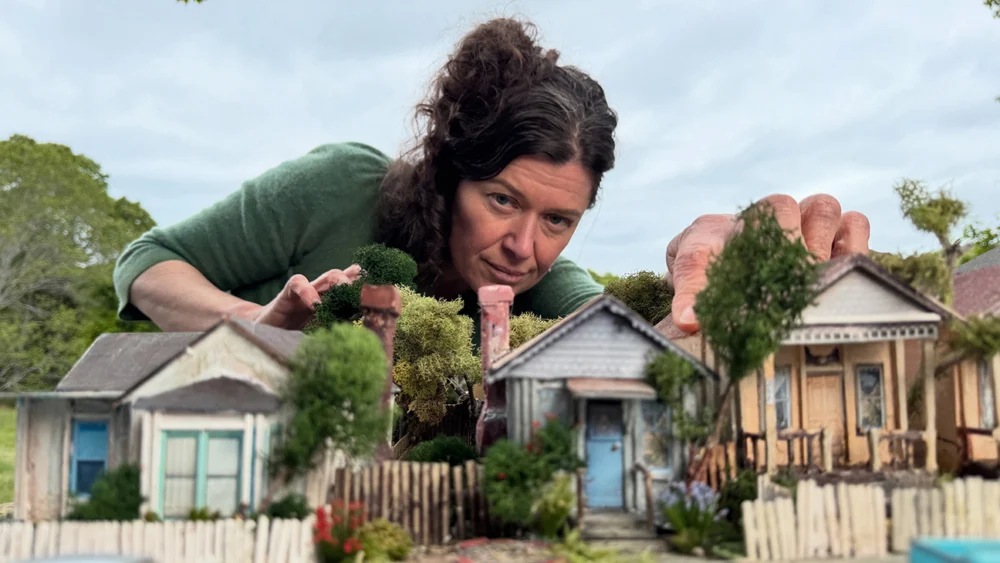
A significant portion of the narrative unfolds within meticulously constructed 1/3 scale sets. These miniature environments recreate Yo’s modest house and even a section of 19th Street in Pacific Grove where she resided. These dollhouse-like models are not merely decorative; they are built to facilitate filming sequences that re-enact scenes from Yo’s final years. Every detail within the tiny, pastel-colored, seaside bungalow is replicated, from the blankets on her bed and the fireplace to, perhaps, the ounce-sized bags of cannabis Yo, a lifelong enthusiast, consumed. This immersive and tangible reconstruction allows viewers to step directly into Yo’s world, offering a unique perspective on her daily life.
The Unconventional Journey of Yolanda Shea
The narrative structure of Yo (Love Is a Rebellious Bird) adopts a whimsical, almost naive quality, echoing a child’s perspective, which perfectly complements Yo’s own artless and unfiltered recollections of her life. The film traces Yo’s journey from her childhood in Italian-speaking Switzerland, where her rebellious spirit often baffled her conventional parents. This early defiance is vividly illustrated through the inclusion of luridly Technicolor footage from Der Struwwelpeter, a 1955 German children’s film adaptation of the classic folk tale about disobedient children. The mildly eerie atmosphere of these clips effectively counters the film’s inherent sweetness, hinting at the complexities of Yo’s character.
Yo’s life unfolded as a testament to her determination to pursue her own truth, regardless of societal expectations. The film chronicles her drug-infused years, including a pivotal acid trip that profoundly altered her life trajectory. While she was a loving mother to her four children, her fierce independence led her to unconventional choices, such as periods of homelessness spent hitchhiking along Highway One, leaving her children in the care of her ex-husband. An anecdote about attending her own mother’s funeral, getting profoundly stoned with her husband’s brother, and then choosing to have sex with him in her late mother’s bed, starkly encapsulates Yo’s audacious and unflinching approach to life. This incident, while perhaps not entirely flattering, underscores her raw honesty and eccentric defiance.
Later Years: An Indomitable Spirit
Despite her complicated past, it becomes difficult not to admire and warm to Yolanda Shea, especially as she is presented in her final years. Worn thin by age, she retains a striking beauty and an impish, beady gaze that reflects her enduring spirit. Remaining a "proper hippie" until the very end, she exhibits no embarrassment in allowing Anna Fitch to film her naked in the bathtub while she candidly chats with a visiting helper. This raw openness further endears her to the audience, showcasing her comfort in her own skin and her authentic approach to existence.
Yo found delight in many aspects of life, even those that initially frightened her. Despite a childhood phobia of birds, she formed a unique bond with a demanding blue jay, diligently putting out nuts for it. The film also reveals a telling memory from her teenage years, where she confessed to a guidance counselor her dislike and even fear of children, stating she did not want to work with them. This revelation stands in stark contrast to her eventual role as a mother of four. In her later life, she is depicted as an affectionate, grandmotherly figure, seen bouncing Anna and Banker White’s infant daughter. A particularly touching scene shows the child sharing her copy of Pat the Bunny with Yo as she lies in a hospital bed, symbolizing the continuity of life and connection across generations.
Beyond Biography: A Universal Narrative
Ultimately, Yo (Love Is a Rebellious Bird) goes beyond merely cataloging the events of a singular life. While Yo eventually pursued art school and befriended notable artists of her generation, including Dadaist sculptor Jean Tinguely, the film deliberately avoids positioning her as a historically significant figure. Instead, it argues for the inherent significance of every individual’s unique journey. Yo is presented simply as someone the filmmakers knew, loved, and cherished—a testament to the idea that ordinary lives, when observed with care and insight, can reveal extraordinary depths. Her formidable will and indomitable spirit, as captured in this documentary, make her no less deserving of cinematic exploration than any celebrated personality.
Banker White’s masterful and jaunty editing ensures that the film flows with an engaging rhythm, while the meticulous richness of detail in every frame makes its 78-minute running time feel substantial, though never tediously so. The inclusion of a varied selection of classical music, ranging from Bach fugues to snatches from Bizet’s Carmen and Puccini’s Madame Butterfly, alongside minimalist compositions by Terry Riley, adds a layer of formal dignity. This thoughtful musical backdrop perfectly complements the narrative, elevating the personal story to a more universal artistic statement.
Critical Reception and Cultural Impact
Upon its debut at the Berlin Film Festival, Yo (Love Is a Rebellious Bird) garnered significant critical acclaim for its innovative filmmaking and profound emotional impact. Reviewers lauded its ability to navigate complex themes of life, death, and self-discovery with grace and inventiveness. The film contributes to a growing trend in documentary cinema that champions personal narratives and explores the lives of individuals who, though not public figures, offer rich insights into the human condition. Its success underscores the enduring power of storytelling, particularly when told with such a distinctive artistic vision.
The film’s exploration of Yo’s unapologetic authenticity and her pursuit of freedom resonates deeply in a cultural landscape increasingly valuing individuality and challenging conventional norms. It serves as a reminder that extraordinary lives are often found in the most unexpected places, lived by those who dare to define their own paths. Yo (Love Is a Rebellious Bird) is not just a film about a friend; it is a meditation on the nature of memory, the art of biography, and the enduring legacy of a spirit that refused to be tamed. The documentary leaves audiences with a lasting impression of Yolanda Shea’s vibrant, complex, and ultimately inspiring existence, proving that love, indeed, can be a rebellious bird, soaring freely and leaving an indelible mark.