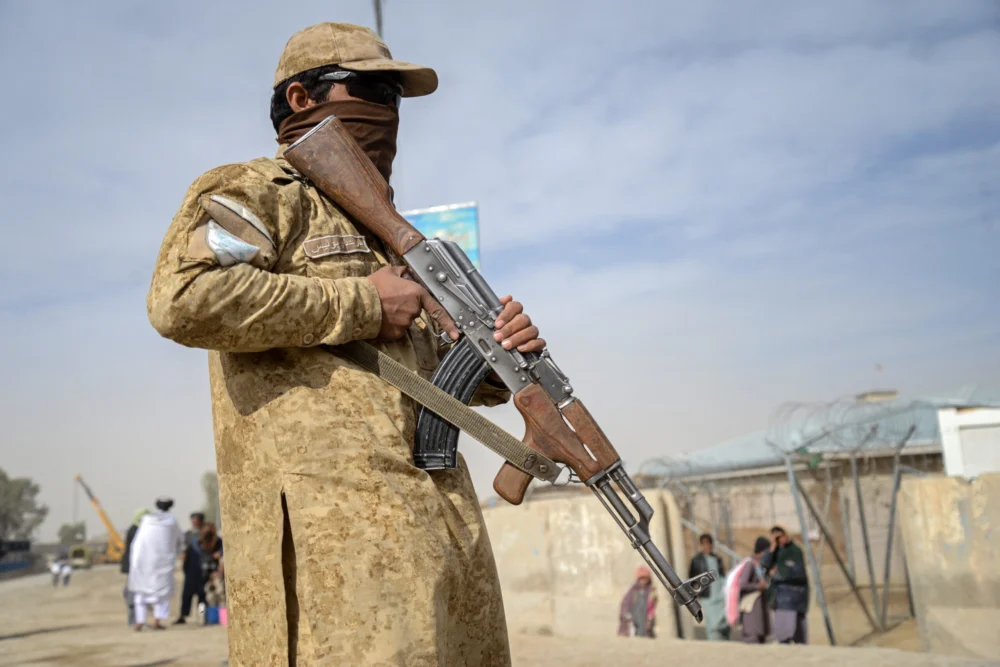
Afghan and Pakistani forces exchanged fire along their disputed frontier Tuesday, escalating a cycle of violence that has gripped the region for days following targeted Pakistani air strikes inside Afghanistan. Both Kabul and Islamabad issued competing narratives, each accusing the other of initiating the latest hostilities near the Torkham and Shahkot border areas. These renewed skirmishes underscore the deeply frayed relations between the two neighboring nations and threaten to further destabilize an already volatile security landscape.
The tit-for-tat accusations paint a stark picture of a border in constant flux, a persistent flashpoint for conflict. The latest exchange of gunfire occurred just days after Pakistan conducted a series of air strikes on Afghan provinces, a move that Kabul vehemently condemned as a violation of its sovereignty and a tragic loss of civilian life. The Pakistani military, however, maintained that its operations were surgical strikes aimed at dismantling militant networks responsible for cross-border attacks on Pakistani soil.
Escalating Tensions Along the Durand Line
The Durand Line, the internationally recognized border between Afghanistan and Pakistan, has long been a source of friction. Its demarcation, established during British colonial rule, is not fully recognized by Kabul, adding a layer of complexity to any border management efforts. This ongoing dispute over territorial integrity and security responsibilities has fueled recurrent clashes and mutual suspicion, exacerbating existing political and ethnic tensions.
On Tuesday, Zabihullah Noorani, the head of the Afghan information department in Nangarhar Province, stated that Pakistani forces initiated the firing in the Shahkot area. He asserted that the fighting had ceased and reported no Afghan casualties. This account directly contradicted that of Pakistani officials, who claimed Afghan forces launched unprovoked attacks near the Torkham crossing.
Mosharraf Zaidi, a Pakistani government official, took to social media platform X to describe the incident. He alleged that Pakistan’s security forces responded with "immediate and effective" action, characterizing the engagement as silencing "Taliban aggression." The differing perspectives highlight the challenges in obtaining an objective account of events in the remote and often chaotic border region.
The Shadow of Deadly Air Strikes
These border skirmishes arrive on the heels of significant Pakistani military operations within Afghanistan on Sunday. The strikes, reportedly targeting Nangarhar and Paktika provinces, were a direct response to a suicide bombing in Islamabad that killed dozens. The United Nations mission in Afghanistan reported that these Pakistani air strikes resulted in the deaths of at least 13 civilians, a figure Kabul contested, claiming the toll was higher and included women and children.
Afghanistan’s interim Taliban government strongly denounced Pakistan’s actions, asserting that the strikes hit a religious school and residential areas. The Ministry of Defence in Kabul issued a stern warning, holding the Pakistani military accountable for the civilian casualties and vowing a "measured and appropriate response" in due course. This strong rhetoric signals a potential for further escalation and a deliberate challenge to Pakistan’s security calculus.
Pakistan’s military, conversely, stated that its Sunday operations targeted "camps and hideouts" utilized by militant groups responsible for a series of attacks within Pakistan. The Pakistani government has consistently accused Afghanistan of harboring these groups and failing to adequately address the threat they pose. This narrative forms the core of Pakistan’s justification for its cross-border actions.
A Deteriorating Diplomatic Landscape
The relationship between Afghanistan and Pakistan has seen a sharp decline in recent months. A significant escalation of violence occurred in October, when deadly clashes along the border resulted in the deaths of over 70 people on both sides. This incident led to the near-complete shutdown of land border crossings, severely impacting trade, travel, and humanitarian efforts.
Islamabad’s ongoing grievance centers on its belief that Afghanistan, particularly under Taliban rule, has not taken sufficient action against armed groups operating from its territory. These groups, according to Pakistan, are responsible for numerous terrorist attacks, including the recent devastating suicide bombing at a Shia mosque in Islamabad. The Taliban government has consistently denied these accusations, framing themselves as custodians of Afghan security and stability.
The Pakistani air strikes, therefore, represent a significant departure from previous diplomatic or border skirmishes. They signal a willingness by Islamabad to unilaterally enforce its security interests within Afghanistan, a move that carries immense diplomatic and security implications. The Taliban’s condemnation and threat of retaliation suggest a hardening of their stance and a potential for direct confrontation.
Broader Implications for Regional Stability
The recurring border clashes and the recent air strikes have far-reaching consequences for regional stability. Both Afghanistan and Pakistan are grappling with internal security challenges, including the persistent threat of extremist groups. A breakdown in relations between these two strategically important neighbors could create vacuums that extremist organizations might exploit, further fueling the cycle of violence.
The impact on civilians in the border regions is particularly severe. Families are displaced, livelihoods are disrupted, and the constant threat of violence creates an atmosphere of fear and uncertainty. The closure of border crossings also impedes the flow of essential goods and humanitarian aid, exacerbating an already dire economic situation in Afghanistan.
Furthermore, the escalating tensions could draw in other regional actors, potentially complicating efforts to achieve lasting peace and security. The international community, already concerned about the humanitarian crisis in Afghanistan, will be watching these developments closely, urging restraint and dialogue to prevent a wider conflagration.
Public Impact and Humanitarian Concerns
For the ordinary citizens living in the border areas, these recurrent conflicts are not abstract political disputes but life-altering realities. Families separated by the closed border crossings face immense hardship. The economic impact is substantial, as trade routes that are vital for both countries’ economies remain choked.
The violence also diverts resources and attention away from pressing humanitarian needs in Afghanistan, a country already facing widespread poverty and food insecurity. The focus on security and retaliatory measures overshadows the urgent calls for international aid and support for the Afghan population.
The cycle of accusation and counter-accusation can also foster deep-seated animosity between the populations of the two countries, making reconciliation and long-term peace even more challenging. Understanding the human cost of these border disputes is crucial to appreciating the urgency of finding diplomatic solutions.
The Path Forward: Dialogue or Escalation?
The immediate future hinges on how both sides choose to navigate this escalating crisis. The Taliban’s vow of a measured response to the air strikes suggests a desire to avoid a full-blown military conflict, but their resolve will be tested by further Pakistani actions or perceived provocations. Similarly, Pakistan faces domestic pressure to demonstrate strength in the face of militant threats, but a sustained campaign of cross-border strikes could prove counterproductive.
Analysts suggest that a return to robust diplomatic engagement and a commitment to addressing the root causes of the conflict, including mutual security concerns and border management, are essential. The establishment of a reliable communication channel and a mechanism for de-escalation could help prevent minor incidents from spiraling into larger confrontations.
However, the deep-seated mistrust and the complex web of security challenges make this a daunting task. The recent events have undoubtedly pushed the two nations further down a precarious path, where the potential for miscalculation and unintended escalation remains acutely high. The coming days and weeks will be critical in determining whether a path toward de-escalation and dialogue can be forged, or if the region is destined for further instability.