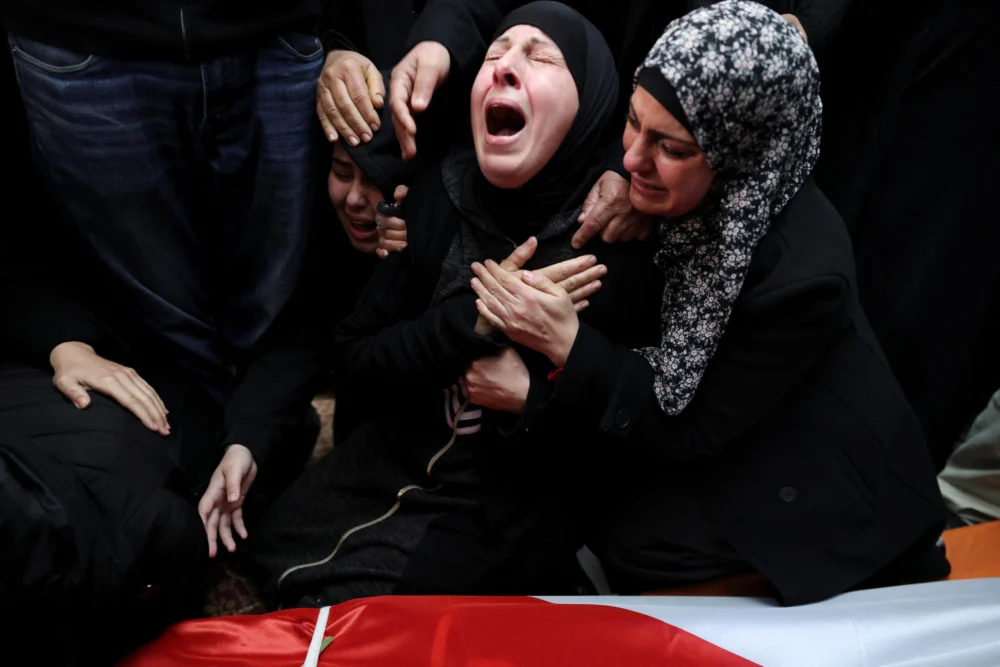
Washington D.C. – The killing of 19-year-old Nasrallah Abu Siyam, a United States citizen, by Israeli settlers in the occupied West Bank has intensified demands for accountability, as rights advocates argue that the U.S. government’s response to a mounting number of American deaths fuels a cycle of impunity. The State Department issued a statement asserting that the safety and security of Americans is its highest priority, a sentiment echoed in previous instances of U.S. citizens being killed in the region.
Abu Siyam was shot dead in Mikhmas, a village near Jerusalem. His death marks at least the eleventh U.S. citizen to be killed by Israeli settlers or soldiers since 2022, a grim tally that has galvanized critics of U.S. policy towards Israel. These recurring incidents, often met with diplomatic expressions of concern but lacking decisive action, are increasingly drawing sharp criticism from advocacy groups and families of the victims.
Mounting Toll and Demands for Accountability
William Asfour, Chicago chapter coordinator for American Muslims for Palestine, expressed deep frustration with the U.S. government’s handling of these deaths. "It’s a joke. I don’t take these people seriously," Asfour stated, articulating a sentiment shared by many who feel the U.S. response is insufficient. He argued that a genuine commitment to protecting American lives would necessitate stronger measures, such as halting weapons supplies to Israel, sanctioning individuals involved in violence, and imposing weapons embargoes.
The pattern of U.S. citizens killed in the West Bank and the subsequent lack of accountability has become a recurring narrative. In July, Khamis Ayyad, a father of five from Chicago, was killed in a settler attack. Despite calls for an independent U.S.-led investigation, the Department of Justice has not opened a probe, and no individuals in Israel have faced charges for his death.
Similarly, Sayfollah Musallet, a 20-year-old from Florida, was beaten to death by Israeli settlers last year. Like Ayyad’s case, no charges have been filed in connection with Musallet’s killing. This trend of unresolved deaths dates back to the case of Rachel Corrie, a peace activist who was run over by an Israeli bulldozer in 2003. In each instance, U.S. officials have expressed concern, but substantive action to ensure justice for the victims has been notably absent.
"It’s a terrible cycle. We just continue to see how dehumanized we are," Asfour remarked, highlighting the perceived indifference towards the lives of Palestinian Americans. He emphasized that beyond verbal assurances, concrete actions are what families and advocates seek to demonstrate a genuine care for American citizens, whether at home or abroad.
The Role of U.S. Aid and Diplomatic Stance
Advocates point to the substantial financial and military aid the U.S. provides to Israel as a leverage point that Washington has failed to utilize effectively. Over the past two years alone, the U.S. has provided Israel with more than $21 billion in aid. However, there has been little indication from the current U.S. administration that it intends to sanction Israel or suspend this assistance.
President Donald Trump, when questioned about his administration’s approach, stated last May that it was not his role "to use U.S. policy to dispense justice" abroad. This stance was further underscored by actions taken to lift existing penalties against Israeli citizens, including those involved in documented abuses against Palestinians, some of whom were U.S. citizens.
The former U.S. Ambassador to Israel, Mike Huckabee, has been a vocal defender of Israeli policies. Publicly, he has exerted minimal pressure to ensure the protection of American citizens. Analysis of Huckabee’s social media activity reveals a consistent amplification of pro-Israel and anti-Muslim content, with some posts defending Israel’s actions in Gaza. Notably, his extensive online presence over the past week, featuring over 40 posts, did not include any mention of Abu Siyam’s recent killing.
However, Huckabee did issue a strong statement last year regarding the killing of Sayfollah Musallet, condemning the act as "criminal and terrorist" and calling for accountability. Despite this condemnation, the U.S. government did not launch its own investigation or impose any sanctions related to the incident.
More recently, Huckabee drew significant criticism for comments suggesting his approval of Israel expanding its territory into neighboring countries, including Egypt, Jordan, Lebanon, Syria, and Iraq, based on his interpretation of biblical prophecy. When discussing the conflict in Gaza, Huckabee also asserted that the Israeli army takes greater measures to protect civilians than the U.S. military. These statements have led critics, like Asfour, to question his loyalty and whether he is representing U.S. interests or acting as an agent for Israel.
Settler Violence and Perceived U.S. Complicity
The American-Arab Anti-Discrimination Committee (ADC) has directly linked Huckabee’s remarks on Israeli expansionism to the ongoing violence against Palestinians and, by extension, U.S. citizens residing in the West Bank. The ADC stated that such remarks "signal permission and the green light for Israeli forces to use violence and empower settlers for further annexation and dispossession." The organization further asserted that the U.S. Ambassador to Israel is "engaging in empowering and allowing for actions that lead to the targeted lynching and killing of US citizens."
Following Abu Siyam’s shooting, a spokesperson for the U.S. State Department confirmed awareness of the death of an American citizen in the West Bank and stated the department was "closely monitoring the situation and stand[s] ready to provide consular assistance." However, this response has been met with skepticism by rights advocates who question the U.S. government’s commitment to its citizens of Palestinian descent.
Charles Blaha, senior adviser at the rights group DAWN, who previously served at the State Department, argued that the consistent failure to act on the killings of U.S. citizens in the West Bank by settlers and Israeli security forces undermines the department’s stated priority of protecting Americans. "This is one of the first things the department teaches incoming diplomats," Blaha told Al Jazeera, "However, their failure to act on the killings of U.S. citizens in the West Bank by settlers and Israeli security forces belies that claim and suggests that US citizens of Palestinian origin are not a priority."
The Escalation of Settler Violence in the West Bank
Settler violence in the occupied West Bank has been on a significant rise in recent years, with former Israeli officials themselves characterizing it as "terrorism." These attacks, often carried out by armed settlers operating under the protection of the Israeli military, frequently target Palestinian towns and farmlands. Incidents include property destruction, assaults, and killings.
Over the past year, these attacks have claimed the lives of at least three Palestinian Americans. This surge in violence has coincided with the Israeli government’s intensified efforts to consolidate its control over the West Bank, a move widely interpreted by experts as de facto annexation of the illegally occupied territory.
Blaha attributed the current climate of violence, including Abu Siyam’s killing, directly to the U.S. government’s inaction. "The US government’s inaction in the face of violence by Israeli settlers has contributed to the atmosphere of impunity that fuelled Nasrallah Abu Siyam’s killing at the hands of Israeli settlers," he stated.
Ahmad Abuznaid, executive director of the U.S. Campaign for Palestinian Rights (USPCR), has also accused the U.S. government of enabling Israeli abuses. He cited the 1985 assassination of Palestinian American activist Alex Odeh in California, an incident that activists claim was inadequately investigated by U.S. authorities, with perpetrators suspected to be pro-Israel operatives.
"From Alex Odeh to Abu Siyam, from occupied Palestine all the way here to the United States, the US government has refused to hold Israel accountable for its military and settler killings of Palestinian US citizens," Abuznaid told Al Jazeera. He concluded, "This is what history has shown us, and if the US government disagrees, they can gladly prove otherwise. Until then, we see it for exactly what it is."