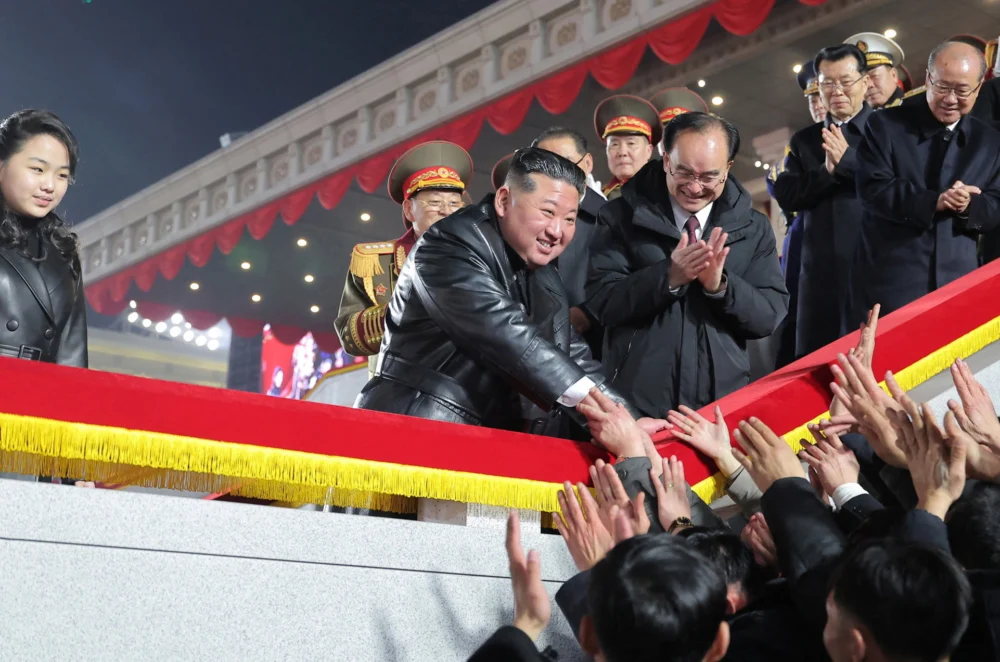
North Korean leader Kim Jong Un presided over a colossal military parade in the capital city of Pyongyang, marking the culmination of the once-in-five-years Workers’ Party Congress. The elaborate display of military might, a hallmark of the reclusive nation’s statecraft, showcased the regime’s continued commitment to its defense capabilities amidst international scrutiny and sanctions. This significant event also served as a platform for Kim Jong Un to articulate his regime’s foreign policy stance, signaling a hardening of positions towards South Korea while leaving a sliver of possibility for engagement with the United States under specific conditions.
Pyongyang’s Spectacle of Power: A Strategic Display
The sprawling military parade, held in the heart of Pyongyang, was more than just a ceremonial event; it was a carefully orchestrated demonstration of North Korea’s military prowess and the unwavering authority of its supreme leader. Thousands of soldiers, clad in immaculate uniforms, marched in precise unison, their rhythmic steps echoing through the city’s grand Kim Il Sung Square. The air was filled with the thunderous roar of heavy artillery and the distinctive engine sounds of advanced military hardware.
This year’s parade was particularly notable for the prominent presence of Kim Jong Un’s young daughter, Kim Ju Ae, who sat alongside her father, observing the proceedings. Her inclusion in such a high-profile state event has fueled speculation among analysts about her potential role in the future leadership of the Democratic People’s Republic of Korea (DPRK). The symbolism of her presence is undeniable, projecting an image of dynastic continuity and solidifying the Kim family’s grip on power.
The parade featured a diverse array of military hardware, including tanks, armored vehicles, and various missile systems. While specific details about newly developed weaponry are often scarce and subject to interpretation, the sheer scale and variety of equipment on display underscore North Korea’s persistent investment in its defense sector. This unwavering focus on military development, even in the face of severe economic challenges and international isolation, remains a central pillar of the regime’s survival strategy.
Geopolitical Messaging: A Dual Approach to International Relations
Kim Jong Un’s pronouncements during the event carried significant geopolitical weight, particularly his remarks concerning relations with South Korea and the United States. His declaration that North Korea would "shut the door" to dialogue with Seoul signals a deliberate escalation of tensions on the Korean Peninsula. This stance reflects a deepening distrust and a continued pursuit of policies that prioritize self-reliance and military deterrence over inter-Korean reconciliation.
Conversely, Kim Jong Un’s statement that cooperation with the United States is "possible if Washington gives due respect" offers a nuanced, albeit conditional, opening. This carefully worded assertion suggests that while Pyongyang remains committed to its strategic objectives, it is not entirely averse to diplomatic engagement, provided its perceived sovereignty and national interests are adequately acknowledged by Washington. This dual approach—firm rejection of engagement with the South coupled with a conditional openness to the U.S.—is a recurring theme in North Korea’s foreign policy playbook, aimed at managing international pressure and maximizing its leverage.
The Workers’ Party Congress: A Foundation for the Parade
The military parade was the grand finale of the eighth Workers’ Party of Korea (WPK) Congress, a pivotal five-yearly gathering that sets the direction for the nation’s domestic and foreign policy. During the congress, Kim Jong Un outlined ambitious goals for economic development, national defense, and ideological reinforcement. The parade served as a powerful visual affirmation of the congress’s resolutions, demonstrating the regime’s commitment to its stated objectives.
The WPK Congress typically involves extensive internal discussions and policy directives, often leading to personnel changes and reaffirmations of leadership principles. This year’s congress, held in early 2026, was no exception, reinforcing Kim Jong Un’s absolute authority and the party’s central role in all aspects of North Korean life. The parade, therefore, was not merely a show of military strength but a tangible manifestation of the party’s renewed mandate and its leader’s vision for the nation.
A History of Spectacle: Military Parades as Statecraft
Military parades have long been a cornerstone of North Korean statecraft, serving multiple strategic purposes. They are designed to project an image of national strength and unity to both domestic and international audiences. For the North Korean populace, these events serve as a potent reminder of the regime’s military might and its ability to defend the nation against perceived external threats, fostering a sense of security and loyalty.
Internationally, these parades are a clear signal to other nations, particularly the United States and its allies, about North Korea’s military capabilities and its unwavering resolve. They are often used to showcase advancements in missile technology and nuclear capabilities, contributing to the ongoing strategic calculus surrounding the Korean Peninsula. The timing and scale of these parades are carefully chosen to coincide with significant national anniversaries or political events, amplifying their impact.
The tradition of massive military parades in Pyongyang dates back to the nation’s founding, with each iteration often designed to impress and intimidate. Under Kim Jong Un’s leadership, these displays have become increasingly sophisticated and frequent, reflecting a deliberate strategy to leverage military power as a primary tool of diplomacy and national identity. The sheer scale and organization required for such events underscore the regime’s ability to mobilize its resources and personnel for state-driven objectives.
International Reactions and Implications
The massive military parade in Pyongyang has inevitably drawn widespread international attention and analysis. United Nations member states, particularly those directly involved in regional security like South Korea, Japan, and the United States, are closely monitoring North Korea’s military activities and rhetoric. The parade’s demonstration of advanced weaponry, including potentially new ballistic missile systems, raises concerns about the proliferation of such technologies and the potential for further regional instability.
South Korea’s Ministry of National Defense likely issued a statement acknowledging the parade and reaffirming its readiness to respond to any provocations. Analysts in Seoul and Washington would be dissecting the parade’s contents for any signs of new military doctrines or technological breakthroughs that could alter the strategic balance on the peninsula. The emphasis on self-reliance and deterrence, evident in Kim Jong Un’s statements, will likely be interpreted as a reinforcement of North Korea’s existing policy of prioritizing military development over denuclearization efforts.
The United States, a key player in regional security, will be assessing the implications of Kim Jong Un’s conditional offer for dialogue. While acknowledging the possibility of engagement, U.S. officials are likely to maintain a cautious stance, emphasizing that any meaningful dialogue must be accompanied by tangible steps towards denuclearization. The U.S. State Department may release a statement reiterating its commitment to working with allies to address North Korea’s nuclear program and its destabilizing activities.
Economic Strain and Military Focus: A Persistent Dilemma
North Korea’s continued emphasis on military parades and the development of its armed forces occurs against a backdrop of significant economic challenges. The nation has been subjected to stringent international sanctions for years, aimed at curbing its nuclear and missile programs. These sanctions have undoubtedly hampered its economic growth and limited its access to global markets.
The decision to allocate substantial resources to military displays, while potentially bolstering national morale and projecting strength, also raises questions about the allocation of scarce resources. Critics often point to the stark contrast between the military spectacle and the reported living conditions of ordinary North Koreans, highlighting the regime’s priorities. The ability of North Korea to sustain such elaborate military displays, even under economic duress, underscores the regime’s centralized control over its economy and its unwavering commitment to its defense objectives.
The juxtaposition of economic hardship and military extravagance is a recurring theme in analyses of North Korea. It reflects the regime’s belief that military power is essential for its survival and its ability to resist external pressure. The ongoing cycle of sanctions, military provocations, and diplomatic stalemate remains a defining characteristic of the North Korean situation, with significant implications for regional and global security.
The Future of Inter-Korean Relations and U.S.-DPRK Diplomacy
Kim Jong Un’s firm stance against engaging with South Korea without preconditions suggests a continued period of strained inter-Korean relations. The prospect of renewed dialogue or reconciliation appears distant, with both sides largely entrenched in their respective positions. North Korea’s focus on military self-sufficiency and its perceived security threats from the South and its allies will likely dictate its approach to inter-Korean affairs for the foreseeable future.
The conditional offer for U.S.-DPRK cooperation, however, presents a potential, albeit narrow, avenue for diplomatic engagement. The key phrase, "if Washington gives due respect," implies that North Korea expects the United States to acknowledge its status as a nuclear power and to refrain from what it perceives as hostile policies. For any meaningful dialogue to occur, both sides would need to find common ground and make concessions, a challenging prospect given the deep-seated mistrust and divergent strategic interests.
Analysts will be closely watching for any further signals or actions from Pyongyang that might clarify its intentions regarding engagement with the United States. The success or failure of any future diplomatic overtures will likely hinge on the willingness of both sides to move beyond their established positions and to engage in substantive, rather than purely symbolic, negotiations. The outcome of these diplomatic maneuvers will have profound implications for the stability and security of Northeast Asia.