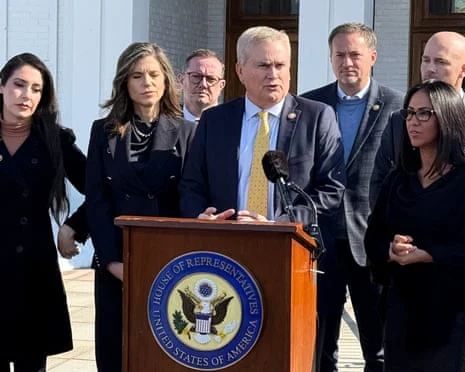
Former Secretary of State Hillary Clinton appeared before the House Oversight Committee on Thursday for a closed-door deposition, testifying under oath that she possesses no knowledge regarding the criminal enterprise of the late sex offender Jeffrey Epstein or his convicted accomplice, Ghislaine Maxwell. The high-stakes proceedings, held at the Chappaqua Performing Arts Center in New York, were marked by sharp partisan exchanges and an immediate disruption after a confidential photograph of the hearing was leaked to social media.
In an opening statement released to the public as the hearing commenced, Clinton sought to distance herself and her husband, former President Bill Clinton, from the decades-long investigation into Epstein’s sex trafficking ring. Clinton asserted that she had never encountered Epstein personally, nor had she ever visited his private island, his various homes, or his offices. She categorized the committee’s decision to subpoena her as an institutional failure rooted in political theater rather than a genuine pursuit of justice for victims.
Hillary Clinton Testifies on Epstein’s Criminal Activities and Denies Direct Ties
The core of Clinton’s testimony focused on a categorical denial of any involvement with the disgraced financier. "I do not recall ever encountering Mr. Epstein," Clinton stated in her sworn remarks. "I never flew on his plane or visited his island, homes or offices. I have nothing to add to that." This statement aims to address years of public speculation regarding the proximity of the Clinton family to Epstein, who was found dead in a New York jail cell in 2019.
Clinton informed the committee that she had already submitted a sworn statement on January 13, detailing her lack of knowledge regarding the criminal activities of Epstein or Maxwell. She expressed horror at the crimes revealed during the various federal investigations and trials, aligning herself with the "decent people" who have been shocked by the scale of the abuse. However, she remained firm that the House Oversight Committee was operating on a false assumption that she held "inside information" on the matter.
The former Democratic presidential nominee used the platform to pivot toward the conduct of the committee itself. She argued that the investigation, led by Republican Chairman James Comer, lacked transparency and was being conducted with a clear partisan bias. According to Clinton, the proceedings were designed to protect specific political figures while distracting the public from other facets of the Epstein files that involve current government officials.
Partisan Clashes and the Demand for Donald Trump’s Testimony
As Hillary Clinton testifies on Epstein’s criminal activities, she has repeatedly called for the committee to expand its scope to include the current president. In her opening statement, she challenged the Republican majority to demand testimony from Donald Trump under oath. She cited reports that the Department of Justice had previously withheld FBI interviews in which a survivor accused Trump of heinous crimes committed decades ago.
"If this Committee is serious about learning the truth about Epstein’s trafficking crimes, it would not rely on press gaggles to get answers from our current president on his involvement," Clinton said. She noted that Trump’s name appears "tens of thousands of times" within the voluminous Epstein files and suggested that a truly non-partisan committee would prioritize his questioning over "fishing expeditions" into her own past.

Representative Robert Garcia, the ranking Democrat on the panel, echoed these sentiments. He argued that the precedent being set by the depositions of the Clintons should be applied equally to the sitting president. Garcia emphasized that survivors deserve answers from every powerful individual named in the files, regardless of their current political standing or office.
Procedural Disruptions and the Leak of Confidential Hearing Photos
The scheduled long day of testimony faced an abrupt interruption when a photograph of the closed-door proceedings appeared on social media. The image was reportedly shared by conservative commentator Benny Johnson, who claimed the photo was provided by Representative Lauren Boebert, a member of the committee. The breach of House rules led to a temporary pause in the deposition as committee members and legal counsel scrambled to address the violation.
Nick Merrill, a long-time adviser to Clinton, spoke to reporters outside the venue, confirming that the hearing had gone off the record. "It’s against chamber rules that were read at the top of the meeting," Merrill said. The incident highlighted the volatile atmosphere surrounding the probe, which the Clintons have previously described as a "kangaroo court" and "pure politics."
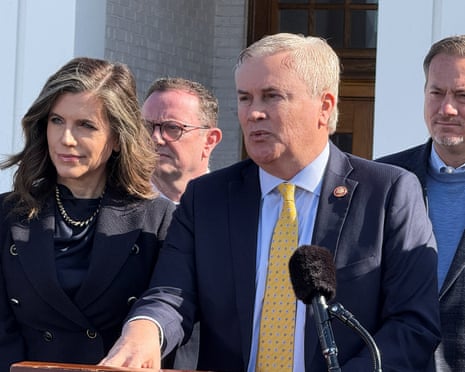
Chairman James Comer remained undeterred by the delay, informing the press that he intends to release the full video and transcript of the deposition once it has been reviewed for errors and approved. Comer predicted that Clinton’s interview would be "long" and that her husband’s testimony, scheduled for Friday, would likely be "even longer."
The Scope of the House Oversight Committee’s Investigation
Chairman Comer has defended the necessity of the probe, insisting that it is a bipartisan effort aimed at government accountability. He noted that the committee spent six months attempting to secure the Clintons’ voluntary cooperation before moving to hold them in contempt of Congress. According to Comer, a majority of Democrats on the committee either supported the move or voted "present," which he cited as evidence that the investigation is a serious, non-partisan endeavor.
The committee’s interest in the Clintons stems from their documented relationship with Ghislaine Maxwell. Comer pointed out that Maxwell was a guest at Chelsea Clinton’s wedding and that Epstein had provided financial support to various Clinton-related initiatives in the past. While Comer acknowledged that these actions are not inherently illegal, he argued they raise significant questions that the public has a right to see answered under oath.
Beyond the Clintons, the committee is also looking into other high-profile figures. Comer mentioned the possibility of questioning Commerce Secretary Howard Lutnick, who has admitted to having lunch with Epstein on his private island. The chairman also highlighted that the committee has already interviewed figures from the previous Trump administration, including former Labor Secretary Alex Acosta and former Attorney General Bill Barr, to understand the systemic failures that allowed Epstein to secure a "sweetheart deal" in Florida in 2008.
Broader Political Context and the Role of Kash Patel
The hearing occurs against a backdrop of significant upheaval within the federal government. Earlier this week, reports surfaced that the FBI had dismissed at least 10 employees who were connected to the investigation into Donald Trump’s handling of classified documents. These ousters were reportedly ordered by the new FBI Director, Kash Patel, who has been a vocal critic of the agency’s prior conduct.
Patel has claimed that the FBI’s previous actions constituted government overreach by the Biden administration. The dismissal of these agents has fueled concerns among Democrats that the current administration is using federal law enforcement to settle political scores. Clinton alluded to this climate in her testimony, describing the Oversight Committee’s focus on her as an attempt to "cover up" for the president’s own past actions and current administrative maneuvers.
The intersection of the Epstein investigation with these FBI firings has created a complex political landscape where both parties accuse the other of weaponizing the legal system. For Republicans, the goal is to uncover whether the Clintons received preferential treatment or held undisclosed knowledge of Epstein’s network. For Democrats, the focus remains on why certain records involving Trump were allegedly withheld and whether the current probe is a diversionary tactic.
Impact on Victims and the Quest for Accountability
Despite the political maneuvering, the underlying focus of the investigation remains the survivors of Jeffrey Epstein’s sex trafficking operation. Clinton expressed her heartbreak and fury on behalf of the victims, arguing that the "institutional failure" of the government has prevented them from receiving true justice. She urged the committee to move beyond "grandstanding" and to use its power to seek out the truth regarding how the system allowed Epstein to operate for so long.
The public interest in the Epstein files remains high, as the documents continue to reveal the names of powerful men in finance, politics, and academia who moved within Epstein’s orbit. The demand for transparency has led to calls for the full, unredacted release of all files, a move that Clinton supported in her statement. She argued that redactions should only exist to protect the identities of survivors, not to shield "powerful men and political allies."
As the legal and political battles continue, the testimonies of Hillary and Bill Clinton represent a significant chapter in the ongoing effort to close the book on the Epstein saga. Whether these depositions provide new evidence or simply reinforce existing partisan divides remains to be seen.
Conclusion and Next Steps for the Committee
The House Oversight Committee is expected to resume its questioning of Hillary Clinton following the resolution of the photo leak incident. Following her testimony, the focus will shift to former President Bill Clinton, whose history of flying on Epstein’s private plane, the "Lolita Express," has been a central point of contention for years. While the former president has denied any wrongdoing, his presence in the recently released files has ensured that his testimony will be among the most scrutinized events of the congressional calendar.
As Congress reconvenes next week, the political fallout from these hearings is expected to influence several other legislative matters, including a bipartisan war powers resolution regarding Iran. The tension between the executive branch and congressional oversight panels continues to grow, with the Epstein investigation serving as a primary flashpoint in the struggle for transparency and political dominance in the 2026 landscape.