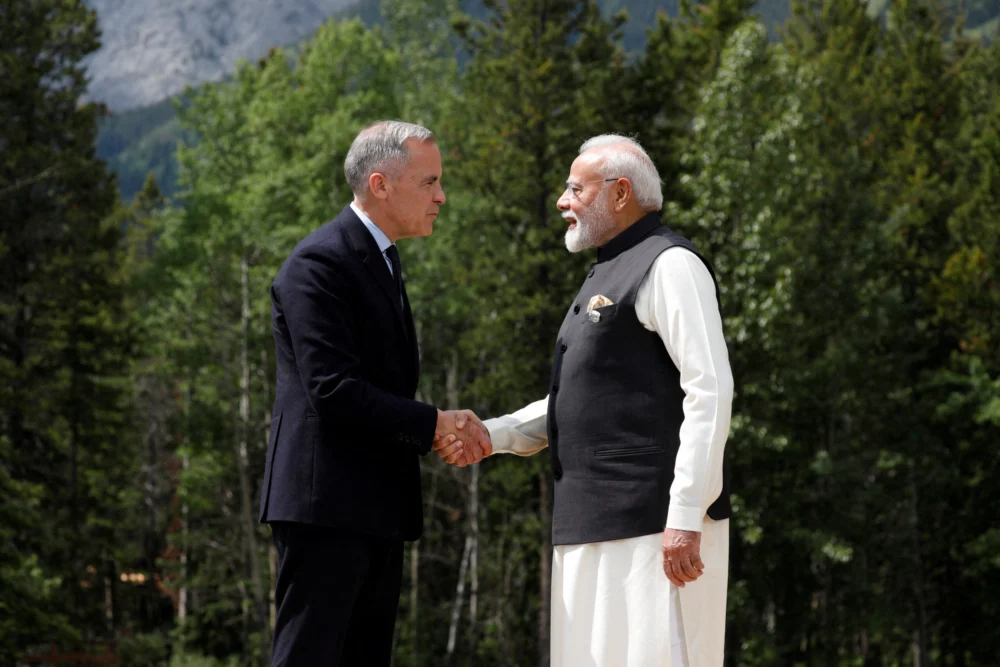
Canadian Prime Minister Mark Carney has arrived in India on a pivotal visit aimed at deepening bilateral relations and diversifying Canada’s economic partnerships, a move underscored by ongoing trade friction with the United States. Carney’s delegation landed in the bustling financial center of Mumbai, where he is slated to engage with prominent business leaders. The core of the visit will unfold in New Delhi on Monday, with a high-stakes meeting scheduled alongside Indian Prime Minister Narendra Modi. Discussions are expected to encompass a broad spectrum of collaborative opportunities, including advancements in trade, energy security, technological innovation, artificial intelligence, and defense cooperation.
India’s Ministry of External Affairs has characterized the Prime Minister’s trip as a "significant step" toward fortifying the burgeoning India-Canada partnership. Randhir Jaiswal, the spokesperson for India’s foreign ministry, emphasized the foundational strengths of the relationship on the social media platform X, stating, "The India–Canada partnership is anchored in shared democratic values, strong people-to-people ties, and expanding cooperation across diverse sectors." This sentiment highlights a shared vision for a robust and multifaceted engagement between the two nations.
The strategic importance of this visit is amplified by Canada’s recent economic recalibrations. Prime Minister Carney has publicly articulated a clear objective to significantly broaden Canada’s trade horizons beyond its North American neighbor. This strategic pivot comes in the wake of considerable trade tensions with the United States, particularly following the imposition of substantial tariffs by the Trump administration on key Canadian exports such as steel, aluminum, and automotive components. In response to these economic pressures, Prime Minister Carney has outlined an ambitious goal to double Canada’s non-U.S. exports over the next decade, positioning India as a crucial partner in achieving this target.
Deepening Economic Ties and Trade Aspirations
The prospect of enhanced economic cooperation between Canada and India has been gaining momentum. Last year, both nations agreed to revitalize negotiations for a comprehensive free-trade agreement, a development that signals a renewed commitment to unlocking greater commercial potential. Prime Minister Carney has previously expressed his ambition to more than double the bilateral trade volume with India by the year 2030, setting a clear annual target of $51 billion. This ambitious objective reflects a long-term vision for economic integration and mutual prosperity.
From India’s perspective, the visit aligns with its broader strategy to attract increased foreign investment. Canadian pension and wealth funds have already demonstrated a significant commitment to the Indian market, with investments reportedly reaching $73 billion. This substantial financial engagement underscores the trust and confidence that Canadian investors have in India’s economic trajectory. Furthermore, India, a nation with a voracious appetite for energy and recognized as the world’s fastest-growing major economy, is actively seeking international support for its ambitious plans to expand its nuclear power capacity. Canada, with its advanced nuclear technology and expertise, is seen as a potential key partner in this critical endeavor.
Navigating Diplomatic Complexities and Resetting Relations
Beyond the economic imperatives, Prime Minister Carney’s visit carries the significant weight of diplomatic reconciliation. A crucial objective of the trip is to address and reset the strained bilateral relationship between Canada and India, which experienced a severe downturn following allegations concerning deadly attacks against Sikh activists on Canadian soil. The Canadian government, under the previous administration of Prime Minister Justin Trudeau, accused the Indian government of orchestrating the 2023 killing of Hardeep Singh Nijjar, a naturalized Canadian citizen and prominent advocate for an independent Sikh state, Khalistan.
These serious allegations have been consistently and vehemently denied by India, leading to a dramatic deterioration in diplomatic ties. In 2024, both nations responded by expelling a number of high-ranking diplomats, escalating the diplomatic crisis. When questioned by reporters about whether Canadian concerns regarding transnational repression would be a central topic of discussion in New Delhi, Canadian Foreign Minister Anita Anand affirmed, "That is always at the forefront of our minds." This statement indicates that while economic and trade objectives are paramount, the sensitive issue of allegations of foreign interference and repression will undoubtedly be a significant consideration during the high-level talks.
Broader Geopolitical and Economic Landscape
Prime Minister Carney’s itinerary extends beyond India, reflecting Canada’s broader strategy of diversifying its international partnerships. Following his engagements in India, Carney is scheduled to visit Australia. In Canberra, he will address the Australian Parliament and engage in discussions focused on strengthening military, trade, and defense linkages. This leg of the tour underscores Canada’s commitment to reinforcing its alliances and security partnerships within the Indo-Pacific region.
The journey will then take Prime Minister Carney to Japan, where he will meet with Prime Minister Sanae Takaichi en route back to Ottawa. The agenda for this meeting is expected to center on enhancing bilateral trade in critical sectors such as automobiles, energy, and vital minerals. These discussions in Japan further highlight Canada’s proactive approach to securing its economic future by building robust relationships with key global players in strategically important industries.
The current geopolitical climate, marked by evolving trade dynamics and increasing global interconnectedness, necessitates a proactive and multifaceted foreign policy for nations like Canada. The visit to India, therefore, represents more than just an economic mission; it is a strategic maneuver to build resilience, forge new alliances, and secure Canada’s position on the global stage amidst a complex and ever-changing international landscape. The success of these diplomatic and economic initiatives will have far-reaching implications for Canada’s long-term prosperity and its standing among global powers.