BARCELONA — Motorola has officially transitioned its latest flagship, the Motorola Razr Fold, from a teaser at CES to a fully detailed competitor in the premium smartphone market during the 2026 Mobile World Congress. The announcement marks a significant pivot for the brand, which has historically focused on the clamshell "flip" form factor but is now aggressively challenging the dominant players in the book-style foldable segment. By releasing comprehensive technical specifications and hardware capabilities, Motorola is positioning the device as a high-performance alternative to established offerings from Samsung and Google.
The Motorola Razr Fold represents the company’s most ambitious engineering feat to date, integrating top-tier silicon with a display architecture that exceeds current industry standards for size and thinness. As the mobile industry gathers in Barcelona to discuss the future of connectivity and hardware, Motorola’s presentation centered on the intersection of generative artificial intelligence and high-density hardware. The company confirmed that the device is built to serve as both a productivity tool and a high-end media consumption platform, aiming to capture a larger share of the professional and enthusiast demographics.
Central to the performance of the Motorola Razr Fold is the integration of Qualcomm’s Snapdragon 8 Gen 5 chipset. This processor, designed with a heavy emphasis on neural processing units (NPUs), is tasked with driving the device’s proprietary "moto ai" suite. Motorola executives noted that the Snapdragon 8 Gen 5 allows for on-device processing of complex AI tasks, reducing the reliance on cloud-based servers and improving user privacy. The inclusion of up to 16GB of LPDDR5X RAM and 1TB of UFS 4.0 storage further solidifies its status as a flagship-tier workstation that can handle intensive multitasking without thermal throttling.
Technical Specifications and the Motorola Razr Fold Performance
The decision to utilize the Snapdragon 8 Gen 5 reflects a broader trend in the 2026 smartphone market, where raw processing power is increasingly dedicated to background AI optimizations. For the Motorola Razr Fold, this means smarter battery management, real-time language translation, and advanced photo editing features that occur instantaneously. Industry analysts suggest that by opting for the highest available tier of Qualcomm’s silicon, Motorola is attempting to future-proof the device against the rapidly evolving demands of mobile software.

Battery life has long been a point of contention for foldable smartphone users, as the mechanical requirements of a hinge often limit the space available for large cells. Motorola claims to have solved this through a high-density 6,000mAh battery housed within the Motorola Razr Fold. This capacity is notably higher than many of its competitors, which typically hover between 4,400mAh and 5,000mAh. Furthermore, the company introduced a rapid charging protocol that provides 12 hours of operational life with just 12 minutes of wired charging, addressing one of the primary pain points for "power users" who remain mobile throughout the day.
The endurance of the Motorola Razr Fold builds upon the success of the previous year’s Motorola Razr Ultra, which received critical acclaim for its longevity. By increasing the battery capacity while simultaneously reducing the device’s physical footprint, Motorola is leveraging new battery chemistries that allow for greater energy density. This engineering choice is critical for a device that features two high-resolution, high-refresh-rate displays that naturally consume significant amounts of power.
Engineering the Motorola Razr Fold Display and Design
In the foldable market, the display is the primary differentiator, and the Motorola Razr Fold introduces dimensions that reset the competitive landscape. The device features a 6.6-inch external cover display, which is large enough to function as a standard smartphone when the device is closed. However, the centerpiece is the internal folding screen, which measures 8.1 inches when fully deployed. This puts the Motorola Razr Fold in direct competition with small tablets, offering more screen real estate than the Samsung Galaxy Z Fold 7 or the Google Pixel 10 Pro Fold.
Despite the massive screen size, Motorola has achieved a remarkably slim profile. When unfolded, the Motorola Razr Fold measures only 4.6mm in thickness, expanding to 9.9mm when closed. Achieving a sub-10mm thickness while folded is considered a major milestone in foldable engineering, as it allows the device to feel more like a traditional smartphone in a pocket. The hinge mechanism has also been redesigned to minimize the visible crease on the internal display, a perennial challenge for the industry that Motorola claims to have mitigated through a new "teardrop" folding structure.
The 8.1-inch internal panel utilizes LTPO OLED technology, allowing for a variable refresh rate that can scale from 1Hz to 144Hz depending on the content being viewed. This flexibility is essential for balancing the fluid motion required for gaming with the power-saving needs of static text. The external 6.6-inch display also features high-end specifications, ensuring that users do not feel a "downgrade" in visual quality when using the phone in its folded state.

Advanced Imaging and the Motorola Razr Fold Camera System
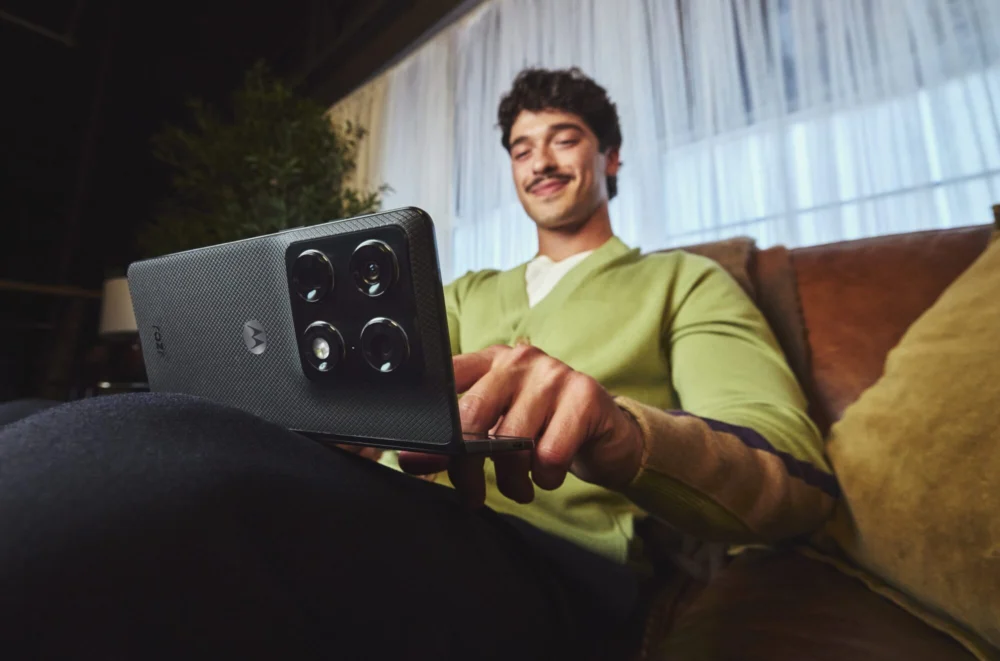
Motorola has historically struggled to match the photographic prowess of Apple or Google, but the Motorola Razr Fold aims to close that gap with a sophisticated triple-camera array. The primary sensor is a 50MP Sony Lytia 828, a high-end component known for its exceptional light-gathering capabilities and dynamic range. It is supported by a 50MP Sony Lytia 600 telephoto lens and a 50MP ultrawide lens, creating a consistent 50MP experience across all three focal lengths. This "triple-50" approach ensures that users do not lose detail when switching between different zoom levels or perspectives.
The camera system on the Motorola Razr Fold is designed to outperform the Google Pixel 10 Pro Fold, which received mixed reviews for its hardware choices. By utilizing the Sony Lytia series, Motorola is leaning into hardware-level image stabilization and improved low-light performance. The device also features a 32MP internal selfie camera for video conferencing and a 20MP external selfie camera, providing high-resolution options regardless of how the device is being held. The "moto ai" software further enhances these images through semantic segmentation, which identifies different elements in a frame to apply optimized processing to skin tones, skies, and foliage.
Market Positioning and Global Competition
The arrival of the Motorola Razr Fold comes at a time of intense speculation regarding the entry of other major players into the foldable space. Rumors of an "iPhone Fold" continue to circulate, with many expecting Apple to debut its first foldable device later this year. Simultaneously, Samsung is expected to refresh its lineup with the Galaxy Z Fold 8, maintaining its position as the market leader. By launching the Motorola Razr Fold with superior battery and display specs now, Motorola is attempting to capture the "early adopter" and "prosumer" segments before its rivals can respond.
The competitive landscape in 2026 is defined by a shift away from novelty and toward utility. Early foldables were often criticized for being fragile or underpowered, but the Motorola Razr Fold is marketed as a "no-compromise" device. Its inclusion of the Moto Pen Ultra, a smart stylus, indicates that Motorola is targeting the productivity market previously dominated by Samsung’s Note series and the subsequent Ultra/Fold lines. The stylus integration allows for precision input on the 8.1-inch canvas, making it a viable tool for digital artists and corporate professionals.
In terms of pricing and availability, Motorola has been cautious. While a specific North American launch date has not been set, the company confirmed that the Motorola Razr Fold will be released in the "coming months." In Europe, the device will be sold as part of a premium bundle that includes the Moto Pen Ultra for €1,999. This pricing places it at the very top of the consumer electronics market, reflecting the high cost of the specialized components required for a device of this caliber.

The Future of the Motorola Razr Fold and Industry Impact
The broader implications of the Motorola Razr Fold launch extend beyond just one company’s bottom line. It signals a maturation of the foldable supply chain, where components like 8-inch flexible OLEDs and 6,000mAh high-density batteries are now viable for mass production. As Motorola pushes the boundaries of how thin and powerful these devices can be, it forces competitors to accelerate their own research and development cycles.
Consumer interest in foldables has grown steadily, but mass adoption remains dependent on durability and software optimization. Motorola has addressed the former with an improved hinge and ultra-thin glass (UTG) coatings, and the latter through "moto ai" enhancements that make better use of the large internal screen. Features such as split-screen multitasking, "tent mode" for media viewing, and seamless hand-offs between the external and internal displays are all designed to justify the premium price tag of the Motorola Razr Fold.
As the tech world looks toward the second half of 2026, the Motorola Razr Fold stands as a benchmark for what is possible in the mobile space. Its combination of a tablet-sized screen, flagship-grade cameras, and a massive battery challenges the notion that foldables must always sacrifice one feature for another. Whether this will be enough to unseat Samsung or stave off the eventual entry of Apple remains to be seen, but for now, Motorola has firmly re-established itself as a pioneer in the hardware revolution.