HBO Max’s new American history-centered sketch comedy series, Life, Larry and the Pursuit of Unhappiness, has quickly become a star-studded affair, attracting an extensive roster of celebrity guest stars and cameos since its premiere. Spearheaded by comedic icon Larry David and executive produced by former President Barack Obama and Michelle Obama’s Higher Ground Productions, the show features dozens of notable personalities embodying historical figures or engaging in comedic sketches across various eras of American history. This ambitious project marks David’s return to HBO Max following the conclusion of his acclaimed series Curb Your Enthusiasm, bringing his signature brand of observational humor and social awkwardness to pivotal moments in the nation’s past.
The series distinguishes itself not merely by the presence of a few high-profile guests but by the sheer volume and caliber of talent appearing in each episode. Viewers have seen a broad spectrum of actors, from David’s former Curb Your Enthusiasm co-stars to major Hollywood names such as Samuel L. Jackson and Lin-Manuel Miranda. The show also features television veterans like Jerry Seinfeld and Jon Hamm, donning period-appropriate wigs and costumes to bring historical scenarios to life. Notably, the series includes the final screen performance of the late Rob Reiner, adding a poignant dimension to its celebrity ensemble. The consistent influx of prominent figures underscores the show’s appeal and its unique position in the comedic landscape, with each appearance contributing to the narrative and comedic impact.
A Deeper Dive into the Premieres: Episode-by-Episode Guest Roster
The show’s format typically involves David interacting with historical figures, often playing a disruptive or curmudgeonly character who injects modern sensibilities into past events. This framework allows for a flexible and varied use of its celebrity guests, who often play both well-known historical personalities and fictional characters caught in the historical crosscurrents.
Episode 1: "Livingston"
The premiere episode, "Livingston," immediately set the tone for the series’ star power. It opened with an appearance by executive producer Barack Obama, playing himself, who offered a self-deprecating introduction to the show while celebrating the nation’s semiquincentennial. His cameo included lighthearted jabs at David, establishing the comedic relationship that permeates the series. Following this, Samuel L. Jackson provided the opening narration, lending his distinct gravitas to the historical context, a role he reprises in subsequent episodes.
The first sketch transported viewers to the drafting of the Declaration of Independence, featuring a comedic clash between founding fathers. Henry Winkler portrayed John Hancock, Chris Parnell appeared as Benjamin Franklin, and Alan Tudyk took on the role of Thomas Jefferson. Larry David’s character, Robert Livingston, attempted to insert anachronistic grievances into the foundational document, leading to humorous disagreements. The episode continued with David portraying Alexander Graham Bell, struggling to introduce the telephone to a demanding crowd of revelers. This segment showcased Richard Kind as Thomas Watson, alongside sitcom mainstays Alison Becker (Parks and Recreation), Mary Sohn (A.P. Bio), and Rodney J. Hobbs (The Office, Modern Family) as members of the impatient audience.
A subsequent sketch delved into WWI trench warfare, where David played a cowardly soldier under the command of a no-nonsense sergeant, portrayed by Michael Chiklis of The Shield. His fellow soldiers included Comedy Bang Bang and Curb Your Enthusiasm alumnus Mike Castle and Jake Reiner, son of the late Rob Reiner. The premiere concluded with a powerful yet humorous segment featuring Jurnee Smollett as civil rights icon Rosa Parks, enduring the irritating presence of David’s character as a fellow bus passenger.
Episode 2: "Farewell"
"Farewell" commenced with Samuel L. Jackson resuming his role as The Narrator. A highly anticipated reunion between Seinfeld creators Larry David and Jerry Seinfeld marked a significant highlight. The duo portrayed legendary explorers Meriwether Lewis and William Clark, respectively, on their expedition to map the Louisiana Territory. The comedic premise revolved around their expedition being an overly convenient excuse for two drinking buddies to embark on a multi-year journey, much to the chagrin of Mavis Lewis, Meriwether Lewis’s long-suffering wife, played by Rita Wilson.
The episode then shifted to a satirical take on the Electoral College, with David portraying Samuel Tilden, who famously won the popular vote in the 1876 presidential election but lost the presidency. His ranting was supported by aides played by Curb alum Matthew Jones and Rich Fulcher of The Mighty Boosh. A Great Depression-era segment featured David attempting to cut a bread line for soup by exploiting the grief of Gloria, a widow portrayed by Kaley Cuoco. Larry Wilmore, formerly of late-night television, and Colton Dunn (Superstore, Parks and Recreation) also appeared in this scene.
The episode culminated in a much-discussed segment featuring the final screen appearance of Rob Reiner. He portrayed George Washington, discussing term limits for the U.S. presidency before a gathered crowd. This scene served as a setup for David’s townsman character to deliver thinly veiled criticisms of former President Donald Trump, without explicitly naming him. Jimmy Kimmel also made a memorable cameo as a crowd member, adding a meta-commentary layer given his own public feuds with Trump.
Episode 3: "McCarthy"
Samuel L. Jackson once again narrated the third episode, "McCarthy." The episode opened with David’s character disrupting the Boston Tea Party. Lin-Manuel Miranda, celebrated for his Broadway role in Hamilton, delivered a scene-stealing performance as one of the Tea Party ringleaders, a clever piece of stunt casting. Comedian Lou DiMaggio also appeared as a Colonial Man, playing off David’s character being excluded from the rebellion.
Later, J.B. Smoove’s character, Jonesey Dean Sharpe, made a memorable stop along the Underground Railroad, exasperating David’s host character with his incessant demands and the unexpected arrival of his friends. The episode also featured a sketch where David played a fictional, less-than-heroic Wright sibling, squabbling with his wife, played by Isla Fisher, over his butter-churning skills. This scene contrasted with Jon Hamm and Sean Hayes portraying the actual Orville and Wilbur Wright, diligently preparing for their historic first flight.
The most talked-about segment of the episode saw Larry David himself taking on the role of Senator Joseph McCarthy. This powerful scene featured Kids in the Hall alum Michael McKean as attorney Joseph Welch, delivering his iconic "Have you no decency, sir?" rebuttal. Rob Huebel (Human Giant, Transparent) also appeared as a senator moderating one of McCarthy’s infamous hearings.
Episode 4: "Deepthroat"
"Deepthroat" continued the tradition of historical satire, with Samuel L. Jackson providing the narration. The episode began by giving the Watergate scandal the Larry David treatment. David portrayed "Deep Throat," the anonymous source who leaked details of the hotel break-in to Washington Post reporters. In David’s comedic rendition, however, his Deep Throat provided only trivial nonsense to Beck Bennett’s (of SNL fame) Bob Woodward during their clandestine parking lot meeting.
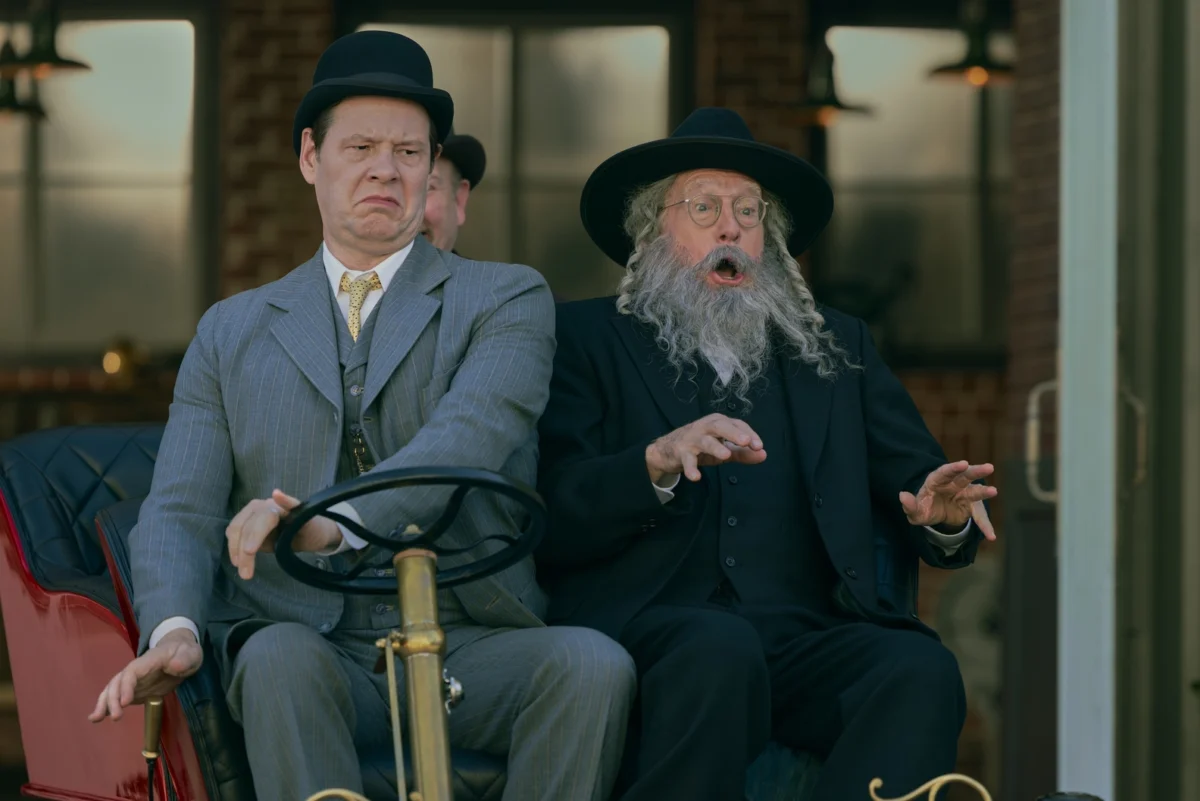
The next sketch featured Ike Barinholtz as the notoriously antisemitic Henry Ford, visibly displeased while showcasing his new vehicle to David’s rabbi character. David then embodied President James Buchanan, depicted as a lecherous figure hitting on every passing woman at a party where he introduced the concept of passed appetizers. Jordana Brewster (Fast & Furious, The Other Two) and Katie Aselton (The League) were among the women who crossed Buchanan’s path, while Diallo Riddle (Marlon, South Side) played his assistant, John Appleton.
The episode concluded with a widely discussed segment that revived an old Larry David stand-up bit. David played Dora Salk, the overly proud mother of Jonas Salk, bragging about her son’s polio vaccine discovery to her neighbor Evelyn, played by Judy Gold. The sketch took a pointed turn as a young man named Bobby, played by Gregg “Jeep” Perrie, appeared to express skepticism, declaring, "That vaccine’s gonna kill people. It’s gonna give them heart attacks!" This segment served as a clear parody of contemporary vaccine hesitancy and conspiracy theories, directly mocking Robert F. Kennedy Jr., whose former wife, Cheryl Hines, was David’s co-star on Curb Your Enthusiasm.
Analysis and Broader Implications of the Celebrity Ensemble
The continuous influx of high-profile guest stars and cameos is a testament to Larry David’s enduring appeal and the unique comedic premise of Life, Larry and the Pursuit of Unhappiness. By blending historical reenactment with David’s signature brand of social discomfort and irascibility, the show creates a platform that attracts both seasoned comedians and dramatic actors looking to explore their comedic chops. The show’s ability to draw such talent highlights its perceived quality and the opportunity it offers for actors to engage in distinct, often self-aware, performances within a historically rich, yet comically irreverent, framework.
The series successfully navigates the challenge of using historical figures for comedic effect, often juxtaposing modern sensibilities and David’s neurotic tendencies against the backdrop of significant historical moments. This approach not only provides ample comedic opportunities but also offers a subtle form of social commentary, using the past to reflect on contemporary issues, as seen in the segments on the Electoral College, vaccine skepticism, and political leadership.
Impact and Cultural Footprint
Life, Larry and the Pursuit of Unhappiness has rapidly generated significant buzz, particularly regarding its impressive cast. The show’s ability to pull together such a diverse and accomplished group of actors for what are essentially sketch roles speaks volumes about its standing within the entertainment industry. This strategy has proven effective in attracting viewers, leveraging the star power of its guests to enhance its profile on HBO Max.
The series airs Friday nights at 9 p.m. on HBO and is available for streaming on HBO Max, positioning it as a key offering in the platform’s content library. Its blend of history, comedy, and celebrity has carved out a unique niche, appealing to fans of David’s previous work while also drawing in new audiences interested in its innovative approach to American history. The show’s continued success and its capacity to attract such a high caliber of talent suggest a bright future, solidifying its place as a distinctive and culturally relevant comedic production.