John Leguizamo’s transformative performance as Eumaeus in Christopher Nolan’s highly anticipated epic, The Odyssey, marks a profound turning point in the actor’s four-decade career, allowing him to explore unprecedented vulnerability and break free from the typecasting that has often defined his roles. The Colombian-American actor, known for his dynamic range across film, television, and stage, has described the experience as a personal zenith, culminating in a portrayal that serves as the emotional heartbeat of Nolan’s ambitious cinematic adaptation of Homer’s ancient tale.
A Distinguished Career and Persistent Typecasting
Leguizamo has built an extensive and celebrated career over 40 years, showcasing his versatility in a diverse array of projects. His filmography includes notable collaborations with acclaimed directors such as Baz Luhrmann, appearing in vibrant features like Romeo + Juliet and Moulin Rouge!, and Jon Favreau, with roles in Chef and the hit Disney+ series The Mandalorian. Beyond the screen, Leguizamo has garnered significant critical acclaim and awards for his solo stage performances, including Emmy and Tony wins for shows like Latin History for Morons and Freak. These one-man productions have often allowed him to delve into deeply personal narratives and showcase a dramatic depth frequently overlooked by mainstream Hollywood.
Despite his extensive resume and accolades, Leguizamo has frequently expressed frustration over the industry’s tendency to pigeonhole him into stereotypical roles, particularly as a Latin man. He often found himself cast as "the villain or the aggressor or a perp," a limitation he believes prevented him from fully demonstrating his expansive acting capabilities on the big screen. This persistent challenge highlights a broader issue within Hollywood regarding representation and the narrow confines often imposed on actors of color.
Christopher Nolan’s Vision: A Transformative Casting
It was acclaimed director Christopher Nolan, known for his intricate narratives and grand cinematic scale, who envisioned Leguizamo in a radically different light for his interpretation of The Odyssey. Nolan sought out Leguizamo for one of the film’s most significant roles: Eumaeus, the loyal and long-suffering swineherd of Odysseus (portrayed by Matt Damon). Eumaeus’s character is central to the narrative, grappling with profound grief and uncertainty over his master’s prolonged absence while steadfastly upholding his duties.
Eumaeus’s role extends beyond mere servitude; he becomes a strategic counselor to Odysseus’s son, Telemachus (Tom Holland), guiding him through the treacherous political landscape of Ithaca. He also cunningly maneuvers to protect Odysseus’s wife, Penelope (Anne Hathaway), and their household from the chaos and avarice infiltrating their home. Leguizamo’s portrayal of Eumaeus emerges as the film’s emotional core, particularly during Odysseus’s disguised return, where Eumaeus’s suppressed emotions finally surface in a powerful, heartbreaking display. This delicate and moving performance allowed Leguizamo to embody a character he described as feeling "very close" to himself, a rare opportunity he had long awaited in his screen career.
The Emotional Core: Finding Himself in Eumaeus
Leguizamo expressed genuine surprise at Nolan’s decision to cast him, acknowledging that even his wife questioned the unusual choice. He recalled thinking, "I don’t know either!" when asked why Nolan would see him for such a role, given his history of typecasting. However, the actor did not question Nolan’s judgment during their initial two-hour lunch meeting, where the director shared intimate details of his life and aspirations, fostering an unexpected connection.

Nolan’s pitch for Eumaeus resonated deeply with Leguizamo, describing the character as "the most loyal character in Western literature." Loyalty, for Leguizamo, is a paramount virtue, one he identifies strongly with both personally and culturally, noting its significant importance within Latin culture. This intrinsic connection to Eumaeus’s core trait allowed Leguizamo to access the character’s emotional landscape with remarkable ease. He noted that playing someone closer to his true self facilitated his choices and emotional responses, offering a refreshing departure from the challenges of portraying characters vastly different from him.
The process of embodying Eumaeus became intensely personal. Leguizamo described how the emotional demands of the role, particularly Eumaeus’s breakdown upon Odysseus’s return, tapped into an unprecedented level of vulnerability. "It was so intense for me. I’ve never really been that vulnerable," he revealed, highlighting the profound impact the role had on him. Nolan’s hands-on directing style, standing directly behind the camera to capture every nuance, created an intimate and supportive environment that allowed Leguizamo to "tap into these really difficult, painful emotions from the depth of my soul."
Method Acting Amidst Epic Scale: John Leguizamo’s Immersive Process
Leguizamo, a staunch believer in method acting, approached the role of Eumaeus with characteristic dedication, undertaking extensive research and immersive preparation. He delved into online resources and historical artifacts like Greek vases and sculptures, seeking clues to Eumaeus’s behavior, despite the character’s relatively limited presence in Homer’s original text. This research underscored Nolan’s creative expansion of Eumaeus’s role.
The physical transformation for the character was equally rigorous. Leguizamo committed to embodying Eumaeus’s advanced age and blindness. He studied the movements of older individuals and spent time with a high school friend who is legally blind, meticulously observing how she navigated her environment. His method extended to practical exercises, such as moving around his own house in complete darkness to understand spatial memory and self-protection.
The on-set transformation was extensive, involving a six-hour makeup application on the first day, masterfully executed by artist Luisa Abel. This process included bleaching his hair for ten hours over two days, applying glues to stretch his skin for age spots and wrinkles, and fitting him with specially fabricated, hand-painted cataract lenses that severely impaired his vision. Leguizamo noted the poetic connection of his character’s blindness to Homer, the legendary blind poet attributed with The Odyssey.
Filming presented its own set of challenges, often taking place on epic, inaccessible locations. Leguizamo recounted shooting scenes on a 900-foot cliff, battling crashing winds and navigating poisonous flora, all while sight-impaired. Yet, he contrasted these grand, sweeping backdrops with the intimate, fever-dream sequences filmed within Eumaeus’s shack. Despite the imposing IMAX cameras and the epic scale, Nolan’s presence directly behind the lens fostered an environment where Leguizamo felt "really seen," enabling him to fully commit to the internal work required. He humorously recalled Nolan, witnessing his shivering in a mini-dress during a cold scene, taking off his own coat for him, prompting Matt Damon to quip about his own arduous ocean scenes.
Global Premiere and Behind-the-Scenes Connections
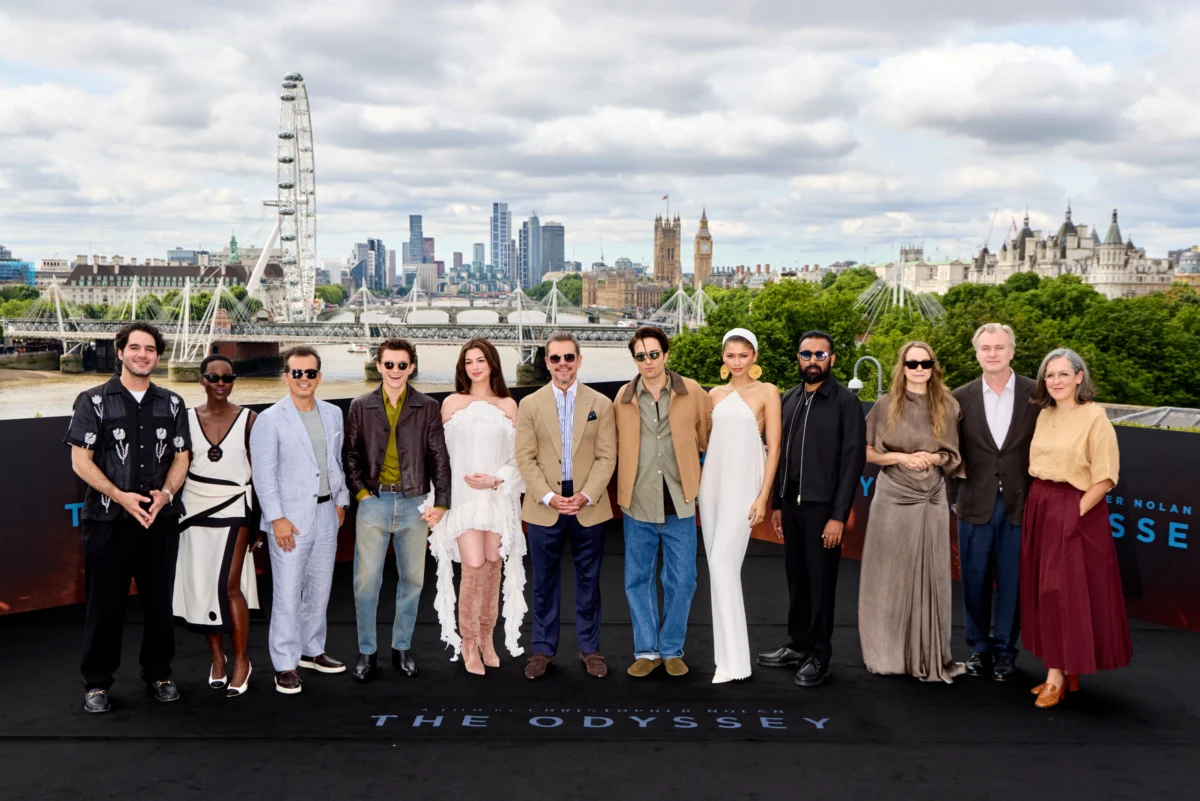
The global rollout of The Odyssey was an experience Leguizamo described as "insane," a spectacle far surpassing any other premiere in his career, including the grandeur of Moulin Rouge! at Cannes. He vividly recalled the London premiere, featuring a massive Trojan Horse installation and an unprecedented lineup of global stars, so numerous they had to pose "prom-style, sideways" to fit in the frame.

Amidst the high-profile events, Leguizamo cherished the more intimate, behind-the-scenes moments. He spoke fondly of a dinner with Lupita Nyong’o, Charlize Theron, Emma Thomas, and Nolan, as well as observing Matt Damon enjoying time with his family after a demanding day. Encounters with Zendaya and Tom Holland, seeing them "just being themselves," also provided welcome glimpses of normalcy amidst the overwhelming hype.
A Profound Viewing Experience and Enduring Bonds
Leguizamo’s initial viewing of The Odyssey was a deeply emotional experience. He watched the film with his wife at Nolan’s preferred theater, the Lincoln Square 13, opting for the "optimal" Row G. Despite the initially empty theater, the film’s massive scale, coupled with its "unbelievably beautiful" score, quickly captivated them. He recounted his wife, who rarely cries at movies, weeping and gripping his hand, which in turn brought him to tears. He mused whether his own tears were a reaction to hers or to Matt Damon’s "incredible monologue at the end where he has remorse over his whole entire life that hit me so hard."
The bond forged with Matt Damon, central to their characters’ dynamic on screen, translated into a genuine friendship off-screen. Leguizamo shared that they exchanged numbers, with Damon even attending his play—a gesture he deeply appreciated. Their camaraderie continued as they attended a World Cup match together, with Leguizamo describing Damon as a "genuine, regular, cool guy" with a great sense of humor.
Breaking Barriers: Representation in Modern Epics
One of the most exciting aspects of The Odyssey for Leguizamo is its groundbreaking approach to casting. He lauded the film’s commitment to breaking down barriers, particularly for period movies, which historically have been overwhelmingly "all white and all British-sounding." The diverse cast, which includes actors of various backgrounds and allows for American accents, was refreshing and vital.
Leguizamo drew a parallel to Lin-Manuel Miranda’s Hamilton, which famously utilized "colorblind casting" to great success, demonstrating its power to make historical narratives feel more "vital, so relatable, so fresh." He emphasized that diverse populations "were all around back then. It wasn’t like we just appeared out of nowhere as a spontaneous generation," challenging traditional, often whitewashed, historical portrayals. This inclusive casting not only makes the film more accessible to modern audiences but also rectifies historical omissions, allowing a broader spectrum of viewers to connect with the timeless narrative.
A Career Zenith and Lasting Legacy
For John Leguizamo, his involvement in Christopher Nolan’s The Odyssey represents a significant professional and personal milestone. He described the film as a "work of art" and Nolan’s "magnum opus," expressing immense gratitude for being part of such a visionary project. The opportunity to work with a "master, craftsman, innovator" who saw a unique quality in him to bring his dream to fruition is a compliment Leguizamo intends to carry for the rest of his life.
This role, allowing him to showcase an unprecedented level of vulnerability and break free from years of typecasting, has instilled in him a profound sense of accomplishment. "I feel so arrived, in a way," Leguizamo stated, reflecting on how all his talents, hard work, and life experiences have culminated in this extraordinary moment. His performance in The Odyssey not only highlights his immense talent but also stands as a testament to the power of diverse casting and the artistic bravery of a director willing to look beyond conventional boundaries.