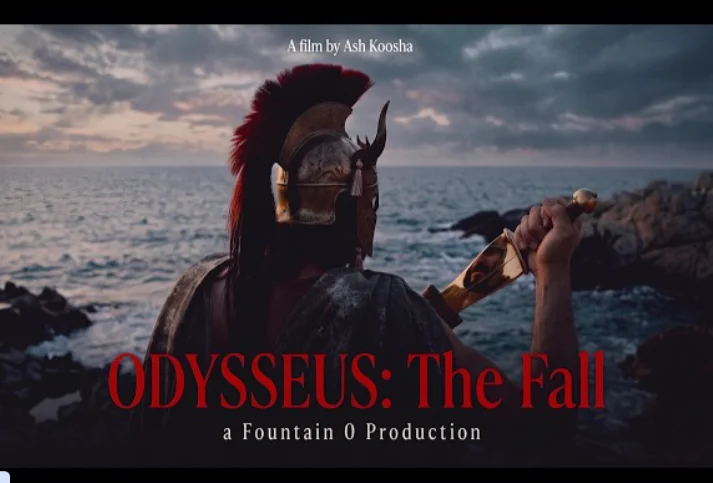
A provocative new 135-minute film, Odysseus: The Fall, created by an AI filmmaker and inspired by Homer’s epic The Odyssey, has ignited a fierce debate within the entertainment industry. The project, conceived by Iran-born, England-raised engineer Ash Koosha, directly challenges the traditional filmmaking paradigm, particularly as it emerges during a summer dominated by Christopher Nolan’s own $250 million analogue epic based on the same classical text. The audacious announcement has sparked widespread discussion about the future of cinema, the role of artificial intelligence, and the very definition of artistic creation.
The Genesis of a Digital Epic
Ash Koosha, along with his brother and collaborator Pooya Koosha, and CNBC founder Tom Rogers, operates under the AI-centric film production banner Fountain 0. Their latest venture, Odysseus: The Fall, has garnered significant attention not just for its subject matter but for its revolutionary production method: it was created for a mere few thousand dollars, entirely without actors. This stark contrast to the colossal budgets and star power typically associated with Hollywood blockbusters immediately positioned the AI Odyssey film at the center of a burgeoning industry controversy.
The timing of the announcement in what has been dubbed the "Summer of Our Damon-ian Lord 2026," coinciding with the release of Christopher Nolan’s highly anticipated The Odyssey, amplified the discussion. Nolan’s film, a monumental undertaking in large-scale analogue filmmaking, inadvertently became a benchmark against which Koosha’s digital creation was measured, despite their vastly different approaches and resources. The classical epic, a public-domain work, thus became the battleground for a philosophical clash between old and new cinematic worlds.
Igniting the Industry Backlash
The news of Odysseus: The Fall did not arrive in a vacuum. It landed squarely amid a public disagreement between Christopher Nolan and his star, Matt Damon, regarding the future viability of large-scale analogue filmmaking. Damon had expressed a sense of finality about such projects, stating, "I knew that this was the last chance I was going to have to do something like this." Nolan, in turn, characterized Damon’s sentiment as "defeatist." Koosha’s announcement, therefore, was perceived by many as an accelerant to the very "end-of-cinema moment" Damon had foreshadowed, utilizing the same revered source material Nolan was championing to stave it off.
The immediate reaction was a mix of excitement, confusion, and outright anger. Critics and industry insiders questioned Koosha’s motives, some labeling him a provocateur. Concerns mounted over whether the AI Odyssey film was merely a low-budget knockoff, aiming to capitalize on the buzz generated by Nolan’s high-profile production. The project drew comparisons to direct-to-video derivatives that often shadow major blockbusters, further fueling the backlash and skepticism about its artistic integrity and purpose.
A Precedent Set: Dreams of Violet
Koosha is no stranger to leveraging AI for filmmaking, though his previous work received a markedly different reception. His earlier AI film, Dreams of Violet, which debuted at Tribeca, explored the recent Iranian democracy protests. That project garnered considerable sympathy, largely because it addressed a humanitarian crisis where traditional filmmaking methods, particularly on-location shooting in Tehran, would have been unsafe or impossible. The perceived urgency and the film’s role as a unique storytelling vehicle for a critical issue made it largely acceptable to an industry grappling with AI’s potential.
However, the context for Odysseus: The Fall is entirely different. The story of The Odyssey, while profoundly resonant, lacks the immediate humanitarian urgency that justified the AI approach for Dreams of Violet. This distinction became a central point of contention for those critical of Koosha’s latest endeavor, prompting deeper questions about the appropriate applications and ethical boundaries of AI in creative fields.
Defining "Tangential Filmmaking"
In response to the controversy, Koosha and his team have articulated a vision for cinema that they term "tangential filmmaking." Ash Koosha clarified that his intention is not to compete with Christopher Nolan or to undermine traditional cinema. Instead, he views his work as inhabiting a "new world" of filmmaking, coexisting alongside the established industry. "He’s doing what he’s doing in the old world of cinema. And he does it brilliantly," Koosha stated, emphasizing his long-standing admiration for The Odyssey and his discovery of Nolan’s project via a Homer-focused online forum.
Koosha likens this new form of cinematic expression to the early days of the internet and blogging, where individuals could publish their opinions and stories, creating an explosion of diverse content outside mainstream media. He posits that AI tools now enable a similar democratization of filmmaking, allowing creators to "paint [their] opinion with images and sound and light" at the "speed of news." This framework suggests that the AI Odyssey film is less a direct competitor and more a cinematic essay or discourse vehicle, offering a personal interpretation of a classic narrative.
Tom Rogers, a producer for Fountain 0, echoed this sentiment, acknowledging the widely accepted superiority of Nolan’s traditional film while emphasizing their distinct goals. "Christopher Nolan is the ultimate in physical filmmaking and what we’re trying to do is be the ultimate in AI filmmaking," Rogers explained. He stressed that their aim is to demonstrate the possibilities of AI when unconstrained by conventional budgets, showcasing that AI-generated content can achieve artistic merit beyond mere "slop."
A Personal Lens on Odysseus
For Ash Koosha, the choice of The Odyssey as subject matter is deeply personal. He sees the epic hero Odysseus as a figure often misunderstood, and his own experience as an Iran-born individual who moved to the West as a child provides a unique lens through which to interpret the narrative. Koosha believes his background offers insight into Odysseus’s motivations, particularly "what it means to be far from home," suggesting that the hero’s prolonged journey was driven by more than just ego.
This personal connection underscores the democratic potential Koosha envisions for AI filmmaking. By dramatically lowering the barrier to entry, these tools empower diverse voices to offer their interpretations of universal stories, enriching the cultural landscape with perspectives that might otherwise remain unheard due to traditional industry constraints. The AI Odyssey film becomes a testament to this accessibility, allowing a filmmaker to imbue a classical narrative with contemporary, personal relevance.
Industry Implications and the Future of Actors
The rise of "tangential filmmaking" and the broader democratization of cinematic content through AI could profoundly reshape the film industry. Koosha contends that the concentration of revenue has historically acted as a significant barrier to entry, limiting the scale and scope of films unless backed by substantial capital and traditional studios. He believes AI will dismantle this barrier, fostering an environment where "all kinds of cinema" can flourish, leading to an "explosion of bottom-up cinematic content."
The question of actors, central to the industry’s identity, naturally arises in this AI-driven future. If films can be made without human performers, what becomes of the acting profession? Tom Rogers offers a counter-intuitive perspective, suggesting that the advent of AI films will actually make actors "more valuable." He posits that the distinct experience of seeing human performance, whether in traditional cinema or live theater, will be heightened and sought after even more, creating a symbiotic relationship rather than outright replacement.
This vision suggests a future of coexistence: a thriving ecosystem where traditional, actor-driven blockbusters and independent films exist alongside a burgeoning category of AI-generated, "scrappy homemade projects." Koosha’s aim is to demonstrate that both forms can produce "gorgeous films," each judged on its own terms and merits.
Strategic Release and Future Outlook
To mitigate confusion and ensure a fair assessment, the team behind Odysseus: The Fall plans to delay its release until late summer, well after Christopher Nolan’s The Odyssey has had its theatrical run. Pooya Koosha emphasized the importance of this strategic timing, stating, "We don’t want people to feel overloaded and confused." Tom Rogers reinforced this, asserting, "We could have released it now but we’re not trying to trick people. We want them to be able to clearly compare."
This measured approach highlights Fountain 0’s commitment to presenting their work not as a stunt, but as a serious exploration of AI’s capabilities in filmmaking. Their overarching goal, as articulated by Rogers, is to "look for the best use of the tools" and to prove that AI can facilitate compelling storytelling. The AI Odyssey film, therefore, stands as an ambitious experiment, a tangible demonstration of a nascent form of cinema. Its success or failure will not only impact Koosha and his team but could also significantly influence the ongoing dialogue about technology’s role in creative expression and the evolving landscape of the global film industry.