Eli Roth’s latest cinematic offering, Ice Cream Man, delivers an ultra-gonzo horror experience tailored exclusively for the most dedicated aficionados of the slasher genre, bypassing mainstream appeal in favor of unadulterated, practical-effects-driven gore. The film, a long-gestating passion project for Roth, plunges audiences into a nightmare where an idyllic small town’s children are transformed into homicidal maniacs after consuming sinister frozen treats, executing their adult victims with a shocking display of ingenuity and brutality. Its unrated release underscores a deliberate pivot away from broad commercial aspirations, firmly planting its flag in the niche territory of extreme horror.
The vision for Ice Cream Man originated more than two decades ago in the mind of Eli Roth, a director synonymous with visceral, often controversial, horror. Known for his contributions to the "torture porn" subgenre with films like Hostel and the body horror of Cabin Fever, Roth has consistently pushed the boundaries of on-screen terror. His 2023 slasher Thanksgiving also solidified his reputation for delivering brutal, no-holds-barred violence. The concept of Ice Cream Man, depicting a community of murderous children, proved too extreme for major studios, leading Roth to establish his own distribution arm, The Horror Section, specifically to bring this labor of love to fruition. This independent pathway allowed for an uncompromising realization of his original, gruesome narrative.
Central to the film’s impact are its extraordinary practical effects, which effectively become the undisputed stars of the production. While Roth conceptualized the story and co-wrote the screenplay with Noah Benson, the grotesque reality of his vision hinges entirely on the mastery of the makeup and prosthetics department. Led by Steve Newburn and Oscar-winner Adrien Morot, recognized for his transformative work on The Whale, the team crafted a relentless series of horrific bodily images designed to shock and repulse. This reliance on tangible, on-set effects stands in stark contrast to the prevalent use of computer-generated imagery in contemporary horror, offering a refreshing, albeit stomach-churning, authenticity to the film’s extreme violence.
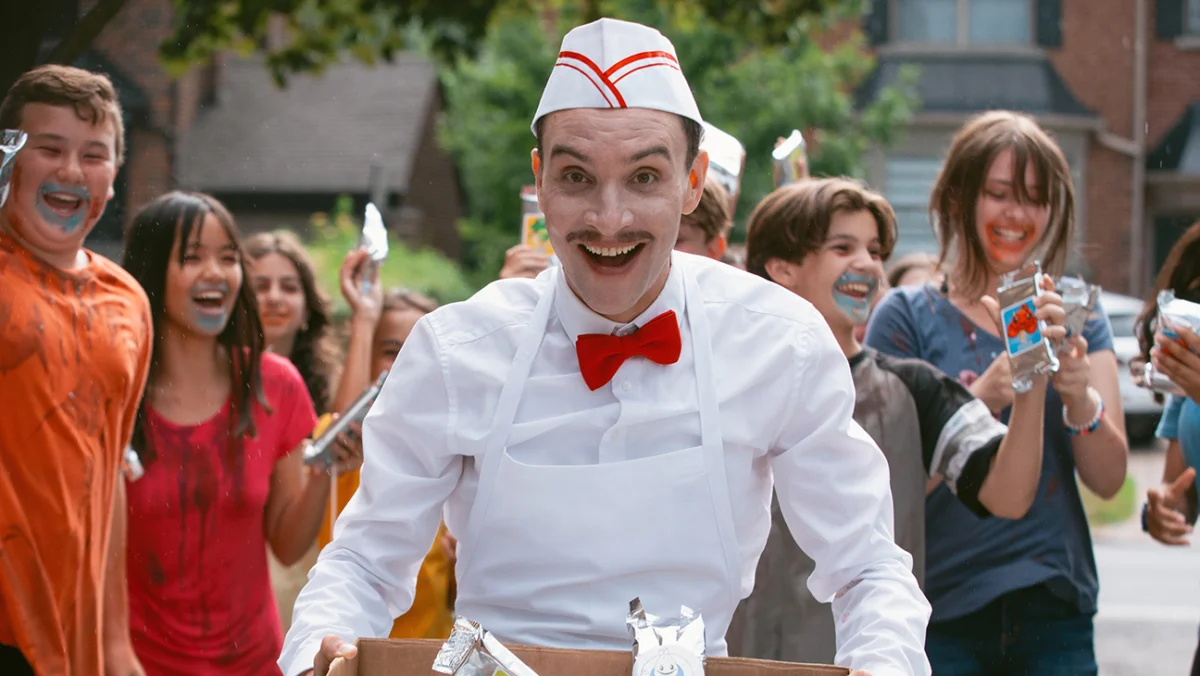
The narrative of Ice Cream Man unfolds with a deceptive simplicity. A strangely adorned ice cream truck, driven by a silent, perpetually smiling vendor, arrives in a seemingly picturesque American small town reminiscent of a Norman Rockwell painting. The frozen treats distributed to local children quickly manifest a terrifying transformation: the youngsters develop severely discolored lips, stare blankly into space, and embark on a murderous rampage against the town’s adult population. Their methods are alarmingly creative, featuring scenes where children dismember their parents, engage in games of tetherball and tag with human heads, and even participate in a tug-of-war using human intestines. This subversion of childhood innocence into pure, unadulterated evil forms the core terror of the film.
Canadian actor Ari Millen, known for his roles in Orphan Black, delivers a chilling performance as the enigmatic Ice Cream Man. His portrayal avoids the overt psycho-killer archetype, instead casting him as an evil enabler whose insidious products catalyze the children’s transformation. Millen’s character is less a direct perpetrator and more a silent, smiling puppet master, though he does occasionally participate in the carnage, notably serving a teacher’s scooped-out brains back to him in an ice cream cone. This subtle yet sinister approach to the antagonist adds another layer of unease to the film’s already disturbing premise.
The child antagonists, once innocent, display a demonic enthusiasm for violence, exhibiting a grotesque playfulness akin to summer campers. A particularly memorable image involves a young girl casually walking through the neighborhood, holding her mother’s severed head as a trophy. These pint-sized killers actively seek to expand their ranks, force-feeding the tainted ice cream to any uninfected children they encounter. The film features a lengthy and virtuosic sequence depicting their frenzied assault on adult teachers and employees at their grade school, showcasing their remarkable ingenuity in methods of slaughter. The intensity of these scenes raises questions about the psychological impact on the child actors involved, prompting speculation about the necessity of on-set counseling for such harrowing portrayals.
While Ice Cream Man primarily focuses on its relentless visual horror, a backstory is introduced through a local priest, Benjamin Byron Davis. This narrative thread involves a past travesty of justice, leading to a revenge plot facilitated by a necromancer. However, critical analysis suggests this narrative context serves largely as a superficial framework, its primary function being to provide a minimal justification for the film’s true raison d’être: demonstrating the exceptional talents of its prosthetics designers. The film’s relentless series of horrific bodily images often overshadows any complex plot development, making the narrative a secondary concern to the visceral spectacle.
Beyond the sheer gore, Ice Cream Man integrates elements of dark humor and macabre visual gags. These "throwaway jokes" include a drive-by decapitation, described as deserving of a rim shot, and deadpan visual flourishes such as a crow pecking out the eyes of a corpse in the foreground. These moments offer brief, unsettling breaks in the relentless onslaught of terror, hinting at Roth’s subversive humor and his understanding of the specific sensibilities of his target audience. This blend of extreme violence and dark comedy is a signature of Roth’s style, aiming to elicit a complex reaction from viewers.
The horror genre has a history of films featuring murderous children, from classics like Village of the Damned and its sequel to the enduring Children of the Corn franchise. However, Roth makes no secret of his ambition to surpass these predecessors in terms of sheer depravity and gore with Ice Cream Man. The film is unapologetically sick and twisted, a descriptor that Roth would likely embrace as a compliment, given his established reputation for pushing the boundaries of taste and conventional horror. This intent to outdo previous efforts solidifies Ice Cream Man‘s position as a new benchmark for extreme violence within the killer children subgenre.
The unrated status of Ice Cream Man is a crucial element in its release strategy and target audience appeal. By forgoing the restrictions of a traditional rating system, Roth ensures that his vision remains uncompromised, allowing for the extreme content that appeals directly to "gorehounds" and "diehard slasher fans." This approach bypasses the need to cater to broader critical or commercial expectations, instead focusing on delivering an unadulterated experience for a niche but dedicated fan base. The film’s critical reception, therefore, is less about universal acclaim and more about its effectiveness in satisfying the specific cravings of its intended audience for visceral, boundary-pushing horror.
Ultimately, Ice Cream Man stands as a testament to Eli Roth’s unwavering commitment to extreme horror and a celebration of practical effects artistry. It is a raw, unpolished, and intensely focused piece of cinema designed to provoke and exhilarate a very specific segment of the horror community. For those who revel in explicit gore, creative dismemberment, and the unsettling spectacle of childhood innocence corrupted into pure malevolence, Ice Cream Man offers an unparalleled, albeit polarizing, cinematic journey. It solidifies Roth’s legacy as a director unafraid to explore the darkest corners of human depravity, even when manifested through the most unexpected and seemingly innocent vessels.