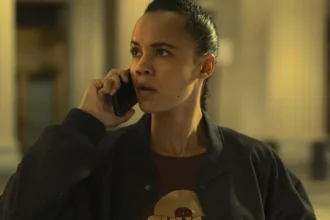
FX and Hulu’s new drama, The Shards, marks a highly anticipated collaboration between two masters of modern American provocation, Ryan Murphy and Bret Easton Ellis, delivering an opulent, often chaotic, and ultimately uneven exploration of privileged youth, burgeoning sexuality, and a looming serial killer in early 1980s Los Angeles. The nine-episode series, adapted from Ellis’ acclaimed novel, immerses viewers in a world of wealth, decadence, and psychological suspense, yet struggles to maintain a coherent tone, oscillating between faithful literary adaptation and a distinct Murphyesque camp.
A Deep Dive into 1980s L.A. Decadence
Set against the backdrop of Halloween 1981, The Shards introduces a coterie of affluent teens navigating their senior year at The Buckley School in Sherman Oaks. The city is gripped by fear, with a curfew enforced due to "The Trawler," a menacing serial killer preying on the privileged. Despite the danger, Debbie (Hayes Warner), the daughter of Hollywood royalty, is determined to host an extravagant party. Her best friend, Susan (Kaia Gerber), the school’s undisputed queen bee, proposes an "Area 54" theme, "like Studio 54, but in space," a concept Debbie hesitantly accepts, foreshadowing the series’ self-aware yet often muddled approach to kitsch and nostalgia. This initial setup immediately establishes the show’s central conflict: the hedonistic pursuits of the wealthy clashing with a dark, pervasive threat.
The creative partnership between Murphy and Ellis inherently set high expectations for The Shards. Both creators are renowned for their unflinching portrayals of excess, depravity, and the darker undercurrents of American culture. Murphy, known for his genre-bending anthologies like American Horror Story and heightened dramas such as Glee and Pose, brings his signature visual flair, ensemble casts, and penchant for melodrama. Ellis, the celebrated author of American Psycho and Less Than Zero, is synonymous with postmodern narratives exploring consumerism, ennui, and the moral decay of affluent youth. Their combined sensibilities promised a television event that would be both aesthetically bold and thematically challenging.
The Genesis of The Shards: From Novel to Screen
Ellis’ original novel, a 600-page tome, is a roman à clef drawing heavily from his own teenage experiences, replete with meticulous details of adolescent masturbatory routines, obsessions with male physiques, detailed Los Angeles driving directions, and extensive name-dropping of fashion brands and musical artists. These elements, which define Ellis’ distinctive literary voice, are faithfully translated to the screen, forming the bedrock of the initial episodes. The novel’s sprawling narrative posed a significant challenge for adaptation, and the nine-episode structure attempts to capture its extensive detail, though not always with seamless success.
The series centers on Bret Ellis (Igby Rigney), an aspiring writer settling into his senior year. Bret, who narrates the series with a detached, almost snooty affectation, dreams of escaping Southern California for adulthood. His daily life involves a strict regimen of self-gratification and time with his sexually liberated girlfriend Debbie, best friend Susan, and Susan’s quarterback boyfriend Thom (Graham Campbell). Unknown to his immediate circle, Bret is secretly gay, engaging in clandestine encounters with classmate Matt (Owen Painter) while harboring an unspoken longing for Ryan (Daniel Dale). This internal conflict, coupled with Bret’s role as an observer and chronicler, positions him as the unreliable narrator through whose perspective the increasingly bizarre events unfold.
Unreliable Narratives and Dysfunctional Families
Bret’s relative parentlessness—his parents are frequently abroad—leaves him and his friends largely unsupervised, fostering a culture of self-medication with cocaine and mood enhancers. The few adult figures present are far from role models. Debbie’s father, Terry (Wes Bentley), is a barely closeted Hollywood producer preying on young men, much to the despair of his wife, Liz (Evan Rachel Wood), who is depicted as a fragile figure overwhelmed by antidepressants and unfulfilled ambitions. These parents are often dependent on assistants like Steven (Jordan Roth), a theatrical figure who manipulates situations from the shadows, embodying a sinister form of Hollywood machination. This adult dysfunction mirrors and amplifies the moral ambiguities of the teenage characters.
The narrative of The Shards truly ignites with two major disruptions that, as Bret perceives, mark his transition from youth to adulthood. First, the arrival of Robert Mallory (Homer Gere), a preternaturally handsome new student with a mysterious past involving a stint in an institution. Second, the escalating terror of The Trawler, a new wave serial killer operating in the wake of notorious L.A. figures like Charles Manson, the Night Stalker, and the Hillside Strangler, preceding his grotesque murders with sadistic taunts. While his friends are engrossed in their hedonistic pursuits, only Bret connects The Trawler’s increased proximity and escalating violence with Robert’s arrival. Bret’s fixation on Robert blurs the lines between lust, suspicion, and an overactive imagination, leading his friends to accuse him of embellishing reality for his nascent novel, Less Than Zero—a meta-commentary on Ellis’ own literary career and the accusations of fabrication he and Murphy have faced.
A Tale of Two Halves: Tonal Shifts in The Shards
The critical reception of The Shards highlights its "nostalgic, over-the-top, and unsurprisingly uneven" nature. The series is acutely aware of the expectations surrounding a "Ryan Murphy and Bret Easton Ellis" production, primarily that of inherent excess. This excess manifests not just in the narrative, but in the visual and auditory landscape. The production design by Merje Veski and costuming by Courtney Wheeler meticulously recreate the early 1980s, from specific restaurant interiors to period-appropriate sunglasses and clothing. The soundtrack is a curated collection of 80s hits, often played in their entirety during montages, providing a rich, if sometimes on-the-nose, sonic backdrop that aims for reverence rather than subtle integration.
A significant point of divergence in The Shards comes mid-season, creating a perceived shift in creative control. The initial four episodes, where Ellis is credited as co-creator, executive producer, and co-writer, largely adhere to the novel’s key incidents and character traits. During this period, directors like Murphy and Michael Uppendahl often frame the young actors as "impossibly sculpted mannequins," creating a deliberate artificiality. While sexy, this aesthetic choice, particularly for actors like Rigney, Warner, and "nepo babies" Gerber and Gere, gives them an almost alien quality, contributing to a sense of unreality. The mood is eerie but rarely genuinely frightening, and despite the Trawler’s mauled victims, the series remains largely bloodless, emphasizing psychological dread over graphic horror. Empathy for the characters, including Bret’s genuine warmth for Ryan, is often sacrificed for this stylized presentation, making them feel less human.
However, a dramatic pivot occurs around the fifth episode, directed by Murphy himself. This episode, described as "wild" and "disconnected," temporarily halts the narrative momentum for a "cheerfully preposterous public access dance competition," reminiscent of a 1980s Hairspray. This marked departure from the novel’s tone allows Murphy to make explicit, overblown pronouncements about the 80s—highlighting fluidity, pastels, and pornography as hallmarks of the decade. While "irritating and messy" to some, this shift is purposeful, signaling a severance from strict adaptation and an embrace of Murphy’s more chaotic, campy style.
Subsequent episodes continue this transformation, evolving into something akin to an unacknowledged third season of Murphy’s Fox comedy Scream Queens. This shift, while potentially alienating for Ellis devotees, results in a show that becomes "funnier and odder," taking "wild swings" like an episode that uses a Shakespeare class to prompt characters into elaborate fantasies inspired by Hamlet, Romeo and Juliet, and Macbeth. While this later half of the season is "chaos" and lacks harmonious coherence, it breaks through the stifling artificiality of the earlier chapters, ultimately benefiting the cast.
Performances and Future Prospects
The performances in The Shards gradually improve as the series progresses. Hayes Warner, as Debbie, shines in the latter half, uncovering the "bruised psyche" beneath her character’s glamorous exterior and delivering cutting dialogue with a precision that echoes Murphy regulars like Emma Roberts and Billie Lourd. Kaia Gerber, despite having less opportunity for the "withering timing" seen in her other works, demonstrates surprising range, effectively portraying Susan’s brittle perfection. The male leads, Igby Rigney and Homer Gere, embody archetypal Murphy characters, with Rigney evoking Evan Peters and Gere often resembling Ashton Kutcher.
The adult cast, however, is given more freedom to "let loose." Wes Bentley’s "vulpine intensity" is expertly utilized by Murphy, while Evan Rachel Wood, as Liz, fully embraces the series’ distinct vibe, positioning her as a potential future Murphy regular. Jordan Roth, a Broadway producer with limited acting credits, delivers a unique, "Mephistophelian obsequiousness" that stands out, fitting the show’s overall sense of characters wearing masks. Additionally, several prominent guest stars, including James Wolk as a victim’s shattered father and Constance Zimmer as Robert’s unraveling aunt, provide powerful, albeit brief, moments of "real emotion," serving as stark reminders of the human toll amidst the glamorous chaos.
The Shards concludes its season with a significant cliffhanger, leaving many questions unanswered about the fate of its characters and the true identity of The Trawler. However, the review suggests that despite the dramatic ending, future seasons may not be "necessary," implying that the inherent excess defining the entire endeavor may also negate the need for a neat resolution. Ultimately, the series stands as a bold, if flawed, attempt to meld two distinctive artistic visions, offering viewers a memorable, albeit disjointed, journey into the dark heart of 1980s L.A. prep school life.