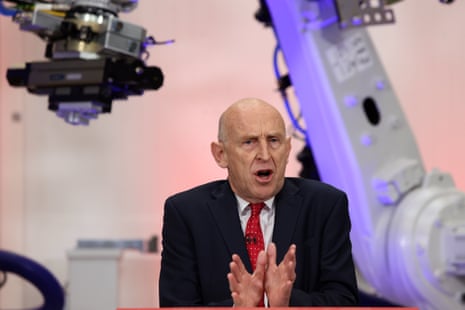
Chancellor John Healey declared Monday that fiscal discipline is the foundational pillar of the current government, arguing that controlling public debt is a moral imperative rather than a mere accounting exercise. Speaking at the Manufacturing Technology Centre in Coventry, Healey asserted that his administration’s commitment to "balancing the books" is the only viable pathway to long-term prosperity and social equity. He emphasized that the government is in "lockstep" with the Prime Minister to meet strict fiscal rules in the upcoming budget, aiming to reduce the nation’s reliance on borrowing.
The Chancellor’s debut economic speech, delivered seven weeks into his tenure, sought to redefine the traditional Labour platform by framing fiscal restraint as a progressive virtue. Healey told an audience of business leaders and regional officials that the cost of servicing national debt has become a catastrophic drain on public resources. He noted that interest payments now account for one out of every ten pounds spent by the government, a figure he described as fundamentally incompatible with the party’s mission to improve public services.
Being ‘True to Labour’s Values’ Means Controlling Spending to Protect Public Services
Healey provided a stark comparison to illustrate the scale of the UK’s debt burden, noting that if debt interest were a government department, it would be the second largest in Whitehall. It currently trails only the Department of Health in terms of total expenditure, dwarfing the combined budgets of the Ministry of Defence, the Home Office, and the Ministry of Justice. The Chancellor argued that this level of spending on interest represents a failure of past governance that must be rectified to free up capital for meaningful investment.
The speech addressed the "Truss penalty," referring to the market volatility and loss of confidence following the 2022 mini-budget under former Prime Minister Liz Truss. Healey argued that the UK has been forced to pay a premium on its debt since that period as it struggles to re-establish its reputation for fiscal sustainability. By prioritizing discipline, the Treasury aims to restore the country’s standing in global markets and reduce the long-term pressures on public finances that have contributed to persistent inflation.
Rebuilding Business Confidence and Wealth Creation
Central to the Chancellor’s strategy is a shift toward a "wealth creation" economy that prioritizes business investment and profit. Healey acknowledged the mounting pressures on British companies, citing the rising costs of energy, regulation, and labor since the COVID-19 pandemic. He pledged to "draw the line" under these escalating burdens, arguing that sustainable growth is the only long-term solution to both the cost of living and the cost of doing business.

To facilitate this, Healey announced a new allocation of £150 million from the British Business Bank specifically targeted at "scale-up" companies in the North of England. This fund is designed to support university spinouts and ambitious enterprises in cities like Liverpool, Manchester, Leeds, and Newcastle. By leveraging public capital to attract private investment, the government hopes to foster a new generation of high-growth businesses that can create jobs within their local communities.
Being ‘True to Labour’s Values’ Means Controlling Spending Through Fiscal Devolution
A significant portion of the Chancellor’s address focused on the "roadmap to fiscal devolution," a plan to permanently transfer economic power from central government in London to regional authorities. Healey criticized the historical centralization of political power in the UK, which he claimed "hollowed out" the fundamentals of the national economy. The proposed shift would begin in 2028, replacing traditional central government grants with a share of local income tax for mayoral strategic authorities.
This devolution plan also includes greater business rates retention for local councils, allowing regions to benefit directly from the economic growth they generate. Healey argued that the next chapter of the British growth story must be "written in more places," rather than being confined to the financial hubs of the southeast. By empowering local leaders to deliver industrial strategies and infrastructure projects, the government believes it can unlock "latent potential" that has been stifled by Whitehall bureaucracy.
Opposition Parties and Critics Reject Healey’s Economic Vision
Despite the Chancellor’s optimistic tone, opposition parties were quick to dismiss the speech as lacking in substance. Shadow Chancellor Andrew Griffith characterized the address as a "policy-light word salad," suggesting that the government remains unaware of the actual drivers of economic growth. Griffith expressed concern for families and businesses worried about potential tax hikes and government borrowing rates that remain near a 28-year high.
Reform UK Treasury spokesperson Robert Jenrick offered an even sharper critique, labeling Healey an "empty vessel" with no clear plan to rescue the economy following recent global market instability. Meanwhile, the Liberal Democrats criticized the government’s refusal to address Brexit-related trade barriers. Lib Dem Deputy Leader Daisy Cooper argued that the Chancellor cannot talk about "turbocharging innovation" while ignoring the "red tape" that continues to hinder British exporters trying to sell to European markets.
Social Unrest and the Immigration Debate
The economic announcement was somewhat overshadowed by ongoing social friction, specifically far-right protests in Portsmouth. These demonstrations were triggered by the arrival of a large boat carrying migrants, leading to road blockages and confrontations with law enforcement. Chief Secretary to the Treasury Emma Reynolds condemned the protesters’ actions during her media appearances, describing the behavior as "thuggish and intimidating."
Reynolds emphasized that while the government supports the right to peaceful protest, the actions in Portsmouth "crossed a line." The intersection of immigration protests and economic policy highlights the complex landscape the Labour government must navigate. Critics argue that economic anxiety often fuels social unrest, putting further pressure on the Treasury to deliver visible improvements in living standards while maintaining its strict "value-based" spending controls.
Strategic Use of Public Finance Institutions
A key element of Healey’s strategy involves the expanded use of Public Finance Institutions (PuFIs), such as the National Wealth Fund and the British Business Bank. These entities are designed to operate with a degree of independence from traditional borrowing rules, allowing them to expand investments in critical infrastructure and technology. This approach is intended to bypass some of the constraints of the national debt while still injecting capital into the economy.
Healey noted that fiscal credibility is "indivisible from growth," a sentiment he shared during recent G20 discussions in North Carolina. He maintained that while Britain’s growth trajectory has been historically weak, the current administration is dedicated to making "Great Britain growth Britain again." This involves a dual mission between the Treasury and a newly established "No. 10 North" office, aimed at removing the regulatory "blockages" that prevent local leaders from driving productivity.
Long-Term Outlook and the Upcoming Budget
As the government prepares for the upcoming budget, the Chancellor’s speech serves as a clear signal to markets and the public that the era of unfunded spending is over. Healey’s "new story about Britain" is one of resilience and pride, but it is also one defined by hard choices and administrative efficiency. The focus on "balancing the books with a buffer" suggests a cautious approach intended to protect the UK against future global economic shocks.
The transition to a more devolved fiscal model will be a multi-year process, with the most significant changes not slated to take effect until the end of the decade. In the interim, the government will be judged on its ability to stimulate private sector investment while keeping a tight lid on departmental spending. Healey concluded his remarks by stating that his purpose as Chancellor is to provide a "sustainable pathway out of indebtedness into prosperity," a goal that he believes is both essential and achievable.