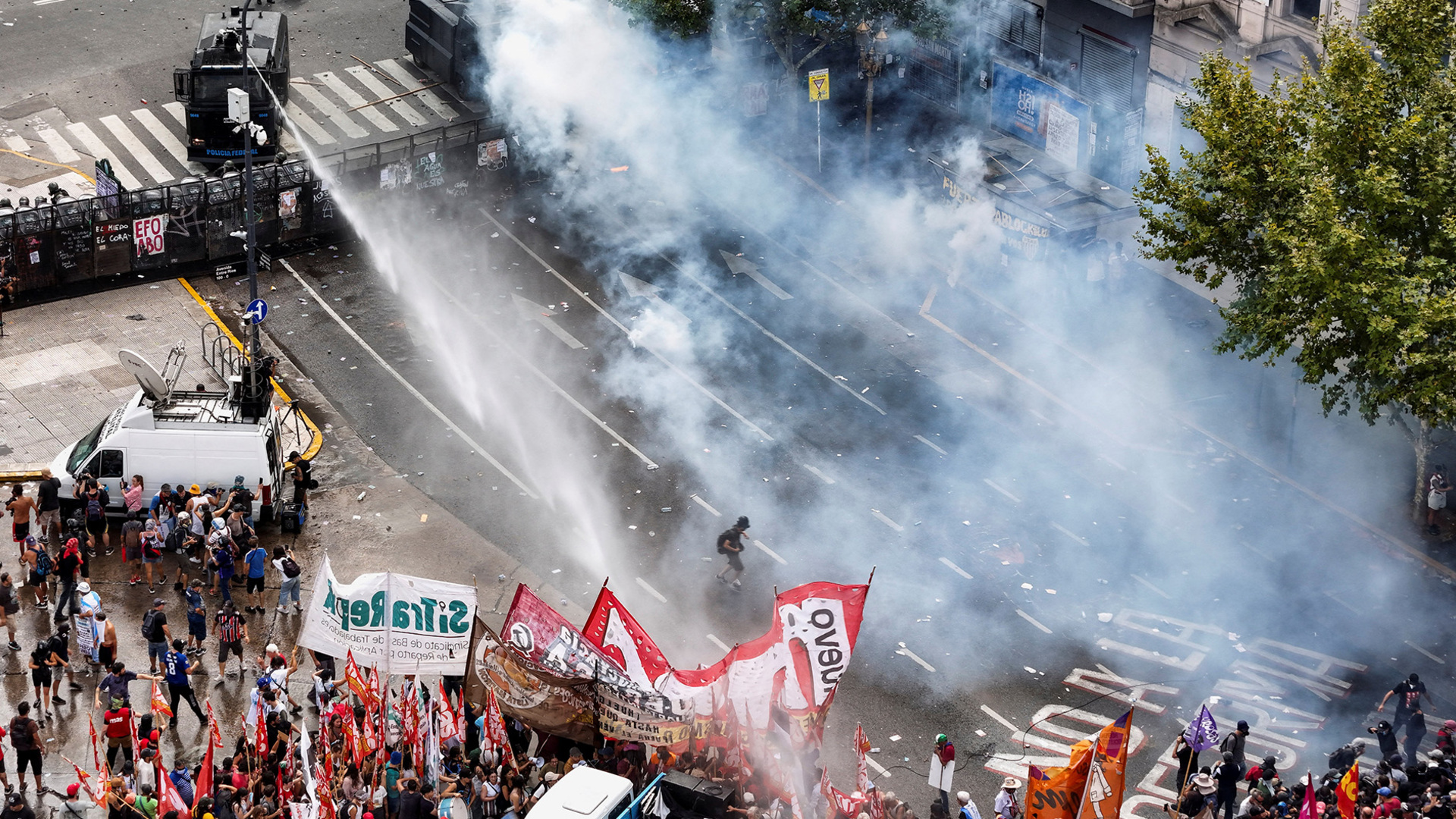
BUENOS AIRES – Argentinian security forces unleashed water cannons and fired tear gas and rubber bullets on Wednesday at a swelling crowd of protesters in Buenos Aires who were demonstrating against controversial proposed labor reforms. The confrontation marked a significant escalation in tensions between President Javier Milei’s administration and powerful labor unions, highlighting the deep divisions over the government’s economic agenda. Unions have vowed to intensify their opposition, arguing the proposed legislation fundamentally undermines workers’ rights and the ability to engage in collective bargaining.
Mounting Opposition to Milei’s Labor Reforms
The demonstrations, which have been building for weeks, coalesced into a significant show of force outside the National Congress building. Thousands of union members, accompanied by a diverse coalition of social organizations and concerned citizens, gathered to voice their staunch opposition to a package of economic and labor reforms spearheaded by President Milei. Union leaders have been particularly vocal in their condemnation, asserting that the proposed changes represent a severe rollback of hard-won worker protections and would cripple the right to strike, a cornerstone of labor activism in Argentina.
The core of the dispute lies in President Milei’s ambitious reform agenda, which he argues is essential for revitalizing Argentina’s struggling economy. His administration contends that the current labor laws are overly rigid, hindering investment, discouraging job creation, and contributing to rampant inflation and economic stagnation. The proposed reforms aim to introduce greater flexibility into the labor market, reduce dismissal costs for employers, and streamline hiring processes. Milei, a self-proclaimed anarcho-capitalist, views these changes as critical steps towards a free-market economy and a way to attract foreign investment.
However, labor organizations and opposition parties paint a starkly different picture. They argue that the reforms disproportionately benefit employers at the expense of workers, leading to increased precarity and a weakening of collective bargaining power. The unions fear that the legislation will pave the way for a surge in informal employment, reduce wages, and diminish essential worker benefits, effectively eroding the social safety net. The specter of diminished worker protections has galvanized a broad spectrum of society, extending beyond traditional union membership.
A Day of Unrest in the Capital
Wednesday’s clashes erupted as protesters attempted to breach security cordons surrounding the National Congress, where lawmakers were debating the controversial legislation. Images broadcast from the scene showed plumes of tear gas engulfing demonstrators, many of whom were seen coughing and shielding their faces. Water cannons were deployed to disperse the crowds, creating chaotic scenes amidst the charged atmosphere. Reports indicated that several individuals sustained minor injuries, and at least a dozen arrests were made, according to preliminary police statements.
The use of forceful tactics by security forces drew immediate condemnation from union leaders and human rights advocates. They accused the government of employing excessive force to silence dissent and intimidate workers. “This is an unacceptable response to peaceful protest,” stated a prominent union spokesperson, addressing reporters amidst the ongoing unrest. “The government is attempting to crush the voice of the people, but we will not be deterred. These reforms are an assault on our fundamental rights.”
The demonstrations were organized by the General Confederation of Labor (CGT), Argentina’s largest labor confederation, and other prominent unions. Their call for a nationwide strike had been building momentum, with widespread participation anticipated across various sectors. The intention was to disrupt economic activity and demonstrate the collective power of organized labor in opposition to the government’s agenda.
President Milei’s Stance and the Economic Context
President Milei, who assumed office in December 2023, has made overhauling Argentina’s deeply entrenched economic system a central pillar of his presidency. His administration has already implemented austerity measures, including significant cuts to public spending and a devaluation of the peso, which have been met with mixed reactions. The labor reforms are seen as a crucial component of his broader plan to deregulate the economy and foster a more business-friendly environment.
In a public address earlier in the week, President Milei defended his reform package, emphasizing its necessity for long-term economic stability and growth. He argued that the current labor framework is a relic of outdated ideologies that have stifled innovation and productivity. “We are liberating the productive forces of Argentina,” Milei stated. “These reforms are not about attacking workers; they are about creating jobs and opportunities for all Argentinians.”
However, critics point to Argentina’s persistent economic challenges, including high inflation, significant external debt, and widespread poverty, as evidence that Milei’s radical approach may exacerbate existing problems. The International Monetary Fund (IMF), which has a long-standing relationship with Argentina, has expressed cautious optimism about some of the government’s fiscal measures but has also highlighted the importance of social dialogue and protecting vulnerable populations.
Broader Implications and Potential Consequences
The confrontation in Buenos Aires signals a critical juncture in Argentina’s political and economic landscape. The government’s willingness to employ strong-arm tactics against protesters could further polarize the nation and deepen social unrest. The effectiveness of President Milei’s reforms hinges not only on their passage through Congress but also on their acceptance by a significant portion of the population.
The labor reforms, if enacted, could have profound implications for the future of work in Argentina. Businesses may experience increased flexibility in hiring and firing, potentially leading to a more dynamic labor market. However, this could also result in greater job insecurity for workers, reduced bargaining power, and a potential decline in union membership and influence. The impact on specific industries, such as manufacturing, agriculture, and the service sector, is also a subject of considerable debate.
Furthermore, the international community will be closely watching how these developments unfold. Argentina’s ability to attract foreign investment and integrate into global markets will depend, in part, on its political stability and its commitment to upholding democratic norms and human rights. The use of force against peaceful protesters could deter potential investors and damage the country’s international reputation.
Public Opinion and Shifting Alliances
Public opinion in Argentina is sharply divided. While a segment of the population supports Milei’s promise of economic recovery and is frustrated with the status quo, another significant portion remains deeply attached to the social protections and labor rights that have been built over decades. The visual evidence of security forces clashing with protesters is likely to resonate with those who are already skeptical of the government’s agenda, potentially galvanizing further opposition.
The protests have also highlighted the complex dynamics between different branches of government and societal actors. The legislative debates in Congress are taking place against a backdrop of intense public pressure, with unions and opposition parties lobbying lawmakers to reject the proposed reforms. The outcome of these legislative battles will have a lasting impact on the balance of power between capital and labor in Argentina.
The Road Ahead: Continued Strife and Negotiation?
The immediate future for Argentina appears to be one of continued tension and potential unrest. Union leaders have vowed to escalate their actions, with further strikes and demonstrations being planned. The government, on the other hand, seems determined to push its reform agenda through, believing it is essential for the nation’s economic survival.
The path forward will likely involve a delicate balancing act for President Milei. He must navigate the demands of international creditors, the expectations of his supporters, and the legitimate concerns of a significant portion of the workforce. Whether the government can achieve its economic objectives without alienating large segments of the population and undermining social cohesion remains a critical question. The events of Wednesday serve as a stark reminder of the challenges inherent in implementing sweeping economic changes in a nation with a strong history of social activism and a deeply felt commitment to workers’ rights. The confrontation outside the National Congress is likely to be remembered as a pivotal moment in this ongoing struggle.