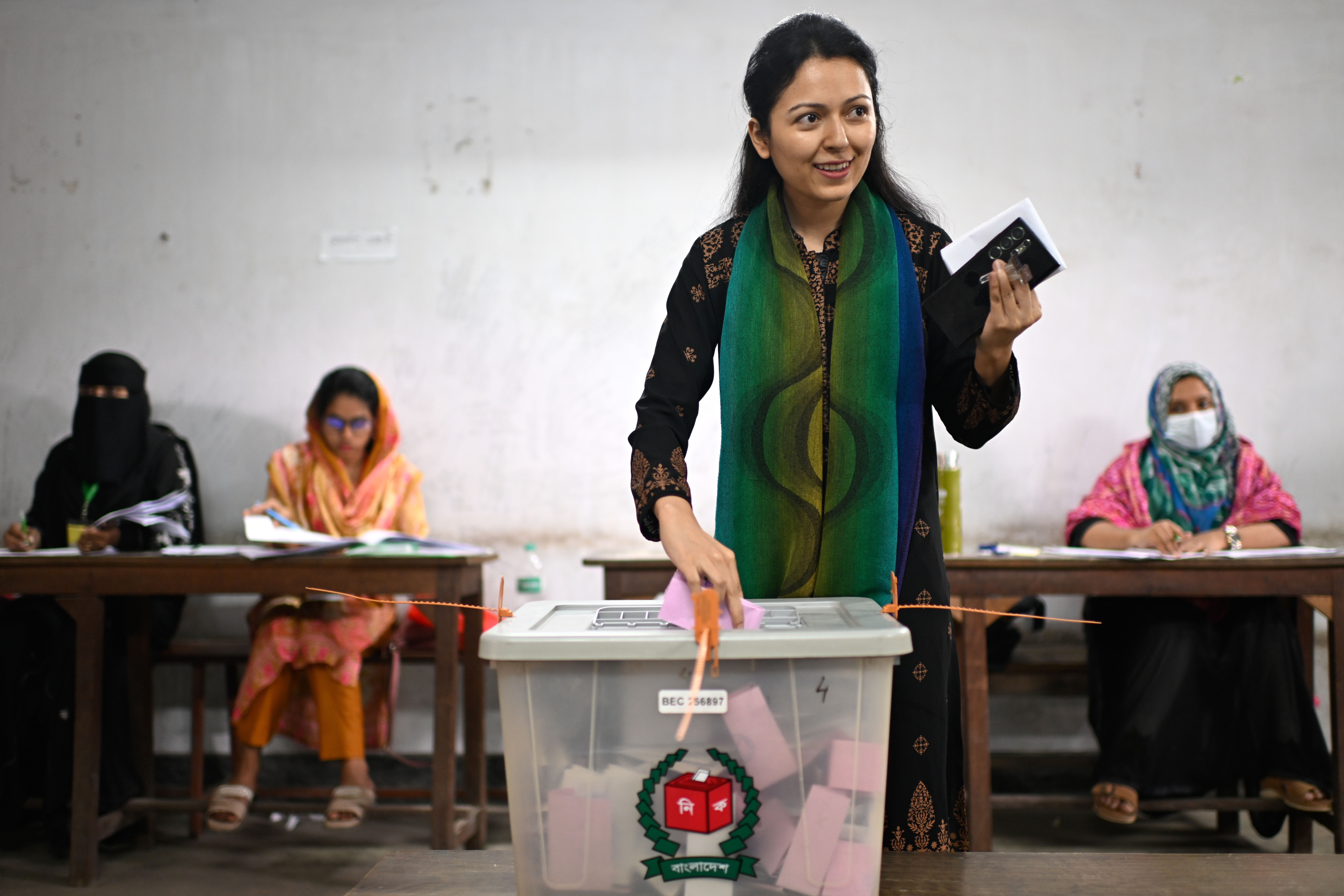
Dhaka, Bangladesh – A palpable sense of festival permeated polling stations across Bangladesh on Thursday as citizens, many of whom had been disenfranchised for nearly two decades, cast their ballots in a pivotal parliamentary election. The vote marks a significant return to democratic practice following a period of intense political upheaval, with citizens expressing a profound sense of civic participation and hope for a renewed democratic future.
The atmosphere at a government school in the capital, Dhaka, mirrored the nationwide sentiment. Hasan Hoque, a former teacher, stood in a long queue, his face alight with a rare smile as he conversed with fellow voters. "It’s been a while standing in this line, but nothing matches the feeling of casting my own vote. It feels like a festival," Hoque shared with Al Jazeera, his voice resonating with the collective enthusiasm. His last electoral participation was in 2008, a year that heralded a significant shift in the nation’s political landscape.
The 2008 election saw the return to power of then-Prime Minister Sheikh Hasina, whose subsequent 15-year tenure was characterized by allegations of electoral manipulation and increasingly autocratic rule. This period of perceived democratic backsliding culminated in a widespread student-led uprising in 2024, which ultimately led to the ousting of Hasina’s government and her subsequent exile. "The elections we had after 2008 were farcical and one-sided under Awami League," Hoque stated, referring to Hasina’s political party, which was subsequently barred from participating in the current electoral process. He elaborated that during those years, the electorate felt their votes were rendered irrelevant, with outcomes seemingly predetermined.
The election held on Thursday is the first parliamentary contest since the transformative 2024 uprising, offering Bangladesh, a nation of 173 million, an opportunity to recalibrate its democratic trajectory after years of turbulence. Beyond selecting a new parliament, voters were also asked to endorse the "July Charter," a foundational document emerging from the 2024 movement. This charter outlines comprehensive constitutional reforms designed to safeguard the country against future authoritarianism and reinforce democratic principles.
An ‘Eid-like Atmosphere’ of Renewed Civic Duty
The sentiment of returning to the ballot box after a long hiatus was echoed by Jainab Lutfun Naher, another voter who had not participated in an election since 2008. "I was pregnant with my daughter in 2008. Today I voted again, and my daughter is now 17," Naher recounted, her voice tinged with emotion. For her, the act of voting was not just a civic duty but a deeply personal and empowering experience. "It feels absolutely great to vote," she affirmed, expressing a profound sense of hope for her nation’s future. "I want this country to prosper. I want it to be democratic, where everyone has rights and freedoms."
The electoral landscape featured two primary alliances vying for power. The Bangladesh Nationalist Party (BNP), led by Tarique Rahman, and a coalition of 11 parties, spearheaded by Jamaat-e-Islami and including the National Citizen Party (NCP) – founded by the youth activists who were instrumental in Hasina’s downfall – were the main contenders. This electoral contest represents a crucial juncture in Bangladesh’s pursuit of democratic restoration.
Voting commenced across 299 out of 300 constituencies, with polling in one seat postponed due to the demise of a candidate. The Election Commission reported a turnout of approximately 48 percent by 2 p.m. local time, with final figures pending. Polls closed at 4:30 p.m. local time, and official results were anticipated early Friday morning.
Across Dhaka’s 20 parliamentary constituencies, the scene was remarkably consistent: extensive queues formed outside schools and community centers repurposed as polling stations. Nazmun Nahar, a first-time voter at one such location, described her anticipation. "I was so excited I could hardly sleep last night," she told Al Jazeera, her enthusiasm palpable. "It felt like Eid," she remarked, a sentiment that resonated with the Chief Election Commissioner, AMM Nasir Uddin, who characterized the voting environment as an exuberant, "Eid-like atmosphere."

Reports from other regions of the country corroborated this festive mood. The government had declared a three-day holiday to facilitate the election, prompting millions of voters to travel to their hometowns. Many undertook journeys on crowded trains, some even on rooftops, to ensure their participation. Abdur Rahman, a voter from northern Bangladesh who experienced the packed train journey, noted the widespread homecoming of friends and family members. "We were robbed of the joy of voting for so long," Rahman stated. "None of us wanted to miss this opportunity."
The Dawn of a New Bangladesh
Following his vote at Gulshan Model High School and College in Dhaka, BNP Chairman Tarique Rahman, a leading candidate for prime minister, outlined his priorities. He pledged to focus on enhancing law and order to ensure citizens feel secure. "I am confident of winning the election," Rahman declared to reporters.
Muhammad Yunus, who heads the interim government established after the 2024 uprising, also cast his ballot at the same polling center. He described the day as profoundly significant. "Today is the birthday of a new Bangladesh," Yunus proclaimed. "Through today’s process, people have rejected the past. From today, at every step, we have gained the opportunity to build a new Bangladesh."
Shafiqur Rahman, leader of the Jamaat-e-Islami party, cast his vote at a different Dhaka polling center. He expressed hopes for a government that would serve the nation, not individual interests. "Through this vote, we hope a government will be formed that does not belong to any individual, family or party, but to the [millions] of people of this country," he told reporters, characterizing the election as a pivotal "turning point" for Bangladesh.
Navigating the Path to Democratic Normalcy
Analysts observed that while isolated incidents of alleged poll malpractice were reported, the overall electoral process remained largely peaceful. Asif Mohammad Shahan, a professor of development studies at Dhaka University, told Al Jazeera that the election was not marred by "reports of major irregularities." He added, "Some isolated incidents have occurred, which are of course unwanted, but every election in Bangladesh has had some irregularities. Unless those are serious enough to change the overall result, they do not cross a critical threshold."
Political analyst Dilara Choudhury described the relatively peaceful conduct of the election as a crucial initial step in Bangladesh’s arduous transition towards democratic normalcy. "Minimal violence in the election is good," she told Al Jazeera. "If both parties accept the results, it would be a first step for Bangladesh towards a new kind of politics or democratic transition."
However, Choudhury cautioned that the election itself does not guarantee a complete democratic transition. She emphasized that the success of this transition hinges on the willingness of both governing and opposition forces to collaboratively pursue and institutionalize the reforms outlined in the July Charter. These reforms are expected to encompass commitments to accountability, the rule of law, and good governance.
Meanwhile, citizens expressed their aspirations for the incoming administration. Mazeda Begum, a voter at a Dhaka polling center, articulated her hopes for progress in education and the economy. "There are many problems in our education system and in the education of our children," she said. "We also face economic difficulties in our daily lives. I hope the new government will work for us."
At another polling station in Dhaka’s Agargaon area, Nurul Amin conveyed a similar sense of anticipation. "I have come to vote after many years," he told Al Jazeera. "This country needs to move forward, and the next government should fix our problems." The collective sentiment underscores a deep-seated desire for tangible improvements and a robust democratic future.