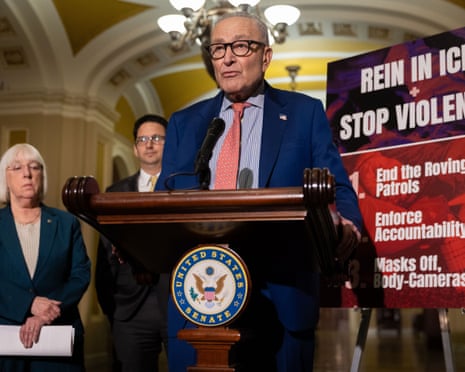
Senate and House Democrats intensified their demands for a total overhaul of Department of Homeland Security operations on Wednesday, signaling a high-stakes standoff as negotiations over a full-year appropriations bill reach a critical juncture. Senate Majority Leader Chuck Schumer, speaking from the U.S. Capitol, asserted that "dramatic changes" are required for immigration enforcement before the party will agree to a long-term funding package for the agency. The ultimatum comes as the federal government operates under a stopgap spending measure signed by President Donald Trump on Tuesday, which provides funding only until February 13.
The Democratic leadership is specifically targeting what they describe as aggressive and opaque tactics utilized by federal agents in recent months. Schumer detailed a list of "guardrails" the party intends to codify, including the termination of "roving patrols" and a definitive ban on what he characterized as "secret police" tactics. Democrats are also pushing for new requirements that would mandate agents to wear visible identification and refrain from wearing masks during enforcement actions.
"You can’t just stop anybody on the street and not even tell them why they’re picked up," Schumer told reporters. The Senator indicated that a formal legislative proposal reflecting these demands would be submitted within the next 24 hours. The push for reform is not limited to street-level encounters; the proposed changes would also require federal agents to obtain judicial warrants before conducting raids, a significant shift from current administrative practices.

Regional Backlash and Operation Metro Surge
The demand for "dramatic changes" in immigration enforcement is largely fueled by the fallout from "Operation Metro Surge," a concentrated federal crackdown in Minnesota that has drawn national scrutiny. While the Trump administration announced Wednesday it would draw down 700 enforcement officers in the state, approximately 2,000 agents remain on the ground. This is a massive increase from the baseline of 100 to 150 officers typically stationed in the region.
The operation has been marred by tragedy and public outcry following the fatal shootings of Alex Pretti, a 37-year-old ICU nurse, and Renee Good, a 37-year-old mother, by federal agents in Minneapolis. These incidents have galvanized local leadership and prompted a sharp rebuke from Minnesota Governor Tim Walz. Although Walz called the recent drawdown a "step in the right direction," he continues to demand a faster withdrawal of federal forces and state-led investigations into the killings.
Minneapolis Mayor Jacob Frey echoed these concerns, stating that the continued presence of 2,000 agents does not constitute de-escalation. He described the federal operation as "catastrophic" for local residents and businesses. The friction between federal and local authorities is further complicated by the "patchwork" of cooperation at the county level. While the Minnesota Department of Corrections facilitates transfers of undocumented immigrants convicted of felonies, many county sheriffs, particularly in Minneapolis’s Hennepin County, refuse to honor ICE detainers or notify federal authorities of arrests.
Public Distrust and the Quinnipiac Poll
The political pressure on the Department of Homeland Security is underscored by a new Quinnipiac University poll released Wednesday. The data reveals a profound lack of public confidence in the administration’s handling of immigration enforcement. According to the poll, more than 60 percent of voters believe the Trump administration has failed to provide an honest account of the Alex Pretti shooting.
The distrust is heavily polarized, with 93 percent of Democrats rejecting the administration’s version of events, compared to 60 percent of Republicans who say they believe the official account. Perhaps most significantly, 80 percent of all voters, regardless of party affiliation, believe there should be an independent investigation into the shooting. The poll also found that a majority of voters believe Homeland Security Secretary Kristi Noem should be removed from her position, further complicating the administration’s path toward a funding agreement.
In response to the mounting criticism, President Trump suggested in an interview with NBC News that his administration could adopt a "softer touch" on immigration enforcement. However, he balanced this by reiterating the need for "toughness" against what he described as "hard criminals." The White House has consistently defended the arrests made during Operation Metro Surge—now exceeding 4,000—as necessary to remove "dangerous criminal illegal aliens."
Dramatic Changes Needed for Immigration Enforcement Amid Civil Liberty Concerns
The debate over "dramatic changes" for immigration enforcement has expanded to include concerns about the upcoming midterm elections. Influential conservative voices, including former White House strategist Steve Bannon, have proposed deploying immigration agents to polling sites in November. Bannon stated on his podcast that the administration intends to have "ICE surround the polls" to prevent what he falsely claims is widespread voting by undocumented immigrants.
These comments have alarmed election officials and civil rights advocates, who argue that a heavy law enforcement presence—particularly immigration agents—is a form of voter intimidation. Historical data suggests that such tactics can discourage even U.S. citizens and legal residents from participating in elections due to fears of racial profiling or detention. The White House has distanced itself from Bannon’s specific rhetoric but has echoed the president’s suggestion that the federal government might need to "nationalize" elections in certain states to ensure integrity.

The controversy over federal overreach extends into other agencies as well. Senator Ron Wyden, the longest-serving member of the Senate Select Committee on Intelligence, sent a classified letter to CIA Director John Ratcliffe on Wednesday expressing "deep concerns" about unidentified CIA activities. While the details remain classified, the move signals a broader legislative effort to rein in executive branch agencies that Democrats believe are operating without sufficient oversight.
Legal Challenges and Institutional Shifts
The struggle for control over immigration policy is also playing out in the federal court system. In New York, a federal judge is reconsidering a bid by the president to erase his hush-money conviction on grounds of presidential immunity. Simultaneously, the U.S. Supreme Court ruled Wednesday that California may proceed with its voter-approved congressional map, rejecting a challenge from the Republican Party and the Trump administration. The ruling reflects the ongoing legal tug-of-war over redistricting and political representation ahead of the midterms.
The administrative strain of the current political environment was vividly illustrated in a Minnesota courtroom this week. An ICE attorney, Julie Le, was removed from her detail at the U.S. Attorney’s Office after telling a judge, "this job sucks." Le’s comments followed a series of missed deadlines by the DHS to release detainees who a judge ruled had been arrested without cause. She testified that she had handled 88 immigration cases in less than a month and that many within the DHS did not understand the gravity of federal court orders.
Global Context and Economic Anxiety
The domestic debate over "dramatic changes" for immigration enforcement is occurring against a backdrop of global instability. A Human Rights Watch report released Wednesday warned that the "rules-based international order is being crushed" under the pressure of current U.S. policies. The report described a "democratic recession" worldwide, noting that 72 percent of the global population now lives under autocracy.

The White House dismissed the report, characterizing Human Rights Watch as a "left-wing group" suffering from "Trump Derangement Syndrome." However, the report’s findings align with a new Gallup poll showing that economic anxiety remains the primary concern for citizens in 107 countries. In the United States, younger adults under the age of 35 are significantly more likely to cite affordability and the economy as their top concerns compared to older generations.
This economic focus was further complicated by the Bureau of Labor Statistics’ announcement that January’s employment report would be delayed due to a recent three-day government shutdown. The delay of critical economic data adds another layer of uncertainty to the ongoing negotiations over DHS funding and immigration reform.
The Path Toward February 13
As the February 13 deadline approaches, the pressure on both parties to reach a compromise is mounting. Democrats have made it clear that "dramatic changes" for immigration enforcement are a non-negotiable prerequisite for a full-year appropriations bill. Their proposal for independent oversight, judicial warrants, and an end to masked enforcement represents a fundamental challenge to the administration’s current operational philosophy.
The White House, while signaling a potential "softer touch," remains committed to the aggressive tactics that have defined its recent crackdowns. The outcome of the next 24 hours, as Democrats submit their formal legislative language, will likely determine whether the Department of Homeland Security receives stable funding or if the country faces another cycle of stopgap measures and potential shutdowns. With public trust at a low and legal challenges mounting, the resolution of this standoff will have profound implications for the future of American civil liberties and the reach of federal enforcement power.