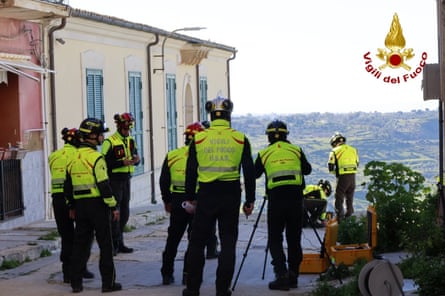
Firefighters in the Sicilian town of Niscemi have completed a high-stakes recovery operation to retrieve approximately 400 rare books from a municipal library currently teetering on the edge of a massive, four-kilometer chasm. The precarious structure, which was partially undermined by a devastating landslide in late January, has become the focal point of an international effort to preserve Sicily’s cultural heritage before the building collapses into the valley below. Specialized teams from the Caltanissetta provincial fire brigade utilized advanced monitoring technology and tactical entry methods to secure the volumes, some of which date back to the 16th century.
The rescue mission follows weeks of geological instability in Niscemi, a hilltop town that has seen entire sections of its infrastructure swallowed by shifting earth. The library now stands on the literal lip of a precipice, with a portion of the reinforced concrete foundation hanging in mid-air. Officials described the operation as a race against time and nature, as geologists warn that the landslide front is expected to retreat by another 10 to 15 meters in the coming weeks, a shift that would almost certainly result in the total destruction of the remaining structure.
High-Stakes Recovery Amid Geological Instability
The recovery operation, which launched early Monday morning, required months of preparatory work and a level of precision usually reserved for tactical law enforcement interventions. Before any personnel set foot near the "black zone"—the area deemed most at risk of immediate collapse—engineers conducted a comprehensive study of the library’s floor plans. Using interior photographs and archival maps, the team charted the exact location of the most valuable collections to minimize the time spent inside the unstable building.
To access the books, firefighters opted against using the primary entrance, which was deemed too structurally compromised. Instead, they drilled through the rear wall of an adjacent, more stable building to create a secondary access point. Working in short, timed bursts of only a few minutes, rescuers entered the library, strapped entire bookcases together with heavy-duty tension cables, and hauled them backward toward the breach. This method allowed the teams to stay as far from the cantilevered section of the floor as possible while still reaching the deep shelves.
Salvatore Cantale, the provincial commander of the fire brigade in Caltanissetta, likened the intensity of the mission to a "bank heist." He noted that the speed of the operation was dictated by the constant threat of a sudden structural failure. "We had to be quick and try to take away as much as we could," Cantale said, emphasizing that every second spent inside the building was a calculated risk.
Advanced Monitoring and the Rescue After the Landslide
The safety of the personnel was managed through a sophisticated network of electronic surveillance. A drone was deployed to provide a live aerial feed of the building’s exterior, allowing ground commanders to watch for external signs of crumbling or shifting soil. Meanwhile, laser sensors were fixed to the section of the library teetering over the drop. These sensors were calibrated to detect the slightest millimeter-scale movement, providing an early warning system for the teams inside.
In addition to the lasers, a separate seismic monitoring device was installed to track vibrations and subtle shifts in the building’s tilt. Because the library is constructed as a single, rigid reinforced-concrete block, geologists believe it will not crumble piece by piece but will instead slide downhill as a unified mass. While this makes the building a death trap for anyone inside during a shift, it also offers a glimmer of hope for the recovery of the remaining 3,600 volumes. Commander Cantale explained that if the building slides as a single block, it may be safer to recover the remaining collection from the valley floor once the structure has settled.
The Cultural Significance of the Niscemi Collection
The library in Niscemi serves as a vital repository for Sicilian history and European literature, housing roughly 4,000 volumes. The collection includes rare editions of historical texts, local chronicles, and general nonfiction. Among the 400 items rescued this week were several irreplaceable editions printed before 1830, focusing on the complex socio-political history of the Mediterranean island.
The "crown jewel" of the collection is a 16th-century manuscript, which was among the first items prioritized for extraction. Scholars and historians have voiced deep concern over the potential loss of these works, noting that they provide a unique window into the regional identity of Niscemi and the broader Caltanissetta province. The loss of such a collection would represent a significant blow to Italy’s "patrimonio culturale" (cultural heritage), which is already under constant threat from the country’s volatile geography.

The Landslide in January: A Town in Crisis
The disaster that led to the library’s current state began on January 25, when the ground beneath Niscemi started to move with terrifying speed. The landslide was triggered by a combination of heavy rainfall and the inherent instability of the clay-rich soil upon which much of the town is built. Within hours, asphalt roads began to crack, and a 4km chasm opened up, carving through residential neighborhoods and public infrastructure.
The scale of the destruction has been immense. A stretch of road, along with several parked cars and vans, vanished into the void as the slope gave way. To date, more than 1,600 residents have been evacuated from their homes, many of which now sit in the "black zone." For the people of Niscemi, the library rescue is a rare piece of positive news in a month defined by anger and despair. Many residents have expressed frustration with the local and national government, arguing that the geological risks of the area were well-documented and that more should have been done to stabilize the slopes before the January catastrophe.
Future Operations and the Use of Robotics
While the rescue of 400 books is a success, the vast majority of the library’s collection remains trapped in the basement. This area is currently considered the most dangerous part of the structure, as it is located directly beneath the primary fracture point of the foundation. Officials are currently investigating the possibility of using specialized robots to enter the lower levels, but such equipment is not currently available in the Niscemi region.
"If we can find the robot, we’ll use it immediately. Otherwise, we’ll have to wait," Cantale stated. The technical challenge lies in finding a robotic unit capable of navigating tight, cluttered spaces while being heavy enough to move crates of books but light enough not to trigger a structural collapse. Until such technology is secured, the remaining 3,600 volumes are at the mercy of the elements and the shifting earth.
National Response and the "Florios of Sicily" Influence
The plight of the Niscemi library captured national attention in Italy after several prominent cultural figures launched a public appeal. Leading the charge was Stefania Auci, the author of the international bestseller The Florios of Sicily. Auci, along with other prominent Italian writers, urged the government to prioritize the "cultural rescue" of the books, arguing that the preservation of history is as essential as the preservation of physical infrastructure.
Speaking to the news agency Adnkronos, Auci expressed relief at the success of the first phase of the operation. "I don’t know whether our appeal truly helped ensure that some of those ancient volumes were saved, but I like to think it played at least a small part," she said. Her involvement helped elevate the story from a local disaster to a national conversation about how Italy protects its decentralized cultural treasures during environmental crises.
Broader Implications for Sicilian Infrastructure
The Niscemi landslide is not an isolated incident but rather a symptom of a broader crisis facing the Italian south. Sicily, in particular, is highly susceptible to hydrogeological instability. Decades of unauthorized construction, combined with a lack of maintenance on drainage systems and the increasing frequency of extreme weather events linked to climate change, have left many Sicilian hilltop towns vulnerable.
Environmental experts suggest that the "Niscemi model"—where entire sections of a town must be abandoned—could become more common if significant investments are not made in soil stabilization and urban planning. For now, the focus remains on the immediate recovery of assets and the resettlement of the 1,600 displaced residents. The rescued books have been transported to a secure, climate-controlled location in a neighboring municipality, where they will be cataloged and assessed for any damage caused by the humidity and dust of the landslide site.
The successful extraction of the first 400 books stands as a testament to the bravery of the Sicilian firefighters and the technical ingenuity of the recovery teams. While the library itself may soon succumb to the chasm, the words and history contained within its most precious volumes have been granted a second life. The operation continues to be monitored closely as officials weigh the risks of returning for the remaining collection before the earth moves again.