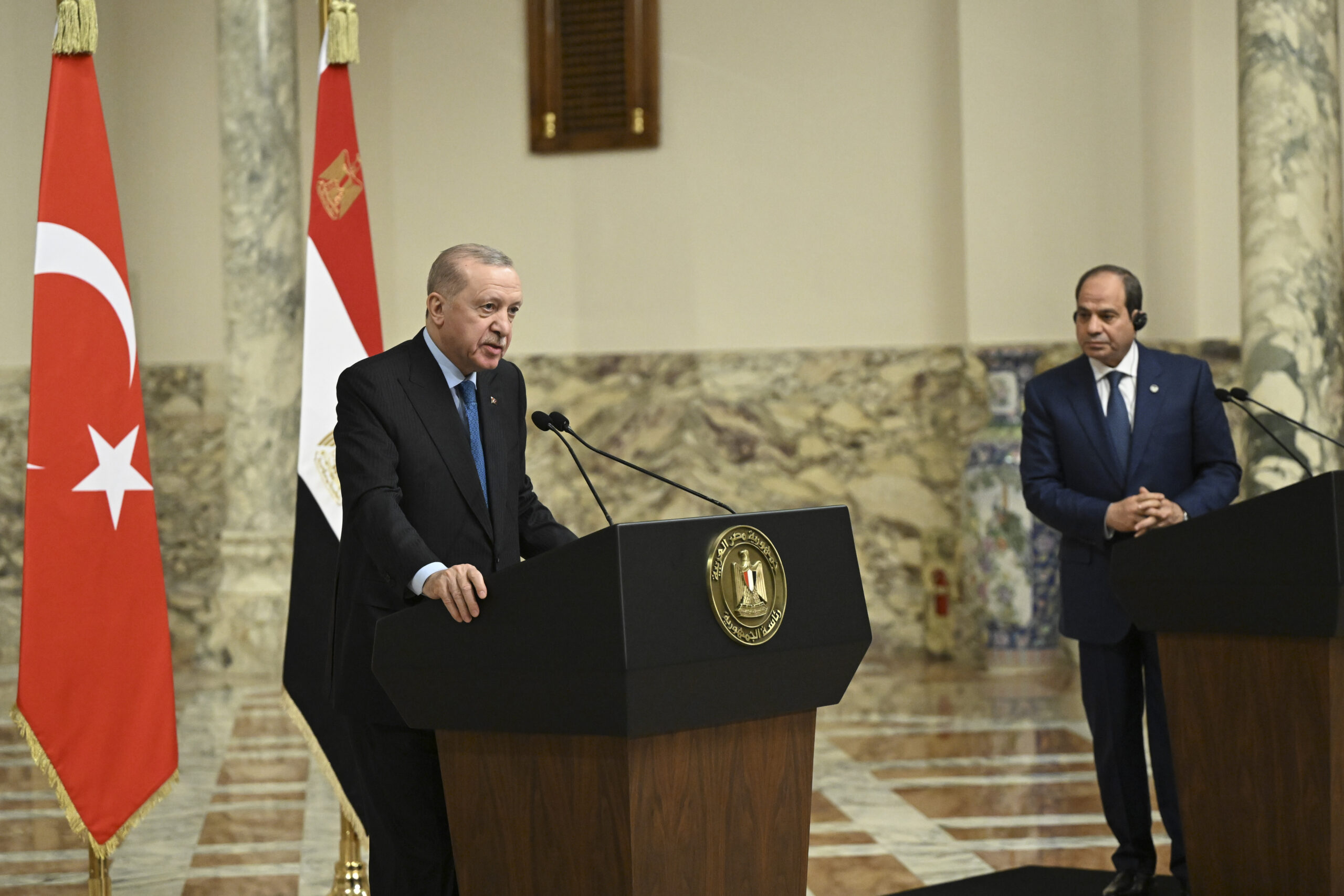
Cairo, Egypt – Turkish President Recep Tayyip Erdogan and Egyptian President Abdel Fattah el-Sisi have jointly condemned alleged violations of a ceasefire in Gaza, emphasizing the urgent need for the full implementation of a U.S.-backed plan aimed at ending the ongoing conflict. The leaders made these strong pronouncements during a joint press conference in Cairo on Wednesday, following a series of deadly Israeli attacks in the Palestinian enclave. Erdogan’s official visit to Egypt, marked by discussions on a range of bilateral and international issues, underscored the strategic importance of this high-level engagement in the volatile Middle East.
The humanitarian crisis in Gaza was a central focus of the talks, with both leaders acknowledging the persistent tragedy unfolding in the besieged territory. President Erdogan explicitly stated that the Palestinian cause had been the paramount item on their agenda, highlighting the dire humanitarian situation exacerbated by recent Israeli military actions. He further pledged that Turkiye and Egypt would maintain close coordination on peace initiatives for Gaza, a region that has been subjected to relentless Israeli attacks, which, despite a purported truce, have resulted in significant civilian casualties, including children.
The discussions extended beyond the immediate crisis in Gaza, encompassing a broader spectrum of international concerns that are critical to regional stability. Presidents Erdogan and el-Sisi also addressed the escalating geopolitical tensions involving Iran, the ongoing civil strife in Sudan, and the complex situation in Somaliland. Their shared commitment to addressing these multifaceted challenges reflects a growing desire for coordinated diplomatic efforts among key regional powers.
A particular point of emphasis was the necessity of establishing a durable truce and a comprehensive peace settlement to bring an end to Sudan’s protracted civil war, which has been ongoing for nearly three years. This shared stance on Sudan signals a unified approach to resolving internal conflicts that have destabilized neighboring countries and contributed to wider regional insecurity.
President Erdogan also weighed in on the delicate diplomatic dance surrounding Iran, a nation with which Turkiye is actively attempting to mediate between the United States and Iran amidst a backdrop of heightened tensions. He articulated that diplomacy remains the "most appropriate method" for resolving disputes, including the contentious issue of Iran’s nuclear program. This diplomatic overture from Turkiye underscores its ambition to play a pivotal role in de-escalating international conflicts through dialogue and negotiation.
Furthermore, President Erdogan voiced strong criticism regarding Israel’s recognition of Somaliland the previous year, characterizing the move as a direct infringement on Somalia’s sovereignty. This condemnation highlights Turkiye’s adherence to international principles of territorial integrity and its opposition to actions that could destabilize fragile states. The Turkish president’s stance aligns with a broader concern among many nations regarding the potential for such recognitions to undermine regional stability and international law.
Boosting Bilateral Trade to $15 Billion
Beyond the critical geopolitical discussions, the meeting between Presidents Erdogan and el-Sisi also focused on tangible economic cooperation, with the signing of several bilateral agreements spanning defense, health, and agriculture sectors. The leaders expressed a clear ambition to significantly deepen trade ties between Turkiye and Egypt, a sentiment echoed by President el-Sisi.
"We also affirmed the necessity of working to raise the volume of trade exchange to $15 billion and removing any obstacles that may hinder achieving this goal," stated President el-Sisi. This ambitious target underscores the economic potential of enhanced cooperation between the two nations. Both leaders were slated to participate in the closing session of a bilateral business forum in Cairo, an event designed to foster stronger commercial links and explore new investment opportunities.
President Erdogan’s visit to Cairo followed a significant diplomatic trip to Saudi Arabia the previous day, where Ankara also signaled its intent to bolster economic and energy cooperation. This engagement marked Erdogan’s first visit to the Kingdom in over two years, signaling a thawing of relations that had been strained following the 2018 killing of journalist Jamal Khashoggi. The renewed dialogue indicates a strategic realignment in the region, with both Turkiye and Saudi Arabia seeking to strengthen their economic and geopolitical partnerships.

The Turkish presidency issued a statement detailing the agreements reached with Saudi Arabia, emphasizing the commitment to enhance collaboration in critical sectors such as oil, petroleum products, and petrochemicals. Additionally, the two nations agreed to bolster cooperation in electricity and renewable energy, leveraging Saudi Arabia’s substantial investments in the energy sector. This focus on energy cooperation reflects a shared interest in securing energy supplies and developing sustainable energy solutions.
Geopolitical Shifts and Regional Dynamics
The convergence of Erdogan and el-Sisi in Cairo comes at a pivotal moment for the Middle East, a region grappling with a complex web of conflicts and shifting alliances. The renewed engagement between Turkiye and Egypt, two of the most influential nations in the region, signals a potential for a more unified approach to addressing shared challenges, particularly concerning the Israeli-Palestinian conflict.
The ongoing conflict in Gaza, characterized by frequent escalations and a devastating humanitarian toll, continues to be a significant concern for regional leaders. The international community has largely condemned the excessive use of force and the dire living conditions in the enclave, with calls for a lasting political solution growing louder. The U.S.-backed plan mentioned by the leaders represents one of the latest diplomatic efforts to broker peace and stability.
The mention of a "genocidal war" in relation to Israel’s actions in Gaza, as articulated in the original report, reflects a highly contentious and charged perspective. International legal definitions of genocide are subject to rigorous scrutiny, and such accusations are typically reserved for findings by international courts. However, the strong language employed by some leaders underscores the profound human suffering and the deep-seated grievances associated with the conflict.
The leaders’ focus on Sudan’s civil war also highlights the interconnectedness of regional security. The conflict has led to a massive displacement of people, a severe humanitarian crisis, and has spilled over into neighboring countries, exacerbating regional instability. Any coordinated effort by Turkiye and Egypt to mediate a peace deal could have a significant impact on the trajectory of the conflict and the well-being of millions of Sudanese citizens.
Diplomacy Amidst Rising Tensions
President Erdogan’s emphasis on diplomacy in resolving disputes, particularly concerning Iran, is a testament to Turkiye’s active role in international mediation efforts. The complex relationship between Iran, the United States, and other global powers, particularly regarding Iran’s nuclear program, has been a source of considerable global concern. Turkiye’s willingness to engage in dialogue and facilitate communication underscores its strategic position as a bridge between different geopolitical blocs.
The criticism leveled against Israel’s recognition of Somaliland by President Erdogan also sheds light on broader issues of state sovereignty and territorial integrity. In a region prone to fragmentation and conflict, adherence to international norms is crucial for maintaining stability. Turkiye’s stance aligns with the principles of respecting the sovereignty of existing states and avoiding actions that could further destabilize already fragile nations.
Economic Aspirations and Future Cooperation
The ambition to raise bilateral trade to $15 billion between Turkiye and Egypt is a significant economic goal. This target signifies a commitment to leveraging economic interdependence as a tool for fostering stability and mutual prosperity. Increased trade can lead to job creation, investment, and a stronger economic foundation for both nations, potentially reducing their susceptibility to external economic shocks.
The deepening of economic ties with Saudi Arabia, following a period of strained relations, is another indicator of evolving regional dynamics. The focus on energy cooperation, particularly in oil, petroleum products, and renewable energy, reflects a strategic imperative for both countries. Saudi Arabia’s vast energy resources and Turkiye’s growing industrial and technological capacity create synergistic opportunities for collaboration. This renewed partnership could have significant implications for global energy markets and the transition to cleaner energy sources.
The implications of these high-level meetings are far-reaching. The coordinated efforts between Turkiye and Egypt, coupled with improved relations with Saudi Arabia, could reshape the geopolitical landscape of the Middle East. A more unified regional approach to conflict resolution, economic development, and security cooperation could lead to greater stability and prosperity for all nations involved. The ongoing efforts to de-escalate tensions in Gaza and Sudan, alongside diplomatic engagement on issues concerning Iran, will be closely watched by the international community. The success of these diplomatic endeavors will ultimately depend on the sustained commitment of all parties involved to dialogue, compromise, and the pursuit of lasting peace.