Peacock’s latest streaming offering, The ‘Burbs, a series-length reimagining of the 1989 cult classic dark comedy, presents an ambitious but ultimately uneven exploration of American suburbia, with star Keke Palmer emerging as its most compelling asset. The series, which premiered on Sunday, February 8, attempts to update the original film’s premise by shifting the narrative focus to new residents navigating the deceptive tranquility of a seemingly idyllic community. While its thematic ambitions are notable, the execution often struggles with tonal inconsistencies and underdeveloped characterizations.
Reimagining a Cult Classic for the Streaming Era
The original The ‘Burbs, starring Tom Hanks, depicted a suburban homeowner’s escalating paranoia about his mysterious new neighbors. The Peacock reboot cleverly twists this premise, introducing Samira (Keke Palmer) and Rob Fisher (Jack Whitehall) as the initial newcomers to the cul-de-sac. Their arrival in the seemingly perfect Hinkley Hills marks a significant departure from the source material, setting the stage for a broader examination of contemporary suburban life. This foundational shift allows the series to explore the push and pull between individual identity and communal conformity, as well as the inherent allure and hidden dangers often associated with such communities. However, early critical assessments indicate that despite this promising setup, the series frequently grapples with an unwieldy structure, leading to a narrative that is both lumpy and somewhat indistinct.
Celeste Hughey’s Vision for Hinkley Hills
Creator Celeste Hughey, known for her work on Apple TV’s Palm Royale and Netflix’s Dead to Me, brings a seasoned understanding of crafting narratives where picturesque settings conceal sinister undercurrents. Hinkley Hills, though its state remains unspecified, is deliberately portrayed as a knowing cliché of white upper-middle-class bliss. From its literal picket fences to its oft-repeated, ominous slogan — "The safest town in America!" — the town immediately signals that its perfect façade likely hides a more troubling reality. This familiar trope, common in numerous suburban-set dramas, serves as an immediate tip-off for viewers attuned to such narrative conventions. Hughey’s prior experience in dark comedies that peel back the layers of seemingly perfect lives provides a strong foundation for this thematic exploration.
The Fisher Family’s New Beginning
For Rob Fisher, returning to the Colonial home where he grew up signifies a nostalgic homecoming. His perspective contrasts sharply with that of his wife, Samira, a former big-city lawyer who, until 18 months prior, led a vastly different life. Now on maternity leave with their newborn son, Miles, Samira views the move into this uncharted territory with a mixture of hope for a comfortable haven and underlying apprehension. Initially, she finds herself charmed by quaint suburban novelties, such as seeing live fireflies, yet simultaneously wary of the neighbors whose introductions are frequently punctuated by unintentional, eyebrow-raising microaggressions. This duality establishes Samira as an outsider, her perspective crucial to unraveling the town’s mysteries.
A Deepening Mystery and Social Commentary
Samira’s initial wariness sharpens into full-blown suspicion with the arrival of Gary (Justin Kirk), a sour-faced recluse who takes residence in the dilapidated Victorian across the street. Her conviction that Gary is connected to the disappearance of a teenage girl two decades prior intensifies, fueled not just by boredom and "baby brain," as she insists, but by a growing sense of unease. Hughey expertly links Samira’s obsession with the mystery to her anxieties about assimilation and identity in a new environment. As a Black woman in a predominantly white community, Samira is acutely aware of how much she stands out, not only due to her race but also her unfamiliarity with local customs and her vibrant, trendy style amidst a sea of drab cardigans and tasteful polos, a visual distinction effectively highlighted by costume designer Trayce Gigi Field.
The series directly addresses these racial and cultural tensions. Samira, referencing the critically acclaimed film Get Out, remarks on the unsettling atmosphere to Naveen (Kapil Talwalkar), Rob’s childhood best friend and one of the few other non-white residents of Hinkley Hills. While Naveen attempts to reassure her that the locals "like to think of themselves as nice, so they try to act nice, until they’re actually nice," Samira’s skepticism remains palpable. This is compounded by incidents like neighbors side-eyeing her for playing Mystikal’s "Shake Ya Ass" in front of her son or calling the police when she attempts a friendly drop-by. These moments underscore the series’ attempt to weave poignant social commentary into its dark comedic fabric, highlighting the microaggressions and systemic biases that can plague seemingly benign communities.
Flickering Themes and Narrative Ambivalence
As Samira delves deeper into the Gary mystery, the broader thematic underpinnings of The ‘Burbs occasionally become muddled. The series struggles to maintain a consistent focus on its larger messages, leaving viewers uncertain about the depth of its intended social critique or how profoundly it expects them to engage with its themes. This narrative ambivalence, while perhaps an honest reflection of the show’s own uncertainty regarding its setting, contributes to the overall unevenness. The show’s premiere, directed by Nzingha Stewart, particularly highlights this struggle, vacillating between sardonic humor, goofy moments, and earnest dramatic beats without firmly committing to a singular tone.
Keke Palmer’s Captivating Performance
Despite these narrative inconsistencies, Keke Palmer emerges as the undeniable standout, providing the most compelling reason to continue watching The ‘Burbs. The One of Them Days star possesses a remarkable ability to generate chemistry with nearly any co-star. Her dynamic with Jack Whitehall as Rob is particularly endearing, portraying a couple still in the honeymoon phase of their commitment, their interactions marked by believable affection and inside jokes. Their on-screen rapport makes their relationship feel authentic and provides a grounding emotional core for the series.
Palmer’s scenes with RJ Cyler, who plays Samira’s brother, Langston, are equally delightful. Though Langston primarily appears via FaceTime, offering an outside voice of reason from the big city, Cyler makes a vivid impression with limited screen time. His warm and comfortable rapport with Palmer adds a layer of familial charm that, while not strictly essential to the main plot, enhances the viewing experience. His presence, albeit occasional, suggests potential for expanded involvement should the series secure a second season, offering more opportunities for this engaging sibling dynamic.
An Ensemble with Untapped Potential
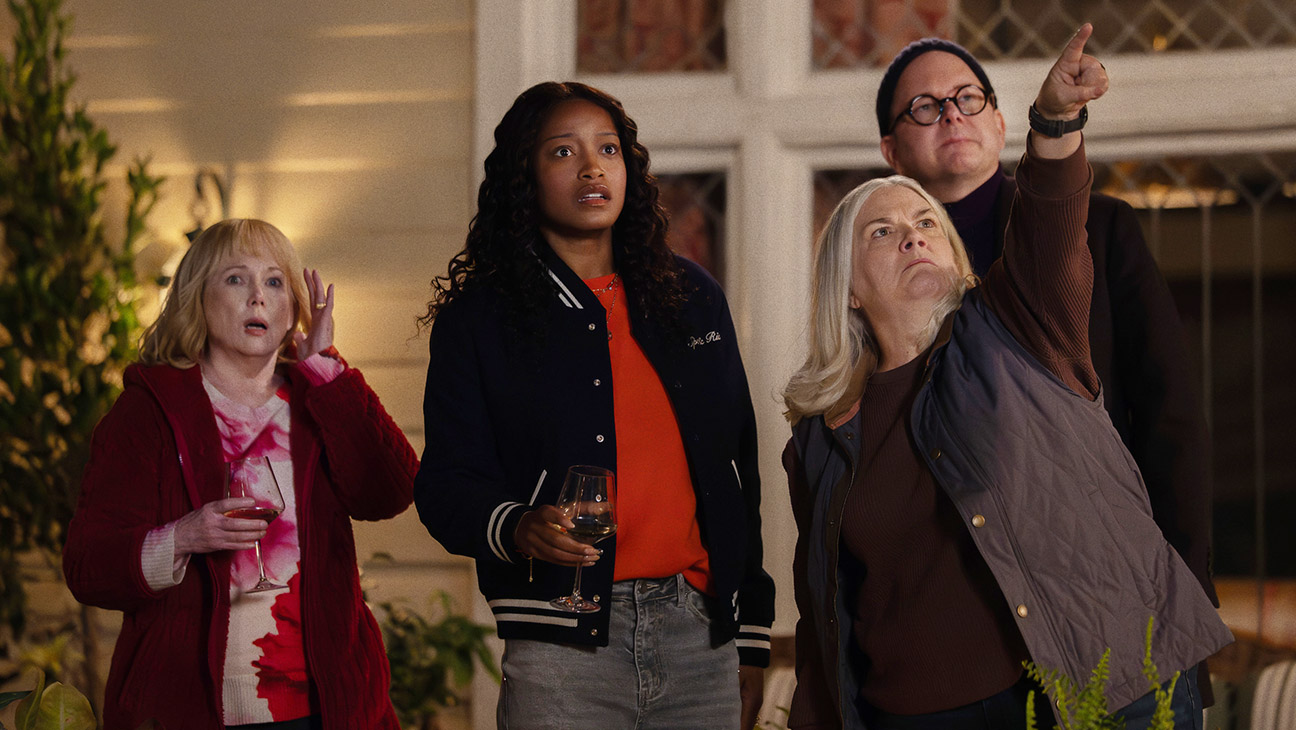
The supporting ensemble, featuring Julia Duffy as the recently widowed wine enthusiast Lynn, Paula Pell as the bored ex-Marine Dana, and Mark Proksch as the mysteriously wealthy nerd Tod, demonstrates more potential than immediate depth. These seasoned comedy professionals excel at delivering affectionate zingers and subtle comedic moments, such as Dana describing Tod as "adult Charlie Brown" or Tod’s awkward tap instead of a handshake upon meeting Samira. Their portrayals add quirky charm to the cul-de-sac’s social fabric, as they gather for happy hours on Lynn’s porch to exchange small-town gossip and eventually delve into Gary-based conspiracy theories with Samira.
However, for a significant portion of the series, these characters remain largely collections of eccentric quirks, lacking the internal complexity needed to make them truly knowable. This issue is a common pitfall in mystery-driven narratives, where characterizations are often deliberately kept vague to maintain plausible suspect lists. It is not until a crucial revelation around the fifth chapter, which clarifies who can be trusted, that the ensemble begins to cohere and the show’s narrative gains stronger footing. Even then, the reviewer notes that lingering lapses in logic and unresolved questions detract from the ultimate satisfaction of receiving answers.
A Fresh Take on Familiar IP
In an era saturated with intellectual property cash grabs that often merely stretch existing storylines without adding substantial value, The ‘Burbs stands out for treating its source material as a launching board rather than an inviolable text. By taking an established premise in entirely new directions, the series offers a refreshing approach to reboots. While it may not fully deliver on all its promises, and its portrayal of suburbia, much like the genre itself, proves to be a mixed bag, the series’ flashes of inspiration and peculiar charm make it a noteworthy entry. Despite its imperfections, the show garners enough unique qualities to warrant a critical nod, perhaps even meriting a toast with one of Lynn’s characteristic glasses of room-temperature Chardonnay. Its willingness to innovate within a familiar framework, coupled with Keke Palmer’s captivating performance, suggests that The ‘Burbs carves out its own distinct space in the landscape of streaming dark comedies.