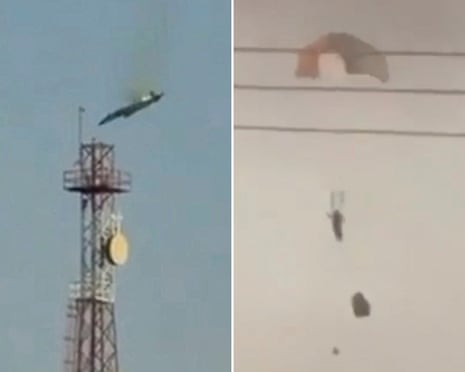
The U.S. Central Command confirmed Monday that Kuwaiti air defenses accidentally destroyed three American F-15 fighter jets during a period of intense combat operations targeting Iranian military assets. The friendly fire incident occurred as the region grapples with an unprecedented escalation of violence, prompting a joint statement from the United States and six allied Gulf nations condemning what they described as Tehran’s "indiscriminate and reckless attacks" across the Middle East.
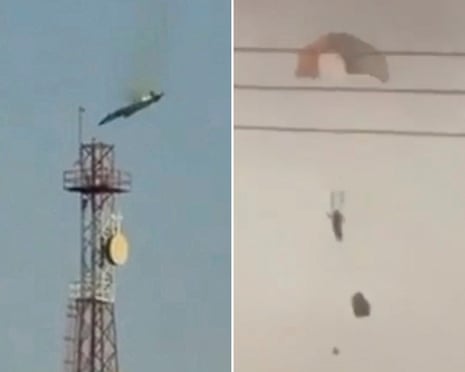
According to a statement released by U.S. Central Command (CENTCOM), all six aircrew members from the three F-15s managed to eject safely. Search and rescue teams recovered the pilots and weapons systems officers, who are currently listed in stable condition at a regional medical facility. The incident took place over Kuwaiti territory during a window of "active combat" that included a barrage of Iranian ballistic missiles, drones, and aircraft sorties.
CENTCOM officials stated that Kuwaiti air defenses, operating at a heightened state of alert to protect sovereign territory from incoming Iranian projectiles, misidentified the American warplanes. An investigation into the communication failures that led to the shoot-down is currently underway. This development comes as the U.S.-Israeli conflict with Iran enters its third day, following the high-profile killing of Iranian Supreme Leader Ayatollah Ali Khamenei and former President Mahmoud Ahmadinejad on Saturday.

Friendly Fire in Kuwait and the Risk to Regional Stability
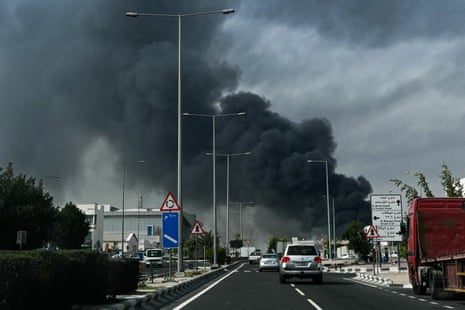
The loss of the three F-15s underscores the chaotic nature of the current multi-front air war. Military analysts suggest that the density of electronic warfare, combined with the sheer volume of incoming Iranian drones and missiles, has created a "fog of war" that endangers allied coordination. In Kuwait City, sirens have become a near-constant presence, and smoke was seen rising near the U.S. Embassy earlier Monday, prompting diplomatic officials to urge all American citizens to take immediate cover.
The U.S. Embassy in Kuwait issued a stern warning, noting a "continuing threat" of missile and drone strikes. While the embassy remains operational, staff have been directed to minimize movement. Local reports from the Al Jahra region of Kuwait described the moment the burning aircraft fell from the sky, with social media footage showing parachutes drifting toward the desert floor amidst the sounds of distant explosions.

The joint statement from the U.S., Kuwait, Saudi Arabia, Bahrain, Qatar, Jordan, and the United Arab Emirates emphasized that the current environment of volatility is a direct result of Tehran’s actions. The coalition argued that Iran’s behavior "violates the sovereignty of multiple states and threatens regional stability." They reaffirmed a collective right to self-defense while commending the air defense cooperation that has, until this incident, prevented even greater loss of life.
Energy Infrastructure Targeted as Iran’s ‘Reckless’ Attacks Threaten Regional Stability
Global energy markets are reacting with alarm as the conflict spreads to critical oil infrastructure. Saudi Arabia’s Energy Ministry announced on Monday that it had partially halted operations at the Ras Tanura refinery, one of the largest oil processing facilities in the Middle East. The decision followed a drone attack that ignited a fire at the complex. Although the fire was extinguished and damage was described as "minor," the precautionary shutdown has sent shockwaves through the industry.
The Ras Tanura complex has a capacity of 550,000 barrels per day. Its disruption, combined with the near-halt of shipping through the Strait of Hormuz, has caused Brent crude prices to soar. Prices jumped by 13% in early trading, hitting a 14-month high of $82 per barrel. Industry experts warn that if the Strait of Hormuz—through which roughly 20% of the world’s oil supply flows—remains blocked or contested, global economic disruption could reach levels not seen since the 1970s.
In Bahrain, the maritime security watchdog UKMTO reported that a vessel in the Port of Bahrain was struck by two "unknown projectiles," causing a fire on board. While the crew was evacuated safely and the fire extinguished, the incident further highlights the vulnerability of regional ports. Bahrain serves as the headquarters for the U.S. Navy’s 5th Fleet, making any attack on its maritime infrastructure a significant escalation.

Nuclear Safety Alarms as Iran’s ‘Reckless’ Attacks Threaten Regional Stability
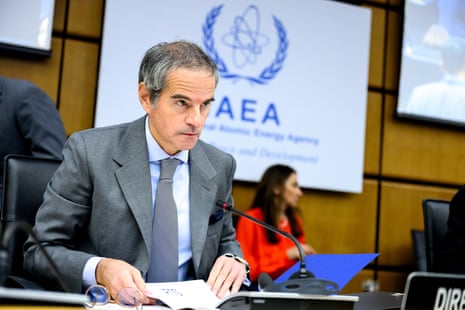
The specter of nuclear disaster has also loomed over the Monday proceedings. Rafael Grossi, Director General of the International Atomic Energy Agency (IAEA), warned that the mass evacuation of major cities might become necessary if civil nuclear power stations are targeted. Speaking at a board meeting in Vienna, Grossi expressed "strong frustration" that diplomatic efforts to curb Iran’s nuclear program had collapsed in favor of military force.
"We cannot rule out a possible radiological release with serious consequences," Grossi said, urging "utmost restraint" from all combatants. While the IAEA has so far seen no evidence of damage to the Bushehr nuclear power plant or the Tehran research reactor, the proximity of airstrikes to these sites remains a primary concern. Iran’s UN ambassador, Reza Najafi, alleged that the Natanz nuclear facility had been targeted by U.S.-Israeli strikes on Sunday, though these claims have not been independently verified.
The U.S. administration has defended its targeting of Iranian sites, citing the need to prevent Tehran from acquiring nuclear weapons. President Donald Trump, in a video statement, asserted that "an Iranian regime armed with long-range missiles and nuclear weapons would be a dire threat to every American." He urged the Iranian Revolutionary Guard to lay down their arms or "face certain death."
Expanding Fronts in Lebanon and the Mediterranean
The conflict has rapidly expanded beyond the borders of Iran and the Gulf. In Lebanon, the Israeli Defense Forces (IDF) have intensified airstrikes against Hezbollah positions in Beirut and the south. The Lebanese Health Ministry reported that at least 31 people were killed and 149 wounded in Monday’s strikes. Hezbollah, a key ally of Tehran, launched its own barrage of missiles and drones into Israel in retaliation for the death of Ayatollah Khamenei.

An IDF spokesperson told reporters that "all options are on the table," including a potential ground invasion of Lebanon. The military has issued evacuation orders for 55 villages and towns across southern Lebanon, leading to a mass exodus of civilians toward the north. Highways from the Dahieh suburb of Beirut were reported to be gridlocked as residents fled amid the rubble of collapsed buildings.
Simultaneously, British forces in Cyprus are responding to suspected drone strikes at RAF Akrotiri. The UK Ministry of Defence confirmed that two unmanned drones heading toward the base were successfully intercepted early Monday. This follows a decision by Prime Minister Keir Starmer to allow the U.S. to use British bases for "defensive" strikes against Iranian missile sites, a move that has made British installations a direct target for Iranian retaliation.
Humanitarian Crisis and Political Fallout
The human cost of the three-day-old war continues to mount. The Iranian Red Crescent Society claimed on Telegram that 555 people have been killed across 131 cities in Iran due to U.S.-Israeli airstrikes. Among the most tragic reports was a missile strike on a girls’ elementary school in the southern city of Minab, which reportedly killed 148 people. International humanitarian organizations are on full alert, though the closure of regional airspace has made the delivery of aid nearly impossible.
In the United States, public opinion on the intervention remains deeply divided. A recent Reuters/Ipsos poll indicated that only 27% of Americans approve of the strikes that killed the Iranian leadership. Approximately half of the respondents expressed concern that the administration is too willing to use military force. Despite this, the White House has maintained that combat operations will continue "until all objectives are achieved."

Diplomatically, the situation remains at a stalemate. While President Trump claimed in an interview with The Atlantic that Iran’s new leadership expressed a desire to talk, Iran’s security chief, Ali Larijani, flatly denied this, stating that Tehran "will not negotiate with the United States." This refusal to engage at the diplomatic table, combined with the ongoing air campaign, suggests that the region faces a prolonged period of instability with no clear exit strategy in sight.