Explosions reverberated across the Persian Gulf on Sunday, marking a second day of escalating retaliatory strikes by Iran targeting United States interests and allies in the region. The volleys of attacks, which began Saturday, are Iran’s stated response to a coordinated assault by the U.S. and Israel that reportedly killed Supreme Leader Ayatollah Ali Khamenei and other high-ranking Iranian officials.
The renewed detonations were heard in Dubai, United Arab Emirates; Manama, Bahrain; and Doha, Qatar, amplifying fears of a significant regional conflict. These nations, long considered pillars of stability in the Middle East, are now engulfed in a rapidly unfolding crisis that threatens to destabilize the global energy market and international relations.
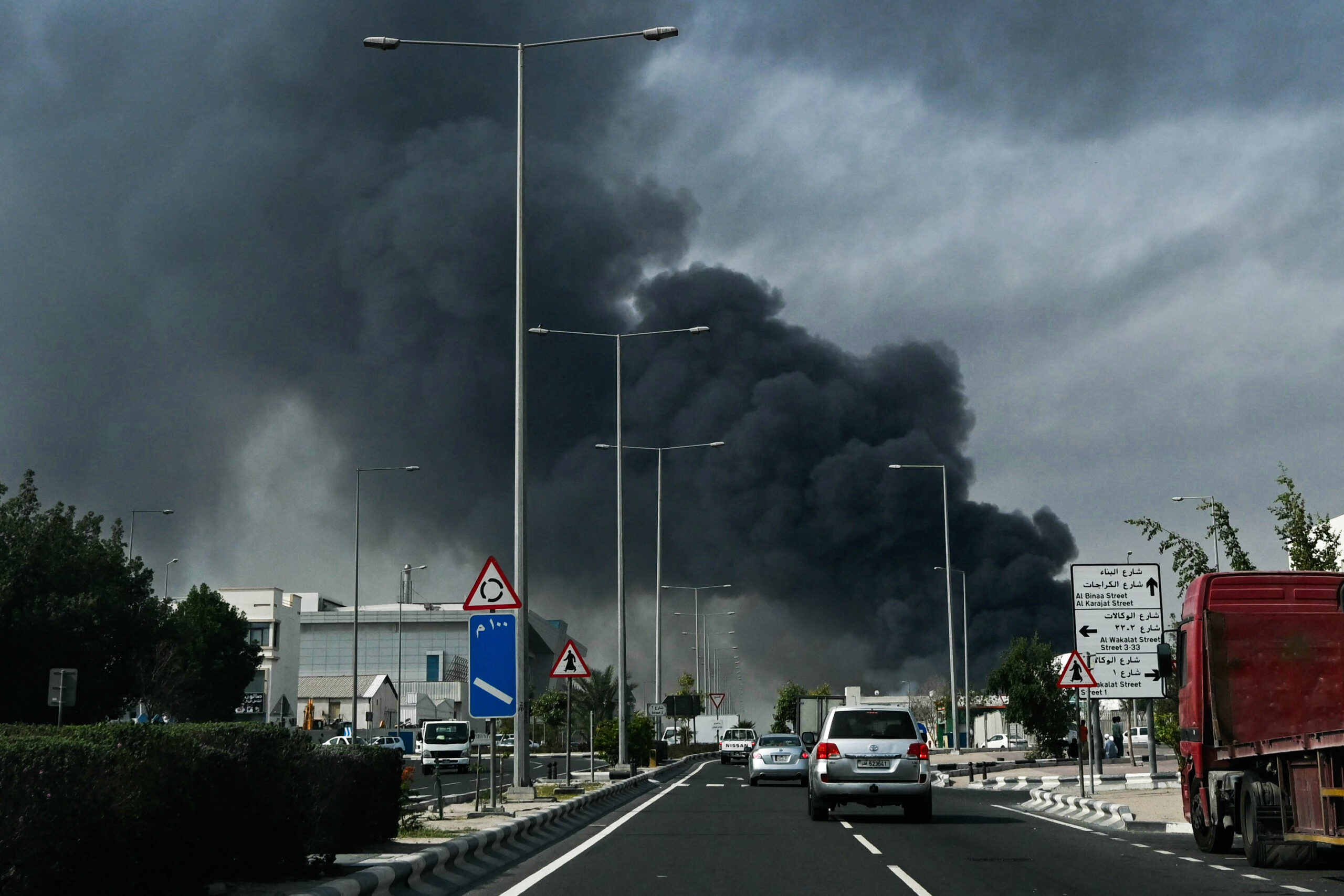
Witnesses in Doha described multiple loud concussions and observed plumes of thick black smoke ascending into the clear morning sky on the southern outskirts of the city. The sounds of explosions marked a stark contrast to the usual tranquility of the Qatari capital.
Shortly after the reports from Doha, a fresh series of blasts shook Dubai, a vital hub for international commerce and finance. In the skies above the emirate, streaks of white smoke indicated missile interceptions, while darker, more ominous billows of smoke rose from the port of Jebel Ali, one of the busiest maritime gateways in the Middle East.
Manama also reported hearing explosions, with eyewitness accounts detailing at least four distinct detonations. As of Sunday morning, authorities in Bahrain had not immediately confirmed any significant damage or casualties resulting from these blasts.
The sustained attacks followed a day of intense Iranian operations against U.S. military installations and associated assets across the Gulf. Oman, which has been actively mediating nuclear talks between the U.S. and Iran, was notably absent from the list of targeted nations, suggesting a deliberate effort to preserve a diplomatic channel.
The oil-and-gas-rich Arab states situated across the Persian Gulf from Iran collectively host thousands of U.S. military personnel. These strategic deployments underscore the region’s critical importance to global security and energy supply chains.
On Saturday, Iran launched an extensive barrage, firing 137 missiles and deploying 209 drones across the UAE, according to the country’s Ministry of Defence. The impacts were visible, with fires and smoke reaching iconic Dubai landmarks such as the Palm Jumeirah and the Burj al-Arab hotel.

At Abu Dhabi’s airport, an incident described by the facility’s authority resulted in at least one fatality and seven injuries. Dubai International Airport, renowned as the world’s busiest for international passenger traffic, and Kuwait’s airport also sustained hits, signaling a broad and coordinated Iranian offensive.
In Qatar, officials reported that Iran launched 65 missiles and 12 drones toward the Gulf state on Saturday. While the majority of these projectiles were intercepted, 16 individuals sustained injuries from the attacks.
The ripple effects of the conflict extended beyond the immediate Gulf states. Jordanian defense systems successfully intercepted missiles that entered the airspace of the capital, Amman, as well as northern regions of the country, according to Al Jazeera Arabic. Sirens also sounded in Kuwait, adding to the growing sense of unease across the region.
In northern Iraq, a drone reportedly crashed near Erbil International Airport, accompanied by a substantial plume of smoke. U.S. forces maintain a presence in Iraq’s autonomous Kurdish region as part of an international coalition combating ISIS.
Iran Vows Retaliation for "Great Crime"
Iranian President Masoud Pezeshkian has publicly condemned the killing of Ayatollah Khamenei, labeling it "a great crime." Adding to the significant losses for Iran’s leadership, the country’s armed forces chief of staff, Abdul Rahim Mousavi, was also reportedly killed in the joint U.S.-Israeli attacks.
Mohammad Bagher Qalibaf, Iran’s parliamentary speaker, issued a stern warning on Sunday, stating, "You [U.S. and Israel] have crossed our red line and must pay the price." He further threatened, "We will deliver such devastating blows that you yourselves will be driven to beg."
Former U.S. President Donald Trump responded to Iran’s retaliatory actions with a forceful statement on his Truth Social platform. He declared that the U.S. would respond "with a force that has never been seen before" if Iran launched further attacks in response to the killing of Khamenei, who had led Iran for 37 years. Trump’s warning underscored the volatile nature of the escalating tensions and the potential for a devastating military confrontation.
Israeli Strikes Deep Inside Iran
Israel’s military announced early Sunday that it had conducted strikes on over 30 targets within western and central Iran. The Israeli Defense Forces indicated that their operations would continue, focusing on Iranian air defense installations, missile sites, military headquarters, and other "regime targets."
The intensity of the conflict has led to significant casualties within Iran. Since Saturday, reports indicate that at least 201 people have been killed across the country. A particularly tragic incident involved an attack on an elementary girls’ school in the southern city of Minab, which resulted in the deaths of at least 148 individuals.

Iran’s Islamic Revolutionary Guard Corps (IRGC) claimed responsibility for retaliatory attacks against 27 U.S. bases, Israel’s Tel Nof airbase, the Israeli army’s command headquarters at HaKirya in Tel Aviv, and a major defense industrial complex within the city.
Shortly after 6 a.m. local time on Sunday, air raid sirens sounded repeatedly across Israel, including in Tel Aviv, following reports of explosions. The coordinated nature of these strikes suggests a significant shift in the operational capabilities and strategic objectives of Iran’s armed forces.
National Mourning and Political Transition
In response to the death of their Supreme Leader, the Iranian government has announced the formation of a three-person interim council to manage the country’s transition. Supporters of Ayatollah Khamenei took to the streets in Tehran and other cities to express their grief and solidarity.
President Pezeshkian declared seven days of public holidays in addition to the 40 days of national mourning already announced by the government. This period of deep national mourning is expected to be accompanied by increased political rhetoric and a heightened sense of national resolve.
Regional Stability Under Threat
The escalating conflict in the Persian Gulf region presents a grave threat to global stability and the international energy market. The interconnectedness of the region’s economies and the presence of major global powers raise concerns about a wider conflagration.
The attacks on key infrastructure in Dubai, Doha, and Manama highlight the vulnerability of these prosperous nations and their critical role in global trade. The potential disruption to shipping lanes and oil production could have far-reaching economic consequences worldwide.
The U.S. military presence in several Gulf states means that any direct confrontation between Iran and its regional adversaries could quickly draw in American forces, escalating the conflict further. The diplomatic efforts to de-escalate the situation are now more critical than ever, as the region stands on the precipice of a potentially devastating war.
The coordinated nature of the Iranian strikes, targeting both U.S. assets and allied nations, indicates a strategic decision to exert maximum pressure and demonstrate a willingness to engage in widespread retaliation. The measured but firm response from Israel and the U.S. suggests a determination to project strength and deter further aggression.
The coming days are likely to be fraught with tension and uncertainty. The reactions from international bodies, regional powers, and global markets will be closely watched as the crisis unfolds. The world is now focused on the Persian Gulf, where the consequences of this rapidly escalating conflict could reshape the geopolitical landscape for years to come.