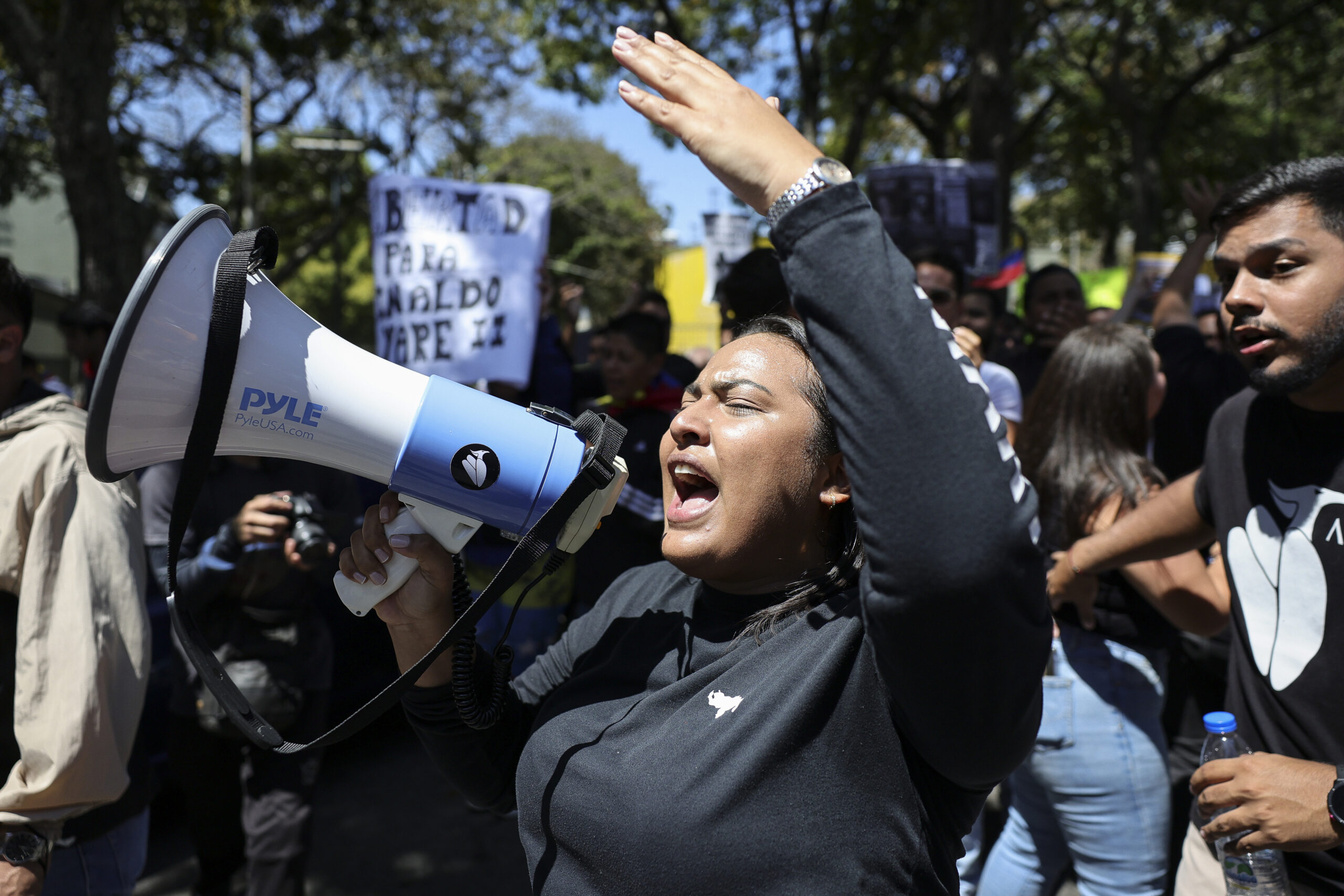
Thousands of Venezuelans took to the streets of the capital, Caracas, on Thursday in dueling demonstrations, underscoring the deep political divisions in the nation as its National Assembly convened to deliberate a crucial amnesty bill for political prisoners. The rallies coincided with Venezuela’s National Youth Day, marking the first significant public display of dissent against the government led by interim President Delcy Rodriguez, who assumed leadership following the United States’ alleged abduction of Venezuelan President Nicolas Maduro in January.
Rodriguez’s administration mobilized its supporters for counterprotests, ensuring a massive turnout for both factions. The show of force occurred as lawmakers debated a landmark piece of legislation that could grant amnesty to individuals detained for political reasons under Maduro’s tenure. The final vote on the bill has been unexpectedly postponed, despite prior government indications that it would be passed this week.
Since assuming office, Rodriguez has overseen the release of hundreds of individuals identified as political prisoners. These actions are widely interpreted as concessions aimed at appeasing the administration of United States President Donald Trump. Other policy shifts under Rodriguez include the significant reduction of Venezuelan oil shipments to Cuba and the implementation of legislation designed to attract more foreign investment into the nation’s state-controlled oil sector.
The release of political prisoners has been a long-standing central demand from both the Venezuelan opposition and international human rights organizations. However, concerns linger regarding the practical implementation of the amnesty legislation, particularly concerning eligibility criteria for release. The bill has yet to undergo a public reading, adding to the opacity surrounding its final form and scope.
Rodriguez initially announced the amnesty legislation last month, framing it as an initiative "to heal the wounds left by the political confrontation fuelled by violence and extremism." She stated that the bill would encompass what she termed the "entire period of political violence from 1999 to the present." The proposed amnesty would cover charges such as treason, terrorism, and the dissemination of hate speech, offenses frequently cited in the detention of dissidents over the past two decades.
However, reports suggest the bill would not extend to those convicted of more serious offenses, including murder, drug trafficking, corruption, or human rights violations. Alex Neve, a member of the United Nations’ Independent International Fact-Finding Mission for Venezuela, commented earlier this week that the bill "offers an opportunity to provide justice and alleviate the suffering of the many people who have been unlawfully detained for political reasons in Venezuela." Neve emphasized the critical need for transparency, stating that civil society groups "must be at the centre of this process."
Human rights groups have already expressed skepticism about the current government’s efforts to free political prisoners. Foro Penal, a Venezuelan human rights organization, has verified the release of at least 431 individuals, a figure that falls short of the government’s reported numbers. According to Foro Penal’s statistics, more than 600 political prisoners remain in custody. Critics point to the case of opposition politician Juan Pablo Guanipa, who, after his release, was subsequently placed under house arrest, raising further questions about the effectiveness and sincerity of the amnesty process.
Scrutiny Over Elections and Political Freedoms
Despite these reservations, the amnesty bill is being hailed by some as a significant breakthrough for a country that, until very recently, consistently denied the existence of political prisoners. The legislation also aims to lift bans preventing several prominent opposition leaders from participating in elections. Among those who could benefit is Nobel Peace Prize laureate Maria Corina Machado, who has been a vocal critic of the Maduro government.
The Maduro administration has faced persistent accusations of employing state-sanctioned violence to suppress opposition movements, including allegations of forced disappearances and torture. Furthermore, the government has been repeatedly accused of electoral irregularities, most notably in the 2024 presidential election, where Maduro controversially secured a third term. Machado had been selected as the opposition coalition’s nominee for the 2024 election but was disqualified from running months prior to the vote, a fate that also befell her successor, Corina Yoris. Ultimately, Edmundo Gonzalez ran as the opposition’s candidate, with the coalition and independent experts maintaining he was the rightful winner.
National Assembly leader Jorge Rodriguez, the president’s brother, recently stated that new presidential elections are not an immediate prospect, telling the U.S. media outlet Newsmax that "stabilization" must be achieved first. The Trump administration has also pushed back against calls for new elections in Venezuela, despite Machado’s assertions that the opposition possesses a "mandate" to govern.
Trump Denies Oil Magnate’s Role in Venezuela Policy
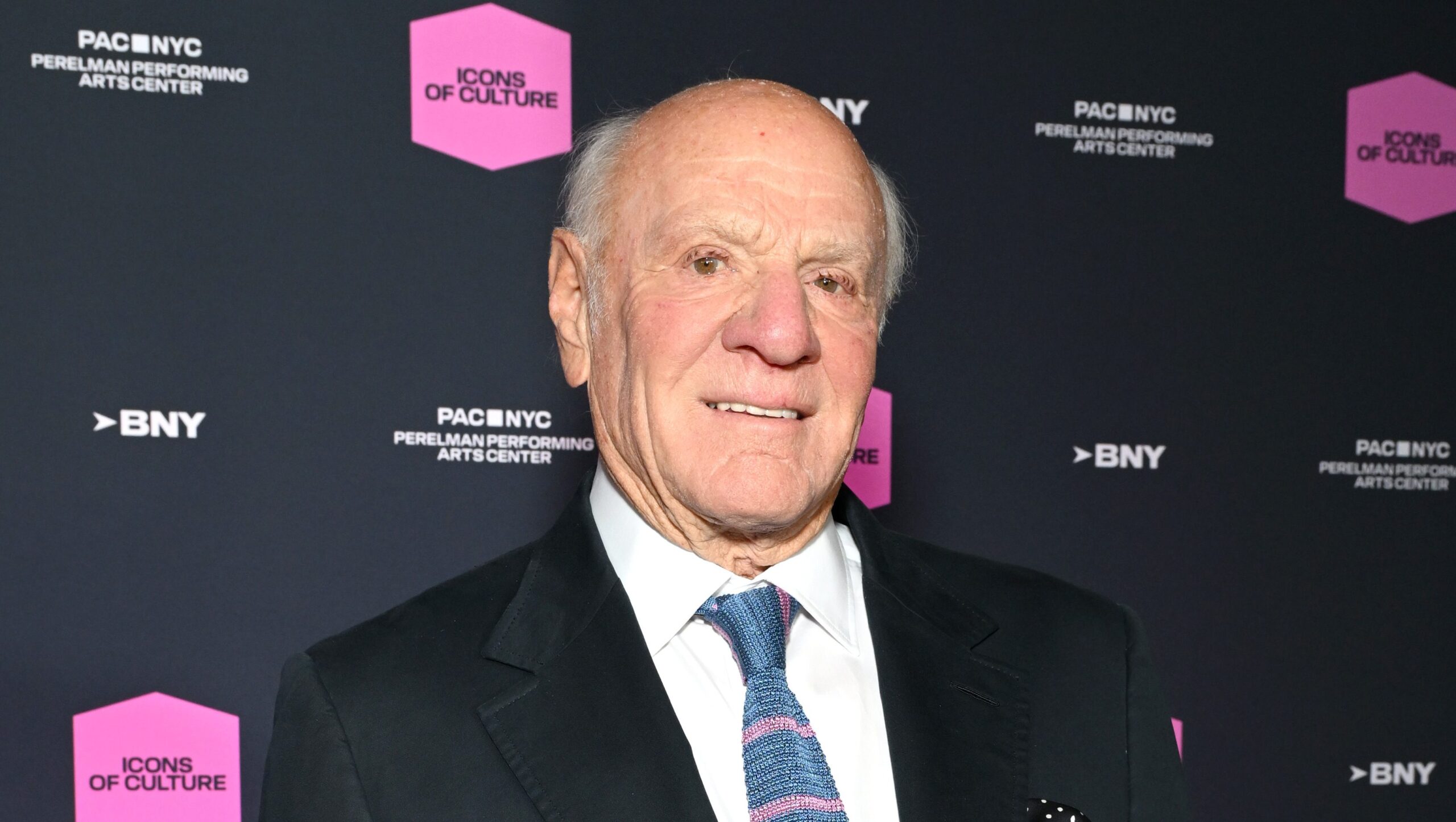
In a separate development on Thursday, President Trump used his Truth Social platform to refute claims that U.S. oil magnate Harry Sargeant III possessed the authority to make decisions on behalf of his administration regarding Venezuela. "He has no authority, in any way, shape, or form, to act on behalf of the United States of America, nor does anyone else that is not approved by the State Department. Without this approval, no one is authorized to represent our Country," Trump wrote.
This statement appeared to be a direct response to media reports suggesting Sargeant had been advising the U.S. administration on strategies to gain access to Venezuela’s substantial oil reserves, a key objective for Trump. Sargeant, who has extensive ties to Venezuela’s oil industry, is a Republican donor and reportedly has a personal relationship with Trump.
Trump further asserted in his post that his administration was "dealing very well" with the Rodriguez-led government. "Relations between Venezuela and the United States have been, to put it mildly, extraordinary!" Trump stated. He clarified, however, "But we speak only for ourselves, and don’t want there to be any confusion or misrepresentation."
Earlier in the week, on Wednesday, U.S. Energy Secretary Chris Wright met with Rodriguez in Caracas, where he expressed optimism about potential cooperation on oil production. Wright’s visit marked the first time a member of the Trump cabinet had visited Venezuela. The engagement signals a complex and evolving diplomatic landscape, with the U.S. simultaneously pursuing access to Venezuelan resources and navigating the domestic political implications of its foreign policy.
The ongoing debate over the amnesty bill, coupled with the shifting diplomatic overtures between the U.S. and Venezuela, highlights the precarious political and economic situation in the South American nation. The outcome of the amnesty legislation could have profound implications for the country’s internal stability and its international relations, particularly with the United States. The transparency and fairness of any amnesty process will be closely watched by human rights organizations and the international community, as Venezuela grapples with its past and attempts to chart a path toward a more stable future. The dual demonstrations in Caracas serve as a stark reminder of the deeply entrenched divisions that continue to shape the nation’s political discourse.