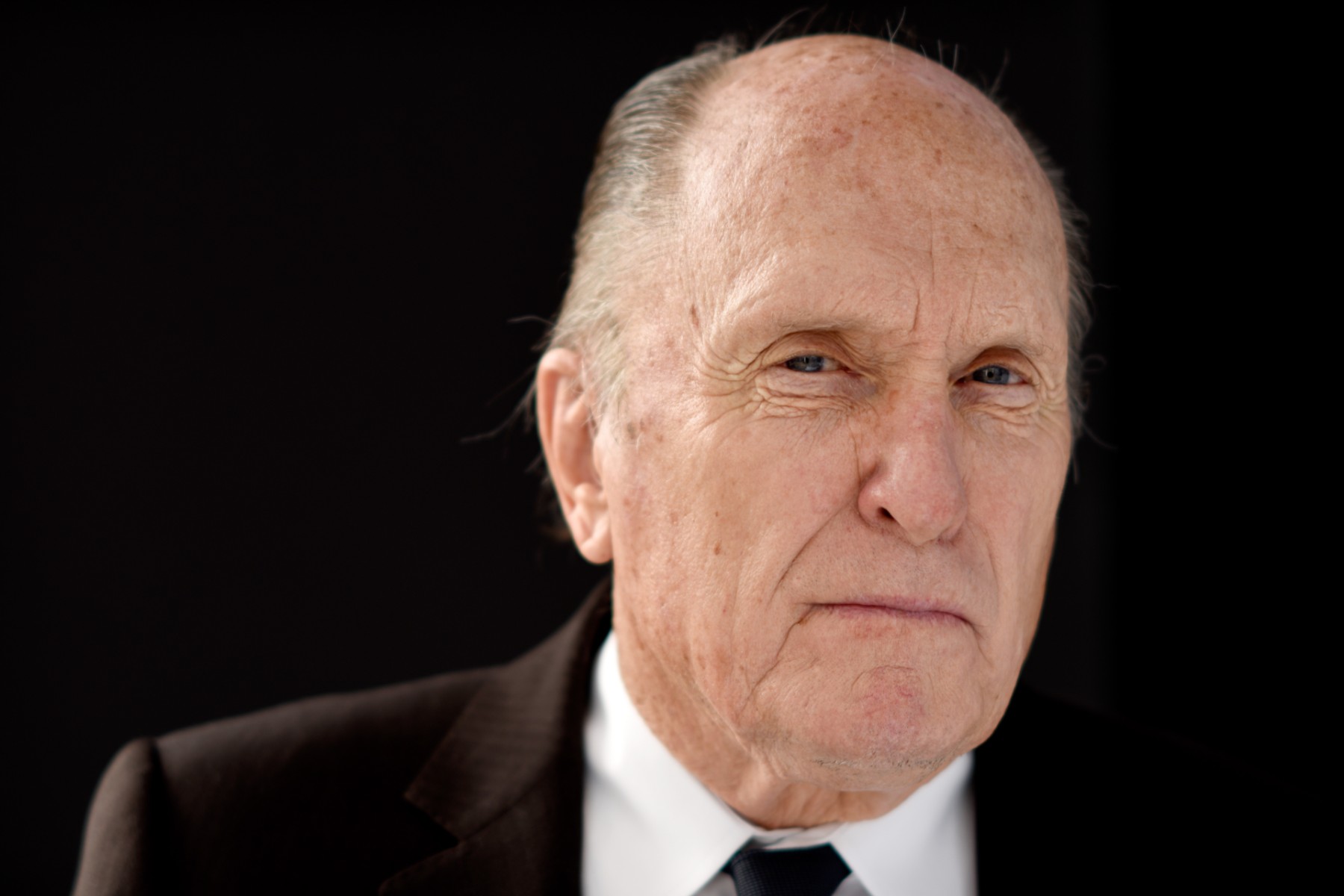
Robert Duvall, the celebrated Oscar-winning actor renowned for his unparalleled versatility and profound dedication to his craft, has passed away at the age of 95. His iconic performances spanned a remarkable career, from his indelible portrayal of the consigliere Tom Hagen in the seminal Godfather films to his poignant turn as an aging country music singer in Tender Mercies. Duvall died peacefully at his home in Middleburg, Virginia, on Sunday, February 15th, as confirmed by his publicist and a heartfelt statement from his wife, Luciana Duvall, shared on his official Facebook page.
A Legacy of Unforgettable Characters
Luciana Duvall reflected on her husband’s passing, stating, “To the world, he was an Academy Award-winning actor, a director, a storyteller. To me, he was simply everything.” She further elaborated on his passion, noting, “His passion for his craft was matched only by his deep love for characters, a great meal, and holding court. For each of his many roles, Bob gave everything to his characters and to the truth of the human spirit they represented.”
Duvall, often described as possessing neither the conventional leading man looks nor the archetypal "character actor" mold, forged a career that defied easy categorization. His performances ranged from the itinerant preacher to Soviet dictator Josef Stalin, showcasing an extraordinary breadth of talent. His film debut in 1962 as Boo Radley, the reclusive neighbor in To Kill a Mockingbird, immediately established him as an actor capable of imbuing even minor roles with profound depth. This initial success paved the way for a career that garnered him seven Academy Award nominations, culminating in a Best Actor Oscar for his unforgettable role in Tender Mercies (1983). His impressive accolades also include four Golden Globe Awards, notably for his portrayal of Gus McCrae in the acclaimed 1989 miniseries Lonesome Dove, a role he frequently cited as his personal favorite. In recognition of his significant contributions to the arts, Duvall was awarded the National Medal of Arts in 2005.
The Enduring Impact of ‘The Godfather’ and ‘Apocalypse Now’
Duvall’s trajectory in Hollywood was significantly amplified by his role in Francis Ford Coppola’s 1972 masterpiece, The Godfather. Having previously collaborated with Coppola on The Rain People, Duvall was cast as Tom Hagen, the adopted son and consigliere of the Corleone crime family. His nuanced performance as an Irishman navigating the intricate world of an Italian mafia family was a masterclass in subtle power and quiet authority. Hagen, though rarely the focal point, was an indispensable presence, providing counsel and strategic guidance that underscored the saga’s complex dynamics. Critic David Thomson aptly described Duvall’s contribution, noting, “Stars and Italians alike depend on his efficiency, his tidying up around their grand gestures, his being the perfect shortstop on a team of personality sluggers. Was there ever a role better designed for its actor than that of Tom Hagen in both parts of ‘The Godfather?’"
His collaboration with Coppola reached a different zenith in the epic war film Apocalypse Now (1979). As the larger-than-life Lieutenant Colonel Bill Kilgore, Duvall delivered one of cinema’s most memorable and chilling monologues. His character, a maverick helicopter pilot obsessed with surfing and napalm raids, embodied a potent, albeit deranged, form of masculinity. The iconic scene where Kilgore orders an attack to the soundtrack of Wagner’s "Ride of the Valkyries" cemented Duvall’s reputation for commanding presence and his ability to deliver powerful performances with remarkable efficiency. Coppola himself acknowledged Duvall’s unique talent, remarking, "Actors click into character at different times – the first week, third week. Bobby’s hot after one or two takes."
Duvall received an Academy Award nomination for Best Supporting Actor for his work in both The Godfather and Apocalypse Now. However, a significant dispute over compensation led him to decline an offer to appear in The Godfather Part III, a decision that was met with considerable disappointment from critics and fans alike. Duvall was vocal about his belief that his contributions warranted greater financial recognition compared to his co-stars.
The Method and the Temperament of a Master Craftsman
Colleagues often marveled at Duvall’s meticulous preparation and his controlled intensity. Michael Caine, who shared the screen with him in Secondhand Lions (2003), recalled Duvall’s pre-scene demeanor: "Before a big scene, Bobby just sits there, absolutely quiet; you know when not to talk to him." This profound focus, however, could also manifest as a formidable temper when interrupted or provoked. This was famously demonstrated during the filming of the John Wayne Western True Grit, where Duvall reportedly bristled at director Henry Hathaway’s instructions.
Versatility Beyond the Mafia and the Battlefield
Duvall’s Oscar win for Best Actor in Tender Mercies (1984) highlighted his profound ability to inhabit complex, down-and-out characters. He accepted the award dressed in a distinctive cowboy tuxedo with a Western tie, a visual representation of his connection to the American spirit. In 1998, he earned another Best Actor nomination for The Apostle, a deeply personal project he wrote, directed, produced, and largely financed. The film, which explored the life of a wayward Southern evangelist, was the result of years of dedicated research, including visits to numerous country churches, and a decade-long effort to bring it to fruition.

His extensive filmography includes a diverse array of memorable characters: the cunning outlaw gang leader ambushed in True Grit; the historical figure Jesse James in The Great Northfield Minnesota Raid; the beleaguered and eccentric Dr. Capt. "Pappy" O’Neill in The Great Santini; the manipulative TV executive in Network; Dr. Watson in The Seven-Per-Cent Solution; and the tyrannical father in The Great Santini. This latter role, based on Pat Conroy’s novel, drew parallels to his own father, Admiral Robert Selden Duvall, whom he described as "a gentleman but a seether, a stern, blustery guy, and away a lot of the time."
Duvall attributed his enduring career to a balanced approach to work and life. "When I was doing ‘Colors’ in 1988 with Sean Penn, someone asked me how I do it all these years, keep it fresh. Well, if you don’t overwork, have some hobbies, you can do it and stay hungry even if you’re not really hungry," he told The Associated Press in 1990. His commitment to acting remained strong even in his later years; he received a supporting actor Oscar nomination at the age of 83 for his role as the titular character in The Judge (2014). His more recent appearances included roles in Widows (2018) and 12 Mighty Orphans (2021).
Early Life and the Path to Acting
Born Robert Selden Duvall in San Diego, California, in 1931, he spent his formative years in Navy towns, including Annapolis, Maryland. His father’s naval career led the family to various postings, providing young Robert with exposure to diverse dialects and the psychological landscapes of military life, which would later inform his acting. He inherited his mother’s artistic inclinations, developing a talent for playing the guitar and performing, while also following his father’s footsteps as a wrestler.
Duvall’s academic path was initially uncertain. He struggled with coursework and narrowly avoided failing out of Principia College in Elsah, Illinois. His parents, concerned about him being drafted into the Korean War, encouraged him to pursue acting as a way to stay in college. This paternal suggestion proved to be a pivotal moment, as Duvall discovered a profound passion and aptitude for the dramatic arts. He recalled, "They recommended acting as an expedient thing to get through… I’m glad they did."
His early college experiences in drama classes were transformative. He spoke of a pivotal moment in a mime play where he played a Harlequin clown, and later, a deeply emotional performance in "All My Sons." A respected mentor, Frank Parker, a former dancer, declared that Duvall’s emotional delivery in the latter was "what I wanted to do."
After serving two years in the Army, Duvall utilized the G.I. Bill to enroll at the prestigious Neighborhood Playhouse in New York. There, he connected with a generation of aspiring actors who would go on to achieve significant fame, including Robert Morse, Gene Hackman, and Dustin Hoffman. Following a promising one-night performance in A View From the Bridge, Duvall began securing roles in television series such as The Naked City and The Defenders.
Personal Passions and Later Life
Beyond his mainstream acting career, Duvall dedicated himself to directing personal projects that allowed him to explore his artistic interests. These included the documentary We’re Not the Jet Set, a film about gypsies titled Angelo, My Love, and Assassination Tango, in which he also starred.
His passion for tango dancing, ignited by the musical Tango Argentina in the 1980s, led him to make numerous trips to Argentina to immerse himself in the dance and its culture. This culminated in the 2003 film Assassination Tango, a narrative about a hit man with a deep love for the dance.
It was during his extensive research for Assassination Tango that he met Luciana Pedraza, an Argentinian actress 42 years his junior, whom he married in 2005. Duvall’s previous marriages to Barbara Benjamin, Gail Youngs, and Sharon Brophy had all ended in divorce. His final marriage to Pedraza was a testament to a late-life romance and partnership.