Netflix’s latest animated legal comedy, Strip Law, has premiered to a mixed critical reception, with many reviewers noting its heavy reliance on pop culture references, particularly those catering to a Xennial sensibility, often at the expense of substantive storytelling and character development. The series, which reportedly found its narrative footing only in its final episodes, has been characterized as a "pop culture-referencing machine" from its initial installment, raising questions about the balance between homage and original narrative in contemporary animated fare.
The Allure of "Strip Law": A Deep Dive into Pop Culture Pastiche
From its outset, Strip Law commits unequivocally to a strategy of dense cultural allusion. The series aims to provide viewers with a constant stream of references, many deliberately obscure, fostering a sense of shared recognition among a specific demographic. This approach, while potentially gratifying for those who appreciate niche trivia, has been critiqued for overshadowing fundamental elements of comedic and dramatic storytelling. The show’s commitment to this style suggests a deliberate targeting of an audience segment that finds amusement in the recognition of esoteric callbacks.
Xennial Sensibility and Obscure Homages
The series specifically targets the "Xennial" demographic—individuals born between the late 1970s and early 1980s—who experienced both analogue childhoods and digital adulthoods, fostering a unique blend of Gen X cynicism and Millennial optimism. This group’s cultural touchstones are heavily leveraged throughout Strip Law, often with a wink and a nod that implies a "you get it, or you don’t" mentality. While this can create a strong bond with its intended audience, it risks alienating broader viewerships who may not share the same encyclopedic knowledge of 1980s and 1990s cultural ephemera. The series seems to operate on the premise that the appreciation of shared obscurity can serve as a primary unifying factor for its audience.
The Vegas Setting: A Superficial Backdrop for "Strip Law"
Strip Law is set against the backdrop of Las Vegas, a city ripe with potential for satirical exploration. However, the show’s engagement with its setting has been described as largely superficial. Jokes about Las Vegas are often broad and accessible, requiring little more than a passing familiarity with the city’s surface-level tourist traps or its international airport. This lack of deeper exploration into the unique culture and complexities of Vegas suggests a missed opportunity to integrate the setting more organically into the show’s comedic and narrative fabric. The review indicates that while some cases-of-the-week attempt to mock the city’s superficiality, many others bear little to no connection to the setting at all, further diluting its impact.
Narrative Foundation: Characters and Plot in "Strip Law"
Created by Cullen Crawford, a veteran writer from The Late Show, Strip Law centers on Lincoln Gumb, voiced by Adam Scott. Lincoln is portrayed as the mediocre son of a legendary Las Vegas lawyer, grappling with the legacy of his recently deceased mother and the presence of her "non-specifically unlikable" former legal partner, Steven Nichols (Keith David). His struggle against the city’s flamboyant legal minds underscores his own perceived inadequacy.
Crafting the Legal Team: Lincoln, Sheila, Irene, and Glem
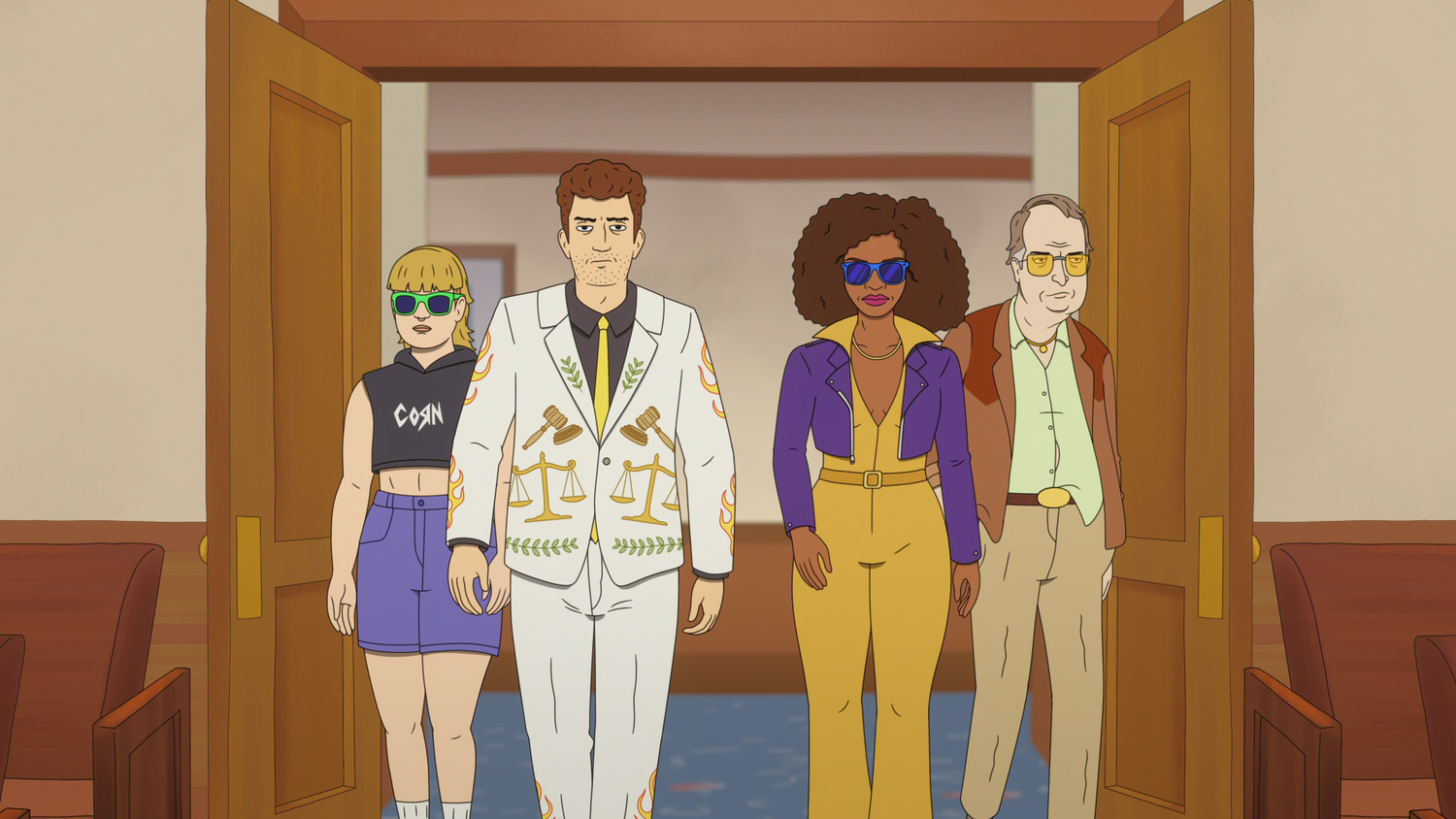
Lincoln’s journey takes a turn when he encounters Sheila Flambé, a magician’s assistant voiced by Janelle James, who is sidelined by the city’s "old boys club." Sheila, who served as a juror in one of Lincoln’s unsuccessful trials, offers him advice on infusing his legal practice with the necessary "pizzazz" for Las Vegas. This leads to her joining Lincoln’s firm, merging her theatrical flair with his conventional legal knowledge.
Their unconventional team expands to include Irene, Lincoln’s weight-lifting teenage niece (Shannon Gisela), who improbably assumes the role of chief investigator, and Glem Blochman (Stephen Root), an eccentric, disbarred lawyer whose primary function appears to be delivering peculiar commentary and facilitating bifurcated A and B storylines. This structure, while attempting to create a dynamic ensemble, has been criticized for feeling forced and artificial, with characters seemingly introduced more for plot mechanics than organic narrative development.
Cullen Crawford’s Vision and the Animated Legal Genre
Crawford’s background in late-night comedy is evident in Strip Law‘s comedic timing and its propensity for rapid-fire gags. However, the show’s engagement with the televised lawyer genre is largely observational rather than transformative. It frequently comments on the conventions of legal dramas without genuinely subverting or moving beyond them. This meta-commentary, while a staple of modern comedy, struggles to evolve into a deeper narrative exploration, preferring to remain on the surface level of genre deconstruction. The show’s preoccupation with tropes from various legal shows, particularly those from David E. Kelley’s prolific 1990s and 2000s output, is a clear example of this self-referential approach.
The Reference Ecosystem: A Panorama of Cultural Callbacks in "Strip Law"
The "DNA" of Strip Law is heavily imbued with a wide array of cultural references. The Simpsons stands out as the most frequently cited, with nods to specific characters, a running gag involving footage clearance issues, and unattributed dialogue snippets. Beyond this, the series features an entire episode dedicated to underdog sports films, specifically referencing The Mighty Ducks, as well as allusions to multiple Stanley Kubrick films. Even more surprisingly, a recurring joke ties into CBS’s Bull, demonstrating a commitment to postmodernism that seemingly disregards both critical quality and real-world controversies surrounding the referenced show.
However, Strip Law‘s ambition to include deeply niche references truly sets it apart. The series reportedly caters to a very specific viewer who might find humor in obscure figures from the documentary American Movie, NBA legend Darrell Griffith, or the character Pistachio Disguisey from The Master of Disguise. This highly specialized approach risks alienating a broad audience, instead aiming for a very narrow, devoted niche. The challenge, as noted by critics, is that these references rarely feel organically integrated into the characters’ personalities, leading to the perception that the characters merely serve as conduits for delivering these allusions.
Animation Quality and Character Design in "Strip Law"
The animation for Strip Law is handled by Titmouse studio, known for its work on other prominent adult animated series like Big Mouth and Venture Bros. The visual style of Strip Law features a mix of hit-and-miss background gags and a general flatness that becomes particularly noticeable in certain episodes. One notable exception is an episode featuring the "Nevada Dates," a parody of the California Raisins, which briefly introduces a distinct visual style. This momentary departure from the show’s typical aesthetic prompts speculation about the potential for more varied visual experimentation. The review also raises questions about the intentionality of certain character designs, such as Glem’s appearance, which bears a striking resemblance to Franklin Sherman from The Critic, leaving viewers to ponder whether it’s a deliberate homage or merely a derivative choice.
The Broader Implications for Netflix and Adult Animation
Strip Law‘s reliance on references and its somewhat shallow character development arrive at a time when Netflix is navigating a competitive streaming landscape. The platform’s strategy often involves producing a wide variety of content to appeal to diverse niche audiences. However, the critical reception of Strip Law highlights a recurring challenge for streaming services: balancing content volume with narrative depth and universal appeal. While a show built on niche references might satisfy a dedicated segment, its broader impact on subscriber retention or critical acclaim remains to be seen. The adult animation genre, which has seen remarkable growth and sophistication with shows like BoJack Horseman and Rick and Morty, demonstrates the potential for animated series to deliver complex narratives and profound emotional resonance. Strip Law‘s approach, in contrast, leans more into immediate comedic gratification through recognition.
Striking a Balance: Reference vs. Resonance in "Strip Law"
The core critique of Strip Law revolves around its inability to foster deep emotional investment in its characters. Despite the vocal talents of Adam Scott, Janelle James, Stephen Root, and Keith David, characters often feel like "fuzzy reference delivery systems" rather than fully realized individuals. This lack of character depth makes it difficult for viewers to connect with the show beyond the superficial thrill of recognizing a particular callback. The introduction of characters like the new paralegal, Kevin, who inexplicably appears and irritates others, mirrors the broader issue of characters feeling shoehorned into the narrative without clear backstories or motivations.
While shows like Venture Brothers, Space Ghost Coast to Coast, and Archer have successfully blended reference-heavy pastiche with compelling character arcs and emotional depth, Strip Law struggles to achieve this balance. Though hints of a more cohesive narrative and deeper character exploration emerged in the final episodes of the first season, suggesting a potential for growth, the immediate gratification offered by its endless stream of references may be enough for many viewers. The series ultimately leaves a lingering question: can a show built primarily on cultural allusions transcend its initial premise to achieve lasting narrative resonance, or will it remain content as a fleeting parade of inside jokes? The current assessment suggests the latter, though the future remains open to development.