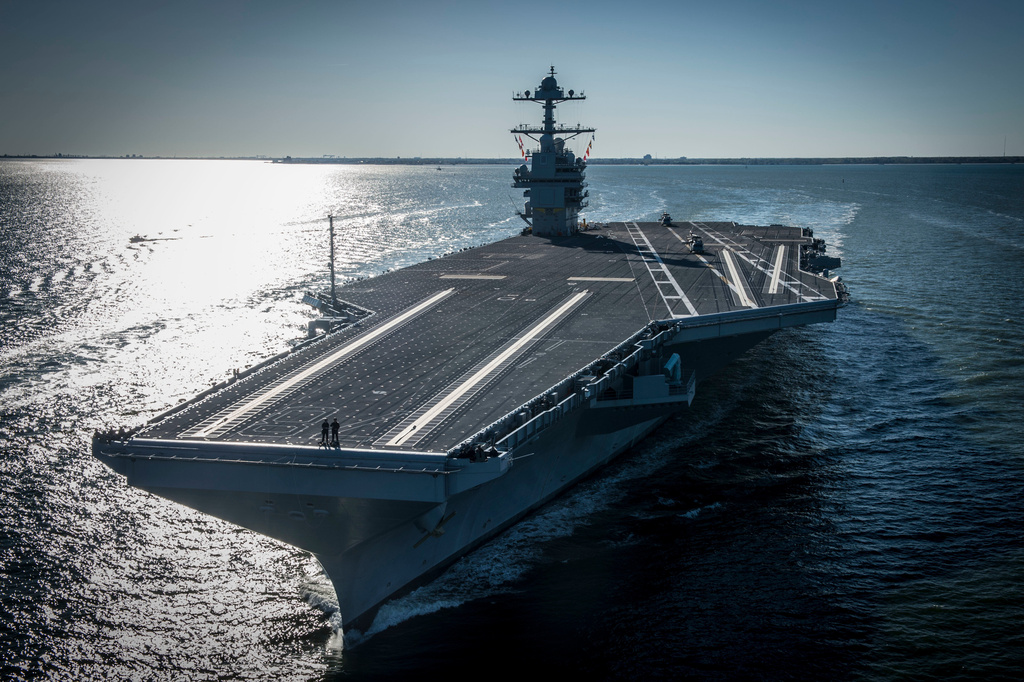
President Donald Trump announced Friday the imminent deployment of a second U.S. aircraft carrier to the Middle East, signaling an intensified American posture amid escalating tensions with Iran over its nuclear and ballistic missile programs. The USS Gerald R. Ford, the U.S. Navy’s newest and most advanced carrier, is set to depart the Caribbean for the region "very soon," according to the President, underscoring a significant buildup of military assets aimed at exerting further pressure on Tehran.
Escalating U.S. Pressure on Iran
Speaking from the White House, President Trump articulated a dual approach of diplomatic engagement and military deterrence. He expressed optimism about ongoing negotiations with Iran, stating his belief that they would be "successful." However, this optimism was tempered with a stern warning: "it would be a ‘bad day for Iran’ if the country failed to make a deal." This declaration highlights the administration’s strategy of using substantial military presence as leverage in diplomatic efforts.
The President further elaborated on his administration’s stance, suggesting that a change in leadership within Iran would be the "best thing that could happen." He drew a stark parallel between decades of stalled negotiations and the loss of American lives, a veiled reference to Iran’s internal security crackdowns and regional activities. This rhetoric underscores the deep-seated animosity and mistrust that has characterized U.S.-Iran relations for nearly half a century.
A Fortified Military Presence in the Region
The impending arrival of the USS Gerald R. Ford signifies a substantial reinforcement of the U.S. military’s presence in a volatile region. This deployment follows the recent dispatch of the Abraham Lincoln carrier strike group, several guided-missile destroyers, advanced fighter jets, and sophisticated surveillance aircraft. This concerted military buildup is designed to project American power and deter any hostile actions from Iran or its proxies.
The USS Gerald R. Ford, a technologically advanced supercarrier, is equipped with a nuclear reactor, enabling sustained operations for extended periods, and boasts the capacity to carry over 75 advanced military aircraft. Its deployment represents a significant escalation in the projection of American naval power in the Persian Gulf and surrounding waters. This strategic move is intended to reassure allies in the region and signal resolve to adversaries.
Diplomatic Maneuvers and Regional Dynamics
President Trump’s announcement came on the heels of a meeting with Israeli Prime Minister Benjamin Netanyahu in Washington. During their discussions, Netanyahu reportedly expressed hope for a "good deal" with Iran but also voiced significant reservations, particularly concerning Iran’s ballistic missile program, which Tehran has consistently declared as non-negotiable. This divergence in priorities between the U.S. and its key regional ally underscores the complexities of forging a unified front against Iran’s nuclear ambitions.
Prime Minister Netanyahu has been a vocal proponent of a more assertive stance against Iran, advocating for increased military action. His calls for such measures have been particularly strong since a significant military engagement in June. This engagement, referred to as "Midnight Hammer," involved U.S. forces briefly joining Israeli operations to strike three Iranian nuclear sites. President Trump at the time described these strikes as having "totally obliterated" the targeted facilities, a claim that underscored the escalating military dimensions of the U.S.-Iran confrontation.
The Shadow of the JCPOA
The indirect U.S.-Iran talks held in Oman last week marked the first significant diplomatic engagement since the June conflict. These discussions aimed to potentially revive or replace the Joint Comprehensive Plan of Action (JCPOA), commonly known as the Iran nuclear deal. President Trump withdrew the United States from the JCPOA during his first term, a decision that significantly altered the landscape of international diplomacy concerning Iran’s nuclear program.
The JCPOA, originally brokered between Iran, the U.S., and several European powers, stipulated that Tehran would curtail its nuclear activities in exchange for sanctions relief. Following the U.S. withdrawal in 2018, Iran resumed enriching uranium beyond the agreed-upon limits, though it has consistently denied pursuing nuclear weapons. The administration’s re-entry into discussions, coupled with the military buildup, suggests a strategic recalibration of U.S. policy towards Iran.
Upon commencing his second term in January, President Trump initially signaled an interest in forging a new nuclear agreement. However, this approach quickly shifted towards a "zero-enrichment" policy, a stance that Iranian negotiators had long dismissed as unworkable. The current diplomatic impasse, coupled with the military deployments, reflects the administration’s persistent efforts to achieve its objectives regarding Iran’s nuclear and missile capabilities.
Challenges in Nuclear Inspections
Compounding the diplomatic challenges is the ongoing struggle to secure full transparency regarding Iran’s nuclear activities. Rafael Grossi, the Director-General of the International Atomic Energy Agency (IAEA), has faced significant hurdles in obtaining Iran’s agreement for comprehensive inspections of sites targeted during the recent military operations. Inspectors returned to Iran after the June conflict, but access to these specific locations has been denied, creating a persistent source of concern for the international community.
Grossi described the dialogue with Iran since the inspectors’ return as "imperfect and complicated and extremely difficult, but it’s there." This acknowledgment highlights the protracted and often fraught nature of international oversight of Iran’s nuclear program. The IAEA’s ability to conduct thorough inspections is crucial for verifying that Iran is not diverting nuclear material for weapons development.
Risk of Regional Escalation
The heightened military posture and the unresolved diplomatic issues raise significant concerns about the potential for further escalation in the Middle East. Gulf Arab nations have repeatedly warned that any direct confrontation could ignite a wider regional conflict, exacerbating existing instabilities in a region still grappling with the aftermath of prolonged conflicts. The deployment of advanced military assets, while intended to deter, also carries the inherent risk of miscalculation and unintended escalation.
The strategic deployment of the USS Gerald R. Ford and other naval assets is a clear demonstration of American commitment to regional security and stability. However, the volatile geopolitical environment, characterized by complex alliances and long-standing rivalries, means that any significant military action could have far-reaching and unpredictable consequences. The international community remains watchful, hoping that diplomatic channels will ultimately prevail over military confrontation.