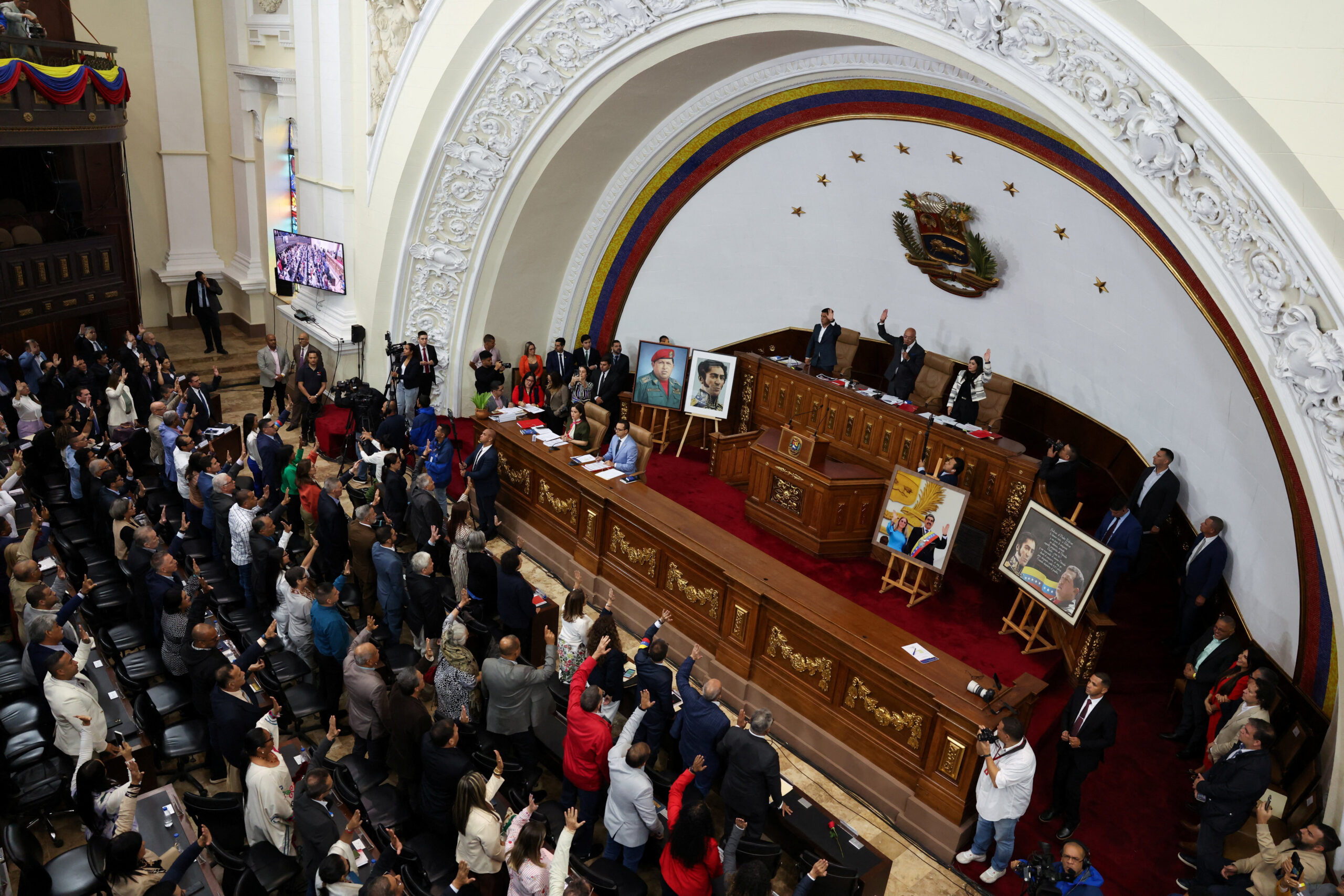
CARACAS, Venezuela – Venezuela’s National Assembly has unanimously approved an initial amnesty bill aimed at releasing political prisoners, a move that has ignited cautious optimism among the country’s opposition and signals a potential shift in the nation’s deeply entrenched political landscape. The legislation, known as the Amnesty Law for Democratic Coexistence, passed its first reading on Thursday, with members of both the ruling socialist party and opposition factions delivering speeches in support.
The unanimous vote, however, masks the complex and often contentious path ahead for the bill, as acknowledged by Jorge Rodriguez, the head of the National Assembly. He cautioned that the legislative process would likely be fraught with challenges, emphasizing the necessity of overcoming divisions for the country to progress. "The path of this law is going to be full of obstacles, full of bitter moments," Rodriguez stated, but added that a willingness to "swallow hard" was essential for national reconciliation. He further articulated a sentiment of shared responsibility, saying, "We ask for forgiveness, and we also have to forgive."
Despite the broad initial support, significant questions and criticisms remain regarding the scope and specifics of the proposed amnesty. Critics have pointed out that the full text of the bill has not yet been made public, and it explicitly excludes clemency for individuals accused of serious offenses, including drug trafficking, murder, corruption, and human rights violations. Media reports suggest the legislation is primarily designed to address charges commonly leveled against political protesters and opposition leaders, leaving the broader implications for those implicated in more severe criminal activities uncertain.
Defining the Scope of the Amnesty Law
The draft legislation, as understood from initial reports and statements, aims to provide amnesty for a range of offenses committed within the context of political activism or protest. These include charges such as treason, terrorism, rebellion, resisting authorities, instigation of illegal activities, and spreading hate. This focus suggests an effort to address the legal repercussions faced by individuals involved in demonstrations and opposition movements that have characterized Venezuela’s recent political history.
Furthermore, the bill is expected to lift political disqualifications that have prevented prominent opposition figures from running for public office. This provision, if enacted, could have a significant impact on the future electoral landscape of Venezuela, potentially allowing leaders like Maria Corina Machado to participate in future political contests. The legislation also specifically names several periods of significant political unrest, including demonstrations that occurred in 2007, 2014, 2017, 2019, and 2024, indicating a desire to provide a blanket pardon for events spanning multiple presidencies.

This historical sweep covers the era of the late President Hugo Chavez, the architect of the "Chavismo" movement, and extends through the presidency of his successor, Nicolas Maduro. Both leaders have faced accusations of suppressing dissent through methods that included arbitrary arrests, torture, and extrajudicial killings, contributing to a deeply polarized political environment and widespread human rights concerns.
The Shadow of Recent Political Upheaval
The timing of this amnesty bill follows a period of intense political turmoil, including the controversial removal of Nicolas Maduro from power. On January 3, the administration of then-U.S. President Donald Trump initiated a military operation that resulted in the apprehension and subsequent transport of Maduro and his wife, Cilia Flores, to New York City to face drug trafficking charges. While the opposition largely hailed this action as a long-overdue measure to restore democracy, international legal experts raised concerns about potential violations of international law and Venezuelan sovereignty.
Following Maduro’s abduction, his government effectively remained in power, with Vice President Delcy Rodriguez, sister of National Assembly leader Jorge Rodriguez, sworn in as interim president. In her inaugural address, she condemned the actions against Maduro and Flores, referring to them as the "kidnapping of two heroes." Despite this rhetoric, Rodriguez has demonstrated a willingness to cooperate with certain U.S. demands, including supporting legislation to open Venezuela’s state-controlled oil industry to foreign investment.
The debate in the National Assembly on Thursday was marked by the continued presence of symbols associated with the Chavismo movement. Images of Hugo Chavez were prevalent, reflecting the enduring influence of his ideology on the current political establishment. The National Assembly itself has been dominated by Chavismo supporters since 2017, when Venezuela’s highest court dissolved the opposition-led legislature and briefly absorbed its powers before re-establishing a body largely controlled by Maduro’s allies.
Contested Elections and Shifting Power Dynamics
Maduro’s presidency has been marked by a series of contested elections. He claimed victory in both the 2018 and 2024 general elections, outcomes that were widely disputed by critics who alleged widespread fraud. The 2024 election, in particular, saw the government refuse to release official voter tallies, a departure from previous standard practices. Opposition groups, however, managed to obtain copies of nearly 80 percent of the tallies, which they claimed contradicted the government’s assertion of Maduro winning a third six-year term.
The political climate in the weeks following Maduro’s apprehension has been characterized by the continued assertion of authority by his government. The subsequent actions of Vice President Delcy Rodriguez, including her cooperation on economic matters, have highlighted the complex and evolving power dynamics within Venezuela.

Weighing Maduro’s Legacy and the Call for Reconciliation
During the National Assembly session, Jorge Rodriguez displayed a photograph of Hugo Chavez holding a crucifix, a symbolic gesture underscoring the ideological underpinnings of the ruling party. Nicolas Maduro Guerra, son of the ousted president and a member of the National Assembly, also addressed the chamber, advocating for national healing. "Venezuela cannot endure any more acts of revenge," he stated, appealing for "reconciliation."
Opposition’s Cautious Optimism and Lingering Concerns
Opposition members within the National Assembly expressed a degree of optimism regarding the amnesty bill, viewing it as a potential turning point. Tomas Guanipa, a National Assembly representative, described the passage as the beginning of a "new, historic chapter" for Venezuela, one where citizens would no longer face imprisonment for expressing dissenting political views.
The exodus of nearly 7.9 million Venezuelans in recent decades, driven by political persecution and economic hardship, underscores the deep societal impact of the country’s prolonged crisis. Concerns about the human rights situation persist, particularly in the aftermath of Maduro’s removal and the ongoing debate about the safety of returning exiled citizens.
President Rodriguez has pledged to release political detainees and to close the notorious El Helicoide prison, a facility that has been the subject of numerous reports detailing torture. However, discrepancies have emerged regarding the number of prisoners released. The human rights organization Foro Penal has documented 383 releases since January 8, a figure significantly lower than the 900 political prisoners the government claims to have freed. Foro Penal estimates that approximately 680 political prisoners remain in detention.
Adding to these concerns, opposition figures allege that the government continues to engage in intimidation and harassment of individuals who voice support for Maduro’s removal or hold opinions contrary to the Chavismo movement. Despite these ongoing issues, Alfredo Romero, the head of Foro Penal, acknowledged the initial passage of the amnesty law as a positive step. "Amnesty is the framework that will ensure… that the past does not serve to halt or derail transition processes," Romero told the news agency AFP, suggesting that such measures are crucial for any future transitional justice efforts.
The Road Ahead: A Second Vote and Future Implications
The amnesty bill must still undergo a second vote in the National Assembly, scheduled for next Tuesday, before it can become law. The outcome of this subsequent vote will be critical in determining the extent of its impact and its ability to foster genuine reconciliation and address the complex legacy of political conflict in Venezuela. The success of this legislation, and the broader efforts towards democratic coexistence, will be closely watched both domestically and internationally. The proposed amnesty represents a significant, albeit potentially limited, step in a long and arduous journey toward stability and justice for a nation grappling with profound challenges.