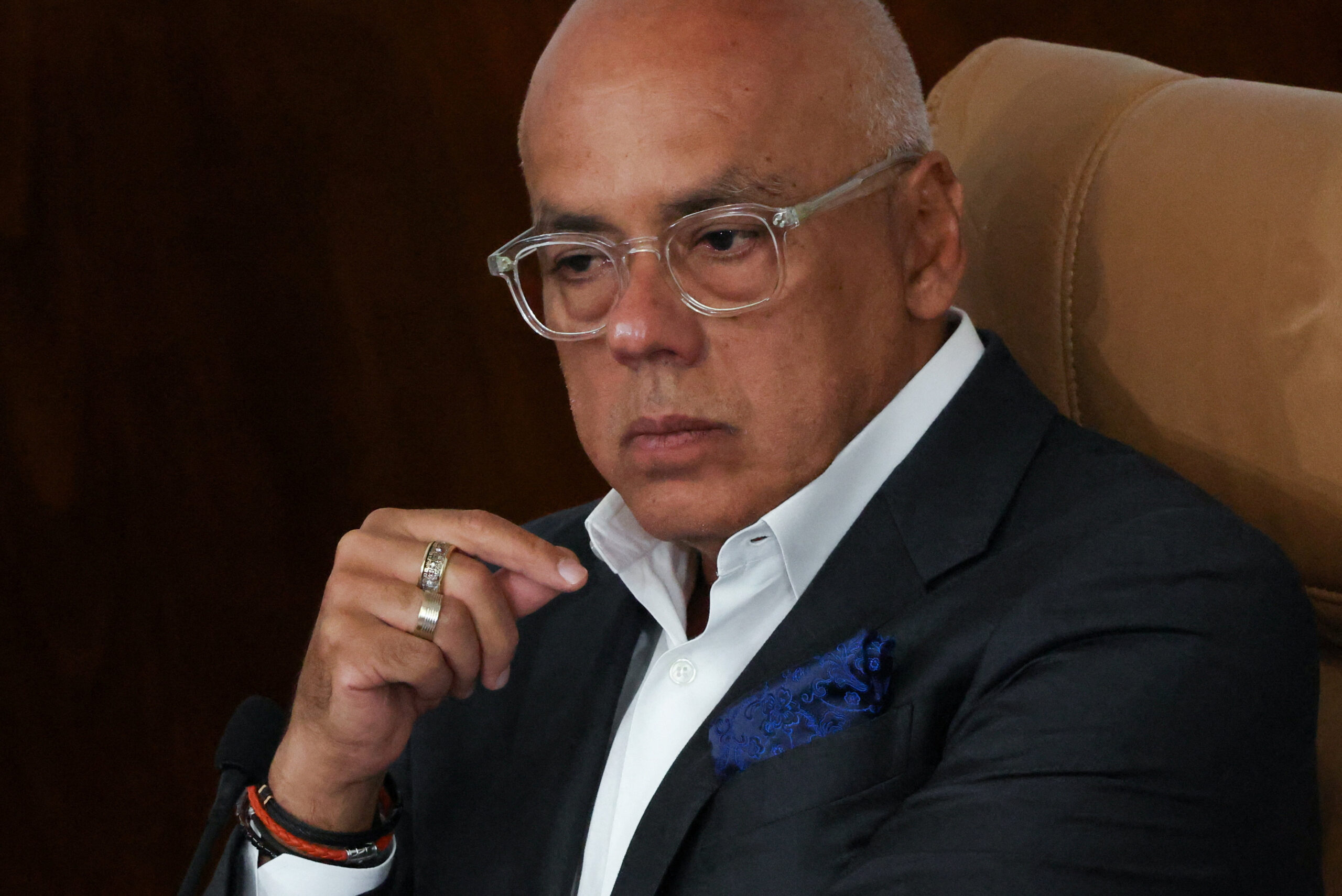
Venezuela’s National Assembly President Jorge Rodriguez stated that the nation will not hold presidential elections in the immediate future, asserting that the government’s current priority is national stability. This declaration comes as the country grapples with the aftermath of President Nicolas Maduro’s recent abduction and navigates a complex political landscape marked by lingering controversy from the last presidential race.
Rodriguez’s remarks were made in an interview with the conservative U.S. outlet Newsmax, published late Monday. The interview delved into the timing of future elections, a topic of significant interest given the six-year presidential term cycle in Venezuela and the disputed results of the 2024 election. When questioned by Newsmax host Rob Schmitt about whether another election would be postponed for five years, Rodriguez unequivocally responded, "The only thing I could say is that there will not be an election in this immediate period of time where the stabilisation has to be achieved."
Re-institutionalization as a Priority
The National Assembly president elaborated that the decision to defer elections is intrinsically linked to a broader governmental strategy aimed at rebuilding and reinforcing Venezuela’s state institutions. This process, termed "re-institutionalization," is intended to restore the full capacity and recognition of all national bodies. Rodriguez emphasized the government’s commitment to ensuring that every institution functions optimally and is universally acknowledged.
Rodriguez, who has presided over the National Assembly since 2021, also cited a public desire for a return to normalcy following the abduction of President Nicolas Maduro. He indicated that the current administration, led by Vice President Delcy Rodriguez, is actively working towards complete national stabilization and reconciliation among all segments of the Venezuelan population.
President Maduro was reportedly abducted in a military action on January 3. In the subsequent weeks, Venezuela’s Supreme Court appointed Vice President Delcy Rodriguez, Jorge Rodriguez’s sister, as acting president. She was formally sworn into office on January 5, receiving support from the Venezuelan military, the ruling party, and notably, the United States.
Path to Future Elections and Opposition Concerns
Jorge Rodriguez indicated that the establishment of a timetable for new presidential elections would necessitate reaching an agreement with all sectors of the opposition. This suggests a potential for future dialogue and negotiation with opposition factions, although the specifics remain unclear.
The abduction of Maduro had initially sparked hopes for a new presidential election, particularly given the significant controversy that surrounded the 2024 race. In that election, Maduro declared victory for a third consecutive term, a claim that was contested by the opposition, who presented voter tallies suggesting their candidate had won. The contested results led to widespread protests and a subsequent government crackdown, which the U.S. State Department estimated resulted in approximately 25 deaths.
During the Newsmax interview, Rodriguez pushed back against assertions that the 2024 election lacked legitimacy. He instead pivoted to his administration’s focus on national unity, stating, "We have been divided for a very long time." This emphasis on unity is central to his government’s narrative as it seeks to consolidate power and move forward.
Amnesty Law and its Implications
A significant legislative effort underway is the passage of a mass amnesty law. This proposed law, which has already received unanimous approval in its first vote in the National Assembly, aims to secure the release of all political prisoners and grant amnesty for crimes related to political dissent dating back to 1999. The bill is expected to pass its second vote this week.
However, the amnesty law has not been without its critics. Concerns have been raised that even with the release of political prisoners, the government might resort to other forms of political repression. When asked by Schmitt whether opposition leader Maria Corina Machado would be able to return to Venezuela and campaign freely should the bill pass, Rodriguez adopted a more circumspect tone.

He declined to comment on specific individuals, stating, "So, allow me not to speak about only one single name, because there are many, many actors abroad that have to be included in this discussion." Rodriguez reiterated that the amnesty law is designed to encourage cooperation from opposition figures abroad, urging them to "comply with the law, so they can come back to the country."
Opposition’s Skepticism and Continued Repression Allegations
Despite the government’s pronouncements on the amnesty law, opposition leaders have consistently alleged that the government fabricates charges of violent crimes to justify the arrest and imprisonment of political opponents. Maria Corina Machado herself faced accusations of conspiring to assassinate Maduro in 2014, a charge that led to her expulsion from the National Assembly.
The broader context of political repression is underscored by recent events involving former lawmaker Juan Pablo Guanipa. Guanipa was released on Sunday after more than eight months in pretrial detention, only to be rearrested less than 12 hours later. His family described the incident as an "abduction," as he was detained by unidentified armed men without a court order.
Officials later claimed that they had requested the revocation of Guanipa’s release order, citing his alleged failure to adhere to the conditions set for his release. In the early hours of Tuesday, Guanipa was transferred to his residence in Maracaibo, where he is now under house arrest.
Maria Corina Machado condemned Guanipa’s rearrest, asserting that his case demonstrates that government-announced releases do not guarantee the full exercise of political and civil rights. She questioned the nature of Guanipa’s "crime" and whether those released were truly free from the Venezuelan government’s alleged "repressive machinery." Machado posed rhetorical questions about the ability of Venezuelans to speak freely, recount their experiences, and describe the current conditions in the country.
The Shadow of the 2024 Election and Future Uncertainty
The Venezuelan presidential election in 2024 remains a deeply contentious issue. President Maduro’s claim of victory was met with widespread disbelief and accusations of fraud from both domestic opposition and international observers. The subsequent protests and the government’s forceful response further deepened political divisions within the country.
Rodriguez’s current stance, emphasizing stability and institutional rebuilding over immediate electoral processes, suggests a strategic effort to consolidate the current government’s position. The proposed amnesty law, while offering a potential pathway for some exiled opposition figures to return, is viewed with skepticism by critics who fear it may be a superficial gesture that does not fundamentally alter the authoritarian nature of the regime.
The international community continues to closely monitor the political developments in Venezuela. The United States, which has played a role in recent events through the abduction of Maduro, maintains a complex relationship with the Venezuelan government. The U.S. has previously supported opposition efforts and called for democratic reforms, making its position on future Venezuelan elections a critical factor.
The focus on "re-institutionalization" could be interpreted as an attempt to legitimize the current government’s authority and structures. However, the effectiveness and fairness of this process will likely depend on genuine inclusivity and respect for democratic principles, which have been lacking in Venezuela’s recent political history. The continued detention and rearrest of opposition figures like Juan Pablo Guanipa cast a long shadow over any claims of a move towards reconciliation and political normalization.
The eventual path to new presidential elections in Venezuela remains uncertain. While Jorge Rodriguez has ruled them out for the immediate future, the conditions under which they might eventually be held, and the fairness of any such process, are subjects of intense scrutiny. The government’s emphasis on stability and institutional repair may serve as a prelude to a more controlled political environment, rather than a genuine opening for democratic competition. The upcoming legislative votes on the amnesty law and the government’s actions regarding opposition figures will be key indicators of its commitment to a more inclusive political future.