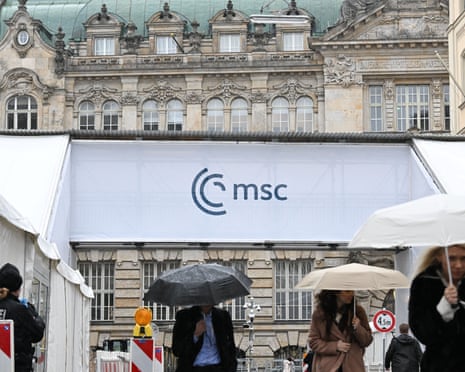
European Union Foreign Policy Chief Kaja Kallas issued a sharp rebuttal Sunday to American critiques of European social and political values, asserting that the continent is far from the collapse predicted by some conservative observers. Speaking on the final day of the Munich Security Conference, Kallas addressed recent comments made by U.S. Secretary of State Marco Rubio, who had characterized the bloc as a "woke" and "decadent" entity on the brink of a cultural and systemic breakdown.
The exchange highlights a widening rhetorical gap between the European leadership and the current U.S. administration regarding the future of Western liberalism and the efficacy of the transatlantic alliance. Kallas, the former Prime Minister of Estonia now leading the EU’s diplomatic arm, used her platform to argue that the European model remains a global aspiration rather than a failing experiment.
Kallas Rejects Rhetoric of ‘Woke Europe’ and Civilizational Erasure
In a direct response to Rubio’s keynote address from the previous day, Kallas noted that "woke Europe not facing civilisational erasure" is a reality evidenced by the long queue of nations seeking to join the European Union. She argued that if the European project were truly in a state of terminal decay, it would not continue to attract interest from both neighboring states and distant partners.
"Contrary to what some may say, woke decadent Europe is not facing civilisational erasure," Kallas told the assembly of world leaders and defense experts. She specifically pointed to the fact that many countries still "want to join our club," noting that this interest extends beyond the continent’s borders to include nations like Canada in various cooperative frameworks. Her comments were seen as a defense of the EU’s social safety nets, environmental regulations, and progressive values—elements frequently derided by American conservatives as "woke" distractions from hard security.
The dispute over the "woke Europe" label reflects deeper anxieties within the halls of the Munich Security Conference. European officials expressed concern that such framing from the United States could undermine the unified front necessary to confront autocratic threats, particularly from Moscow and Beijing. By reframing the debate, Kallas sought to shift the focus from cultural grievances back to the tangible successes of European integration and its role as a stabilizing force in global politics.
Assessing the Russian Threat: From Superpower to ‘Economy in Shreds’
Beyond the cultural exchange with Rubio, Kallas provided a grim assessment of the Russian Federation’s standing after four years of full-scale war in Ukraine and over a decade of regional conflict. She challenged the notion that Moscow retains its status as a global superpower, describing the Russian military and economy as severely degraded.
"But let’s be clear-eyed about Russia: Russia is no superpower," Kallas stated. She cited staggering figures to support her claim, noting that after four years of intensive combat, Russian forces have barely advanced beyond the front lines established in 2014. The human cost of these minimal gains has been catastrophic, with Kallas citing a figure of 1.2 million casualties on the Russian side.

According to the EU’s top diplomat, the Russian economy is currently "in shreds" and fundamentally "broken." The loss of the European energy market, which for decades served as the primary source of revenue for the Kremlin, has left the Russian state disconnected from the global financial system. Furthermore, the exodus of skilled citizens fleeing conscription and political repression has created a long-term demographic and economic crisis for Moscow.
Kallas warned, however, that Russia’s weakness on the battlefield makes it more dangerous in diplomatic settings. "In fact, the greatest threat Russia presents right now is that it gains more at the negotiation table than it has achieved on the battlefield," she said. This sentiment reflects a growing fear among European hawks that a premature peace deal could allow the Kremlin to solidify territorial gains that it could not secure through military force.
Defense Industrial Strategy and the ‘Kentucky’ Friction
The conference also laid bare significant tensions regarding defense procurement and the future of the NATO alliance. Benjamin Haddad, France’s Minister for Europe, urged the bloc to prioritize "European preference" in defense spending. He argued that as European nations increase their military budgets—often at the cost of social programs—they should not be funnelled into the U.S. industrial base.
"We cannot increase defense budgets to subsidize a factory in Kentucky," Haddad remarked, referring to the tendency of European nations to purchase off-the-shelf American hardware like F-35 fighter jets and Patriot missile systems. He described a shift toward European-made equipment as "common sense," noting that reliance on external suppliers often comes with "strings attached" and "fine print" regarding how and when weapons can be deployed.
This push for European strategic autonomy was met with a more nuanced perspective from NATO’s Deputy Secretary General, Radmila Šekerinska. While acknowledging the need for increased production, Šekerinska warned against dismantling the existing integrated supply chains that link European and American defense firms.
"We need to produce more, and we need to produce more everywhere," Šekerinska said. She highlighted critical shortages in air defense capabilities, noting that current stockpiles are "not up to the task." She cautioned that attempting to decouple the European defense industry from the United States could result in a weaker, rather than stronger, alliance. "If we try to dismantle these links, we end up weaker," she added, emphasizing that the upcoming NATO summit in Ankara would focus on interoperability and speeding up regulatory processes.
Ukraine’s Path to EU Accession Hits Diplomatic Roadblocks
While the rhetoric regarding "woke Europe not facing civilisational erasure" dominated the headlines, the practical realities of EU expansion remained a somber topic. Latvian President Edgars Rinkēvičs provided a sobering update on Ukraine’s efforts to secure a firm date for its accession to the European Union.
Despite President Volodymyr Zelenskyy’s persistent push for a concrete timeline as part of a future peace settlement, Rinkēvičs indicated that there is currently "no readiness" among EU member states to agree on a specific date. "We understand that we need Ukraine in the European Union," the Latvian president said, but he admitted that the consensus required for a hard deadline is missing.

Rinkēvičs explained that the delay is tied to several factors, including the need to maintain credibility in the Western Balkans. Nations in that region, such as North Macedonia, have undergone significant reforms and even changed their names to facilitate EU entry, yet they remain in a state of diplomatic limbo. "We have been promising so many things in return for reforms… we have been promising membership for so long," Rinkēvičs said, suggesting that skipping over the Balkans to admit Ukraine could permanently damage the EU’s reputation in the region.
Furthermore, the Latvian leader noted that Moldova’s future is inextricably linked to Ukraine’s. He argued that if Ukraine moves forward, Moldova cannot be left behind, adding another layer of complexity to the enlargement process. Ultimately, Rinkēvičs tied the accession timeline to the eventual peace deal with Russia, though he expressed skepticism that Moscow would engage in good faith. "If Russia is not moving, then we are not going to have a deal," he concluded.
Shifting Political Tides: Hungary, France, and Poland
The future of European unity also hinges on a series of critical elections. In Munich, discussions turned toward the upcoming vote in Hungary, where long-time leader Viktor Orbán faces a significant challenge. Orbán has been a consistent obstacle to EU aid for Ukraine and has frequently echoed the "anti-woke" rhetoric seen in the United States.
President Rinkēvičs cautioned against assuming that an election would automatically unblock the path for Ukraine. "I would caution that both Olympic Games and elections sometimes produce very unexpected results," he said. He reminded the audience that while a change in Budapest might ease some tensions, elections in France and Poland next year could just as easily shift the political landscape in the opposite direction.
This sense of political volatility has led many European officials to advocate for a "self-focus" strategy. Benjamin Haddad suggested that Europe should stop reacting to every speech from Washington and instead focus on its own rearmament and economic competitiveness. He argued that a more balanced, mature transatlantic relationship would be built on two equal pillars rather than a European side that is constantly "looking for love" or seeking validation from the United States.
As the Munich Security Conference drew to a close, the consensus among European leaders was one of cautious self-reliance. While they remain committed to the transatlantic alliance, the verbal sparring over "woke" culture and "civilisational erasure" has signaled that Europe is increasingly prepared to define its own path, independent of the ideological shifts in American domestic politics. The focus now turns to the battlefield in Ukraine and the factories across the continent, where the true fate of the European project will be decided.