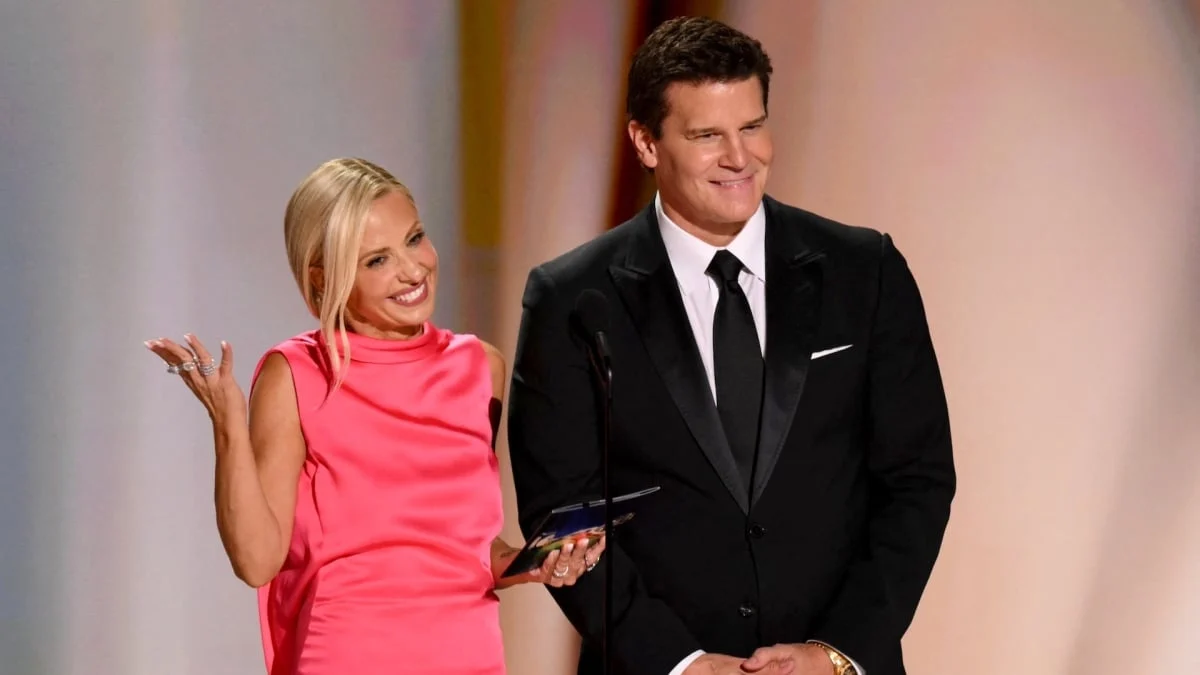
Sarah Michelle Gellar utilized her appearance at the 78th Primetime Emmy Awards to address the recent, high-profile cancellation of the "Buffy the Vampire Slayer" revival. Standing alongside former co-star David Boreanaz, Gellar delivered a pointed remark regarding the shuttered project that had been in development for several years under the Disney-owned Hulu and Searchlight Television banners. The exchange occurred as the duo took the stage to present the award for Outstanding Lead Actor in a Limited or Anthology Series or Movie, a moment that quickly transitioned from a nostalgic reunion to a direct commentary on the current state of television production.
The interaction began when Boreanaz, who portrayed the vampire-with-a-soul Angel in the original series and its subsequent spinoff, turned to Gellar to discuss their characters’ complicated romantic history. "You know, Sarah, I always thought that Buffy and Angel would end up together," Boreanaz remarked, referencing a debate that has persisted among the show’s fan base for over two decades. Gellar’s response was immediate and sharp: "Well, I guess we won’t find out." The comment served as a definitive acknowledgement of the reboot’s demise, which was officially confirmed earlier this year following months of industry speculation.
The failed "Buffy" project had been one of the most anticipated revivals in recent television history. Initially announced as a collaboration between Gellar and Academy Award-winning director Chloé Zhao, the series was intended to serve as a modern-day continuation of the supernatural drama that defined a generation of genre television. Unlike previous attempts to reboot the franchise with a new cast, this iteration was expected to feature Gellar returning to her iconic role as Buffy Summers, providing a bridge between the original narrative and a new era of demon-hunting in the 21st century.
The Development and Sudden Collapse of the Cancelled Buffy Reboot
The timeline of the cancelled "Buffy" reboot is a case study in the volatility of the modern streaming landscape. Development reportedly began in earnest in late 2024, with Hulu and Searchlight Television aggressively pursuing a "prestige" take on the material. The attachment of Chloé Zhao, known for her character-driven work on "Nomadland" and her foray into blockbusters with Marvel’s "Eternals," signaled that the project would move away from the campier elements of the 1990s and toward a more cinematic, atmospheric tone.
However, the road to production was fraught with logistical challenges. In March 2026, while attending the South by Southwest (SXSW) festival in Austin, Texas, Gellar revealed the sudden nature of the project’s termination. In an interview with People magazine, the actress disclosed that she received the news of the cancellation just moments before she was scheduled to appear on stage for a fan-focused panel. "I was just about to take the stage in front of all the fans," Gellar said at the time. "Hulu had decided not to move forward with the Buffy revival. Let me tell you, nobody saw this coming."
Industry analysts point to a broader contraction within the streaming industry as the primary reason for the project’s sudden death. During the 2025-2026 television season, several major platforms, including Hulu’s parent company Disney, implemented significant cost-cutting measures. These shifts resulted in the cancellation of high-budget projects that were still in the early stages of production. Despite the brand recognition of "Buffy the Vampire Slayer," the projected costs of a Zhao-directed series, combined with the complexities of licensing and talent contracts, likely contributed to the studio’s decision to pull the plug.
A Bittersweet Reunion at the 78th Primetime Emmy Awards
The 78th Primetime Emmy Awards provided a platform for Gellar and Boreanaz to reunite publicly for the first time since the reboot’s cancellation was finalized. For viewers, the sight of "Buffy and Angel" together again was a reminder of the enduring legacy of the original series, which aired from 1997 to 2003. The original program, created by Joss Whedon, was a critical and commercial powerhouse that blended high-school metaphor with supernatural horror, eventually moving from The WB to UPN for its final two seasons.
The "jab" delivered by Gellar at the Emmys resonated beyond the immediate audience in the theater. It highlighted the frustration often felt by creators and actors when long-term projects are discarded due to shifting corporate priorities. By addressing the cancelled "Buffy" reboot on one of the industry’s biggest nights, Gellar reclaimed the narrative surrounding the project, ensuring that its absence from the television schedule was noted by both peers and executives.
The 2026 ceremony was not entirely focused on missed opportunities, however. The night carried a heavy emotional weight for the "Buffy" community during the annual "In Memoriam" segment. The Academy paid tribute to the late Anthony Head, the British actor who portrayed Rupert Giles, the librarian and "Watcher" who served as Buffy’s mentor throughout the series. Head’s passing earlier in the year had already cast a shadow over the "Buffy" fandom, and his inclusion in the tribute provided a somber counterpoint to Gellar’s more defiant comments earlier in the evening.

The Legacy of Buffy the Vampire Slayer and the Era of Reboot Fatigue
The cancellation of the "Buffy" revival comes at a time when the television industry is grappling with "reboot fatigue." While established intellectual properties (IP) are often seen as safer bets for streaming services looking to retain subscribers, the success of such projects is far from guaranteed. For every successful revival, such as "Cobra Kai" or "Star Trek: Picard," there are dozens of others that fail to capture the spirit of the original or are cancelled before they can find an audience.
In the case of "Buffy the Vampire Slayer," the bar for a revival was exceptionally high. The original series is frequently cited in academic circles and by television critics as one of the most influential shows of all time. It pioneered the use of serialized storytelling in genre fiction and established a template for the "strong female lead" that would be emulated for decades. Any attempt to return to that world faced the daunting task of honoring the original lore while justifying its existence in a vastly different cultural climate.
The involvement of Chloé Zhao was seen as a way to circumvent these hurdles. By bringing an auteur’s sensibility to the "Slayerverse," the project aimed to elevate the material beyond mere nostalgia. Sources close to the production indicated that the series would have explored a middle-aged Buffy Summers navigating a world where the supernatural threats had evolved alongside technology. The cancellation leaves these story threads unresolved, a fact that Gellar’s Emmy comment underscored with surgical precision.
Public and Industry Reaction to Gellar’s Remarks
Social media response to Gellar’s "jab" was swift and overwhelmingly supportive. Fans of the franchise, many of whom have spent years campaigning for a continuation of the story, praised the actress for her candor. The "Bangel" versus "Spuffy" (Buffy and Spike) debate, a cornerstone of the show’s online community, was briefly reignited, but the prevailing sentiment was one of disappointment that the Zhao-led project would never see the light of day.
Within the industry, Gellar’s comment is being viewed as a sign of the increasing transparency among high-profile talent regarding the instability of streaming deals. In previous decades, actors might have remained silent about a failed project to avoid friction with major studios. However, in an era where "tax write-off" cancellations and "purged" content have become common, more actors are choosing to speak out about the impact these decisions have on the creative process.
The 78th Primetime Emmy Awards will likely be remembered as much for these unscripted moments of honesty as for the awards themselves. By using her time on stage to address the cancelled "Buffy" reboot, Sarah Michelle Gellar reminded the industry that while corporations may own the rights to a character, the emotional connection to the story remains with the actors and the audience.
The Future of the Buffy Franchise
While the specific revival at Hulu and Searchlight Television is dead, the future of the "Buffy" brand remains a topic of ongoing discussion. The property is a crown jewel in the 20th Century Studios library, which is now a subsidiary of Disney. Given the current trend of reviving dormant franchises, it is unlikely that the "Slayerverse" will remain quiet forever. However, any future attempt will have to contend with the high-profile failure of the most recent effort and the clear dissatisfaction expressed by the series’ original star.
For now, the legacy of "Buffy the Vampire Slayer" continues through comic books, novels, and the continued popularity of the original 144 episodes on streaming platforms. Gellar herself has moved on to other projects, including her recent work in the supernatural drama "Wolf Pack," but her Emmy appearance proved that she remains protective of the character that launched her career.
The 2026 Emmys served as a final, public stake through the heart of the reboot that almost was. As the television industry continues to recalibrate in a post-peak TV environment, the story of the "Buffy" revival stands as a reminder of the delicate balance between creative ambition and corporate reality. Gellar’s remark was more than just a jab; it was a definitive closing of a chapter on a project that promised much but was ultimately claimed by the shifting tides of the entertainment business.