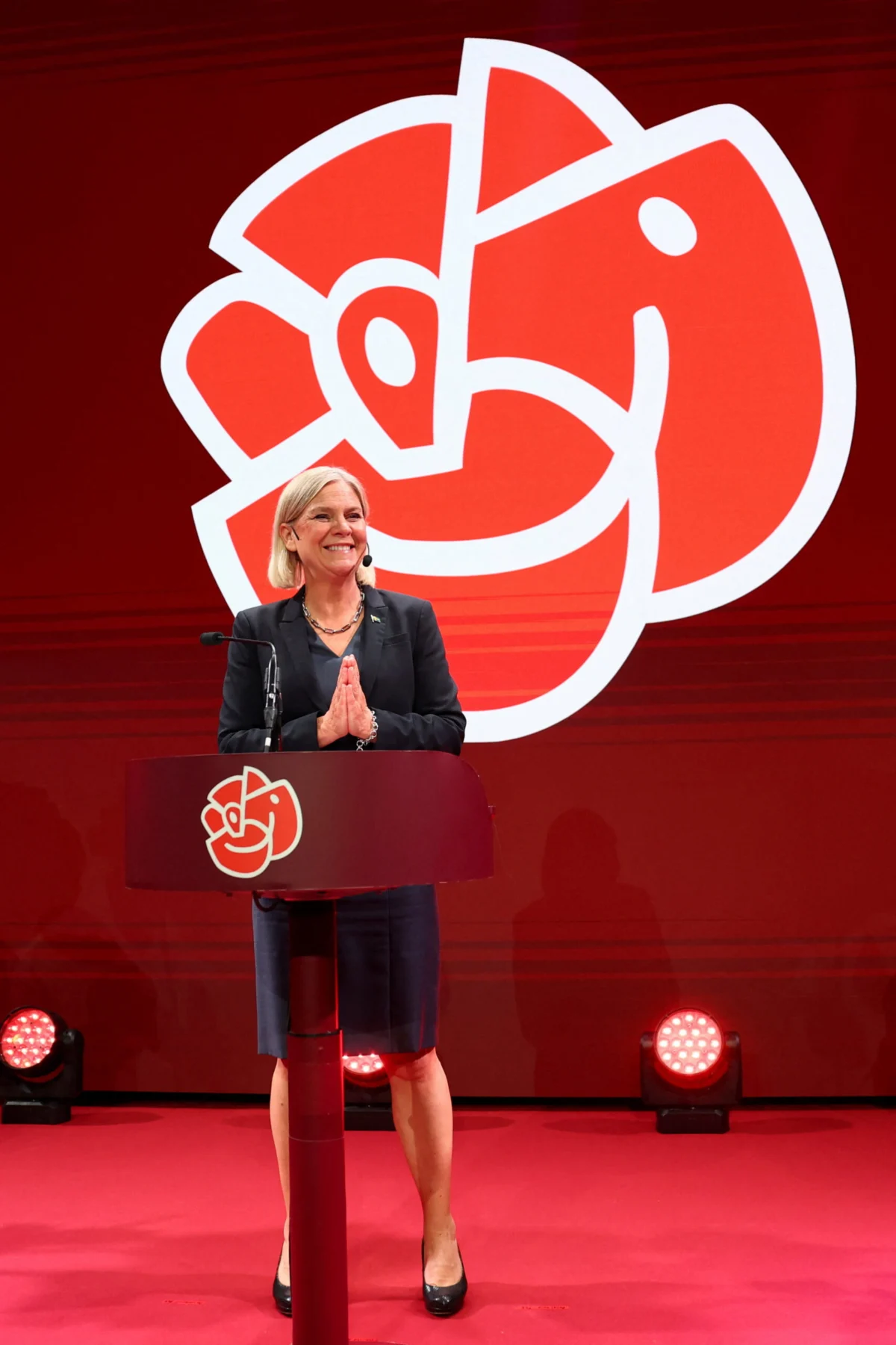
Sweden’s opposition leader, Magdalena Andersson, has officially commenced negotiations to assemble a coalition government following a narrow electoral victory for the left-wing bloc last week, a process expected to be fraught with significant political challenges. Andersson, at the helm of the Social Democrats, received the mandate from Parliament Speaker Andreas Norlen on Friday to explore government formation. This pivotal moment arrives just after the confirmed election results led to the resignation of the incumbent center-right Prime Minister Ulf Kristersson.
Navigating a Narrow Mandate: The Challenge Ahead
The task presented to Andersson is a delicate balancing act, given the razor-thin majority her bloc secured. The left-wing coalition garnered 176 seats in the Riksdag, the Swedish Parliament, out of a total of 349, giving them a slim margin of just three seats over the right-wing opposition. This slender lead underscores the need for broad consensus and potentially difficult compromises to maintain stability.
Andersson acknowledged the gravity of the situation, stating in a public declaration, "I have now been tasked with exploring the possibility of forming a government. A task I undertake with great humility and will act constructively to put together a new government." She emphasized a call for unity, urging all political factions to prioritize national interests over partisan considerations. "My approach to the work that is now taking place is that all political forces now need to put party tactics aside and put Sweden and the Swedish people first," she added.
The Road to Coalition: Potential Alliances and Sticking Points
To solidify her administration, Andersson is expected to seek the support of three key left-leaning parties: the Greens, the Centre Party, and the Left Party. However, early indications suggest that achieving a unified front will not be straightforward. The socialist Left Party has signaled its demands, indicating that cabinet positions for some of its Members of Parliament will be a prerequisite for their endorsement.
Conversely, the liberal Centre Party has presented a more resolute stance, publicly stating its unwillingness to support a government formed under these specific conditions. This divergence in positions highlights the ideological spectrum within the left-wing bloc and the potential for protracted negotiations. The differing priorities and policy platforms of these parties represent significant hurdles Andersson must overcome to forge a cohesive governing coalition.
A Tight Timeline and Contingency Plans
Andersson has been granted a deadline of September 28 to present a viable government to Parliament. Should her efforts falter, the mandate would then shift to the outgoing Prime Minister, Ulf Kristersson. His center-right bloc secured 173 seats in the election, placing him in a position to attempt to assemble his own coalition.
The political landscape in Sweden is characterized by a propensity for coalition and minority governments. This is largely due to the nation’s established political structure, which features two dominant blocs—the left and the right—each comprising multiple parties. This fragmented, yet stable, system often necessitates intricate negotiations to form a functional government, a process that can extend for considerable periods. The aftermath of the 2022 election, for instance, saw the government formation process stretch for over a month, illustrating the complexities involved.
Historical Precedents and the Swedish Political Fabric
Sweden’s parliamentary system, with its multi-party structure, has historically seen the formation of minority or coalition governments as the norm rather than the exception. This tradition stems from a desire to ensure broad representation and consensus-building across the political spectrum. The outcome of the recent election, with a narrow majority for the left, is a continuation of this trend, demanding careful negotiation and compromise.
The challenges faced by Andersson are not unique in Swedish politics. Past governments have navigated similar complexities, often requiring extensive dialogue and the forging of alliances between parties with diverse ideological leanings. The success of any new administration will hinge on its ability to bridge these divides and deliver on the promises made to the electorate.
The Evolving Role of the Social Democrats
As the largest party within the left-wing bloc, the Social Democrats, led by Andersson, are positioned to play a central role in shaping Sweden’s future policy direction. Their historical influence in Swedish politics, having been in power for extended periods, means their approach to governance carries significant weight. However, the current political climate, marked by a more fragmented party system and shifting voter allegiances, presents a new set of dynamics for the party to contend with.
Andersson’s leadership will be tested not only in her ability to secure a parliamentary majority but also in her capacity to steer a cohesive government that can address the pressing issues facing Sweden, including economic challenges, environmental concerns, and social welfare. Her emphasis on putting the nation first suggests a strategic approach aimed at transcending traditional party lines to foster a sense of shared purpose.
Broader Implications for Swedish Governance
The formation of a new government in Sweden carries implications beyond its immediate political landscape. The nation’s commitment to social democracy, its robust welfare state, and its international role are all influenced by the composition and policies of its governing bodies. A stable and effective government is crucial for maintaining Sweden’s economic competitiveness, its social cohesion, and its standing on the global stage.
The tight parliamentary arithmetic also suggests that any government formed will likely need to be attentive to the concerns of a broader range of parties, potentially leading to a more centrist policy orientation or a focus on issues with wider cross-party appeal. This could mean a more pragmatic approach to policy-making, prioritizing areas where consensus can be more readily achieved.
The Public’s Perspective and Expectations
For the Swedish public, the outcome of the election and the subsequent government formation process directly impacts their daily lives. Decisions made by the new administration will affect everything from taxation and public services to environmental regulations and foreign policy. The narrow margin of victory means that the government will need to be highly responsive to public opinion and demonstrate its commitment to addressing the concerns of all citizens, not just those who voted for the winning bloc.
The expectation is that the new government will prioritize stability and effective governance. The protracted nature of government formation in the past has sometimes led to public frustration, and there will be a keen interest in how quickly and effectively Andersson can deliver a functional administration. The focus will be on tangible policy outcomes and the government’s ability to navigate the complexities of the Riksdag.
The Path Forward: A Test of Political Will
Magdalena Andersson’s mandate to form a government represents a critical juncture for Sweden. The coming days and weeks will be a test of her negotiating skills, her ability to build bridges between disparate political factions, and her capacity to inspire confidence in her vision for the country. The success or failure of these efforts will not only determine the composition of Sweden’s next government but also shape its policy agenda and its trajectory in the years to come.
The challenges are considerable, but the opportunity to forge a new path forward for Sweden is also significant. The coming period will be closely watched, both domestically and internationally, as Sweden navigates this crucial phase of its political evolution. The ultimate goal will be to establish a government that is both stable and capable of addressing the nation’s pressing needs and aspirations.