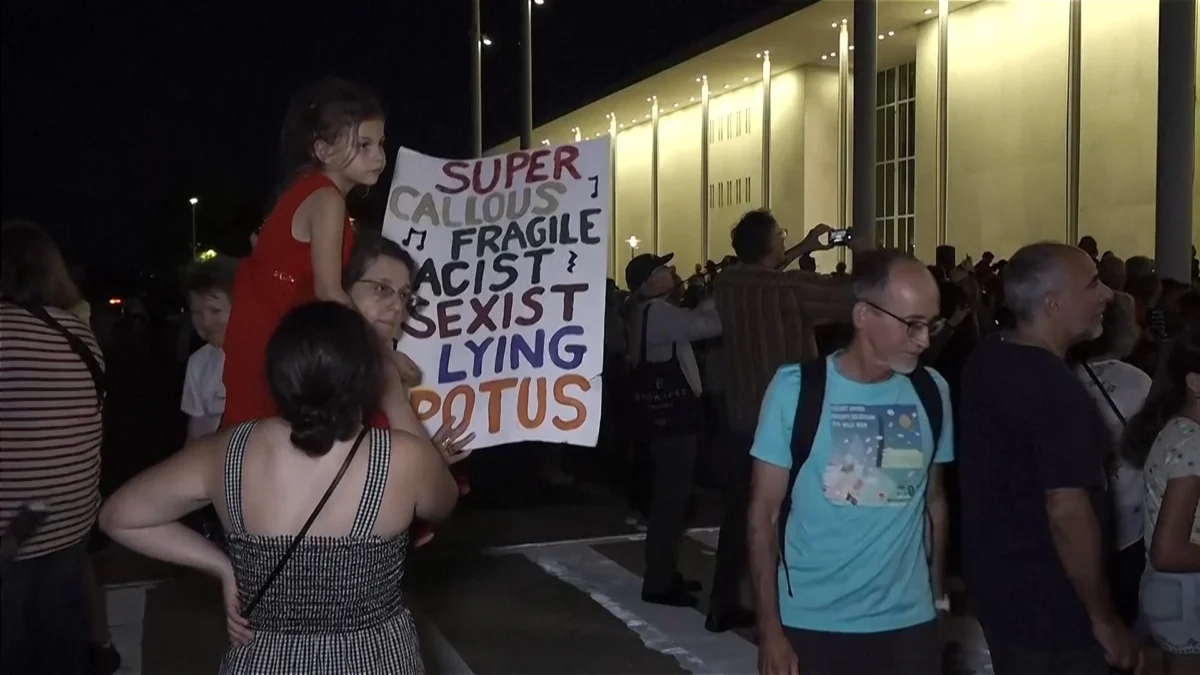
Washington D.C. – Protests erupted outside the John F. Kennedy Center for the Performing Arts this past Saturday, September 19, 2026, following President Donald Trump’s controversial remarks regarding the iconic arts institution. The President, in a statement that has sent shockwaves through the cultural and political spheres, declared his intention to shutter the Kennedy Center for extensive renovations, going as far as to suggest it could be “ripped down” if his demands are not met.
The catalyst for the public outcry appears to be a contentious demand from President Trump to have his name emblazoned on the building. Sources close to the administration, speaking on condition of anonymity, have indicated that Trump views the potential renaming as a crucial legacy project, and has expressed extreme displeasure at the perceived lack of deference. His pronouncements have been widely interpreted as a direct threat to the continued existence of the Kennedy Center in its current form, a sentiment that has galvanized artists, patrons, and citizens alike.
A Cultural Cornerstone Under Fire
The Kennedy Center, a vibrant hub for national and international performing arts, has stood as a symbol of American cultural achievement since its opening in 1971. Named in honor of the 35th U.S. President, John F. Kennedy, it hosts a diverse array of performances, including theater, opera, ballet, symphony orchestras, and contemporary music. The center also serves as a vital educational resource, engaging millions of students and educators annually through its acclaimed arts education programs.
For decades, the Kennedy Center has been a bipartisan point of national pride, a testament to the enduring power of the arts to unite and inspire. Its stages have showcased both established masterpieces and groundbreaking new works, fostering a rich and dynamic cultural landscape. The mere suggestion of its demolition, therefore, represents a profound affront to this legacy and a potential blow to the nation’s artistic identity.
Escalating Rhetoric and Public Reaction
President Trump’s remarks, which were reportedly made during a private meeting with advisors before being leaked to the press, have been met with widespread condemnation. Critics have decried the President’s language as not only disrespectful but also a deeply troubling indicator of his administration’s priorities. The notion that a national cultural landmark could be threatened over a personal naming dispute has ignited fury among those who cherish the arts and the institution’s historical significance.
Protesters, numbering in the hundreds, converged on the Kennedy Center’s plaza on Saturday, brandishing signs and chanting slogans that defended the arts center and denounced the President’s alleged intentions. Many carried banners emblazoned with phrases like “Arts Not Arrogance,” “Save the Kennedy Center,” and “Culture Over Ego.” The demonstration remained peaceful, with participants expressing their solidarity and determination to protect what they consider a national treasure.
The President’s Justification and Underlying Motives
According to reports, President Trump characterized the Kennedy Center as a “dump” in his private discussions, a stark contrast to the widely held perception of the venue as a world-class institution. He is said to have argued that the extensive renovations he envisions would be a necessary undertaking, but that his cooperation, and potentially the funding for such a project, was contingent upon the building being renamed in his honor. This demand has been met with particular incredulity, as it represents an unprecedented attempt to leverage national cultural assets for personal aggrandizement.
Political analysts suggest that this latest controversy highlights a recurring pattern in the President’s public discourse: a tendency to personalize national institutions and to equate public service with personal loyalty and recognition. His administration has frequently been characterized by its emphasis on the President’s own brand and legacy, and this incident appears to be a particularly audacious manifestation of that inclination. The arts community, in particular, has expressed deep concern over what they perceive as a fundamental misunderstanding of the role and value of cultural institutions.
A History of Controversy and Presidential Engagement
While the current threats are unprecedented in their severity, the Kennedy Center has not been without its share of political entanglements throughout its history. However, these have typically revolved around issues of funding, programming, and representation, rather than existential demolition threats driven by personal demands. Presidents of both parties have historically lent their support to the center, recognizing its importance as a unifying force in American culture.
Former President John F. Kennedy himself championed the creation of the center, envisioning it as a “living memorial” to the arts and humanities. His widow, Jacqueline Kennedy Onassis, played a pivotal role in its establishment and continued to be a staunch advocate throughout her life. The center’s very foundation is rooted in a bipartisan commitment to fostering artistic excellence and accessibility for all Americans.
The Arts Community’s United Front
The response from the national and international arts community has been swift and overwhelmingly unified. Leading figures from theater, music, dance, and visual arts have issued statements condemning President Trump’s remarks and reaffirming their unwavering support for the Kennedy Center. Many have pointed to the potential irreparable damage to the arts ecosystem if such a threat were to materialize, not only in Washington D.C. but across the nation.
The Kennedy Center itself has remained largely silent on the specific details of the President’s pronouncements, opting for a measured response that emphasizes its commitment to its mission. However, behind the scenes, sources indicate that the institution is actively engaging with stakeholders and exploring all available avenues to safeguard its future. The potential for legal challenges and significant public advocacy campaigns is being discussed.
Broader Implications for Cultural Policy
This controversy raises profound questions about the relationship between government, culture, and presidential authority. Critics argue that the President’s actions, if carried out, would set a dangerous precedent, potentially politicizing national cultural institutions and subjecting them to the whims of individual leaders. The idea that a president could unilaterally decide the fate of such a significant landmark based on personal grievances or demands is seen as a direct threat to democratic norms and the independence of artistic expression.
The potential economic and cultural fallout from the closure or demolition of the Kennedy Center would be immense. The venue is a major employer and a significant draw for tourism, contributing millions of dollars to the D.C. economy annually. Beyond the financial implications, the loss of its programming and educational outreach would leave a void in the nation’s cultural fabric that would be difficult, if not impossible, to fill.
Legal and Political Hurdles Ahead
Should President Trump pursue his stated intentions, he would likely face significant legal and political obstacles. The Kennedy Center is a federally funded institution, and any drastic action would require navigating a complex web of legislative approvals and potential judicial review. Members of Congress from both sides of the aisle have already begun to voice their opposition, signaling a potential bipartisan front against any move to demolish the center.
The public protest on Saturday is likely just the beginning of a sustained campaign to protect the Kennedy Center. Advocacy groups are already planning further demonstrations and fundraising efforts to support legal defense and public awareness initiatives. The battle lines have been drawn, and the coming weeks and months are expected to see intense debate and action surrounding the fate of this cherished American institution.
A Defining Moment for National Heritage
The current crisis at the John F. Kennedy Center for the Performing Arts represents a defining moment for how the United States values and protects its cultural heritage. The President’s threats have illuminated the precarious position of national landmarks when subjected to personal and political pressures. The response from the public and the arts community will undoubtedly shape the future discourse on the role of culture in American society and the responsibilities of leadership in safeguarding these vital institutions for generations to come. The resilience of the Kennedy Center, and indeed the spirit of American arts, is now being tested under an unprecedented spotlight.