Apple officially introduced its redesigned MacBook Pro OLED on Wednesday, marking the first time the company’s signature Dynamic Island interface has appeared on a desktop or laptop computer. The announcement, which served as the centerpiece of Apple’s week-long "Pro and Tell" hardware showcase, confirms years of speculation regarding the convergence of mobile and desktop user interfaces. This new iteration of the MacBook Pro signifies a major shift in Apple’s design philosophy, integrating touch-enabled technology and sophisticated software overlays previously reserved for the iPhone.
The flagship feature of the new hardware is the "PROLED" XDR display, a proprietary OLED panel that replaces the mini-LED technology found in previous generations. While the move to OLED provides significant improvements in contrast ratios and power efficiency, the most visible change is the software-driven "island" at the top of the screen. This interactive module replaces the static notch that has characterized the MacBook Pro line since 2021, providing a fluid space for system alerts, background tasks, and real-time data.
According to technical specifications released by Apple, the Dynamic Island on the MacBook Pro OLED serves as the primary hub for several core macOS functions. It is now the dedicated home for the revamped Siri AI, Spotlight search, and Live Activities. On the iPhone, the Dynamic Island has been praised for its ability to surface relevant information without interrupting the user’s primary workflow, and Apple appears to be betting on a similar utility for professional creators and power users on the Mac.
Integration of Dynamic Island on the New MacBook Pro OLED
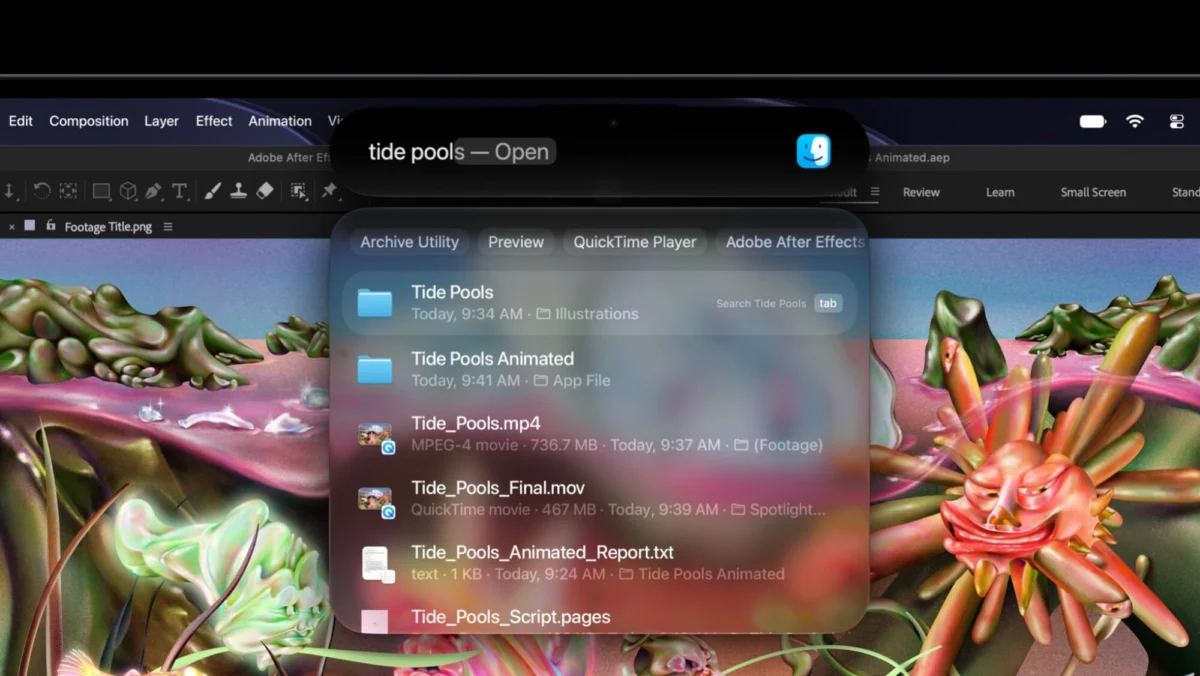
The implementation of the Dynamic Island on a larger display format allows for a more expansive set of interactions than those seen on the iPhone 14 Pro or later models. On the MacBook Pro OLED, the module expands horizontally to provide status updates for ongoing AirDrop transfers, music playback controls, and download progress bars. When a user initiates a Spotlight search, the interface expands from the top-center of the screen, creating a centralized focal point for system navigation.
Initial demonstrations of the software show that the island remains persistent but non-intrusive. For example, when a user plays media through Apple Music or a supported third-party application, the album art and a waveform visualizer appear within the island. Clicking the module expands it into a mini-player, allowing for playback adjustments without the need to switch windows or open the Control Center. This mirrors the multitasking capabilities that have become a staple of the iOS experience, adapted for a multi-window desktop environment.
Furthermore, the Dynamic Island integrates deeply with the new Siri AI features. When the voice assistant is triggered, the island glows with the signature multicolored Siri light, and text responses are displayed directly within the expanded module. This move suggests that Apple is looking to move system-level notifications away from the traditional top-right corner of the screen, centralizing the user’s attention at the top-center of the PROLED display.
Evolution of the Pro Display: From Liquid Retina to PROLED
The transition to the MacBook Pro OLED represents a significant hardware milestone for the Mac lineup. For several years, Apple relied on Liquid Retina XDR displays, which utilized mini-LED backlighting to achieve high brightness and local dimming. While effective, mini-LED displays often suffered from "blooming" effects, where light from bright objects bleeds into darker areas of the screen. The new PROLED technology eliminates this issue by allowing each individual pixel to emit its own light, resulting in true black levels and infinite contrast.
The inclusion of touch sensitivity on the MacBook Pro OLED marks another historic departure for the company. For over a decade, Apple executives maintained that touchscreens were not ergonomically suited for laptops, famously referring to them as "ergonomically terrible." However, the "Pro and Tell" announcements suggest a reversal of this stance. The new touch interface is designed to complement the Dynamic Island, allowing users to tap on the island to manage notifications or swipe through active tasks directly on the screen.
Industry analysts suggest that the move to OLED was motivated by the need to reduce the thickness of the display lid and improve battery life. Because OLED panels do not require a separate backlight layer, the MacBook Pro OLED features a slightly thinner profile than its predecessor. Additionally, the efficiency of OLED when displaying dark mode interfaces is expected to extend the laptop’s runtime during professional workloads, such as video editing or software development.
Functional Changes and the Integration of Siri AI
The arrival of the Dynamic Island on the Mac coincides with a broader push toward artificial intelligence across Apple’s ecosystem. The MacBook Pro OLED is powered by the M6 series of chips, which feature an enhanced Neural Engine specifically designed to handle on-device AI processing. The Dynamic Island acts as the visual front-end for these AI capabilities, providing a dedicated space for "Intelligence" notifications and generative suggestions.

For instance, when a user is drafting an email or a document, the Dynamic Island can surface suggested edits or summary snippets generated by the M6 chip’s AI cores. This integration transforms the island from a simple notification bar into an active productivity tool. By leveraging the proximity of the island to the MacBook’s high-resolution camera system, Apple has created a unified "sensor housing" that feels like a deliberate part of the software experience rather than a physical limitation.
Spotlight search has also undergone a total transformation within the MacBook Pro OLED interface. Instead of a floating bar in the middle of the screen, the search results now cascade down from the Dynamic Island. This design choice keeps the center of the screen clear for the user’s primary work while providing a high-contrast area for search results against the OLED’s deep blacks.
Technical Constraints and the Absence of Face ID
Despite the visual similarities between the MacBook Pro OLED and the iPhone, one key biometric feature remains absent from the laptop. The new MacBook Pro does not include Face ID. Users must still rely on the Touch ID sensor integrated into the power button for biometric authentication, secure payments, and password management.
The decision to exclude Face ID from the MacBook Pro OLED likely stems from the physical constraints of the laptop’s lid. While the Dynamic Island houses the front-facing camera and ambient light sensors, the depth required for the TrueDepth camera system—which powers Face ID—remains a challenge for the ultra-thin OLED panels. Apple’s engineering team has prioritized a slim form factor, which currently precludes the inclusion of the infrared projectors and sensors necessary for facial recognition.
However, the presence of the Dynamic Island has led to speculation that Face ID may be integrated into future iterations of the Mac. By establishing the "Island" design language now, Apple is preparing its user base for a screen layout that can eventually accommodate more complex sensor arrays without requiring a change in the software’s visual identity.
Market Positioning and the Competitive Landscape
The release of the MacBook Pro OLED with Dynamic Island places Apple in direct competition with a growing field of high-end Windows laptops that have offered OLED and touch capabilities for several years. Manufacturers like Dell, HP, and Lenovo have long marketed OLED laptops to creative professionals, citing color accuracy and high contrast as primary selling points. Apple’s entry into this space, bolstered by its proprietary silicon and integrated software ecosystem, is expected to intensify competition in the premium laptop segment.
Market researchers believe that the inclusion of the Dynamic Island will be a major selling point for consumers who are already familiar with the iPhone’s interface. This "homogenization" of the user experience makes the transition between devices more seamless, a strategy Apple has pursued through features like Universal Control and Handoff. By bringing the Dynamic Island to the Mac, Apple is further blurring the lines between its mobile and desktop operating systems.
The pricing for the new MacBook Pro OLED reflects its position as a high-end professional tool. With the addition of the PROLED display and the M6 architecture, the starting price has seen a modest increase compared to previous models. However, the company argues that the productivity gains provided by the touch-enabled interface and the AI-driven Dynamic Island justify the premium cost.
Future Outlook for the Mac Hardware Roadmap
The introduction of the MacBook Pro OLED is widely viewed as the beginning of a broader transition for the entire Mac lineup. History suggests that features introduced in the "Pro" models eventually migrate to the MacBook Air and the iMac. If the Dynamic Island proves successful on the MacBook Pro, it is highly probable that future iterations of the MacBook Air will adopt similar OLED technology and software interfaces.
Furthermore, the "Pro and Tell" event has set a new precedent for how Apple announces its hardware updates. By dedicating a full week to "Pro" level announcements, the company is signaling a renewed focus on its core professional user base. The MacBook Pro OLED is not just a hardware refresh; it is a re-imagining of how users interact with macOS in an era of AI and high-fidelity displays.
As developers begin to optimize their apps for the Mac’s version of the Dynamic Island, the utility of the feature is expected to grow. Just as the iPhone’s island evolved from a simple notification area to a robust multitasking tool, the MacBook Pro OLED’s island will likely become an essential component of the professional creative workflow. For now, the move represents Apple’s most significant step yet in creating a unified, touch-forward future for the personal computer.