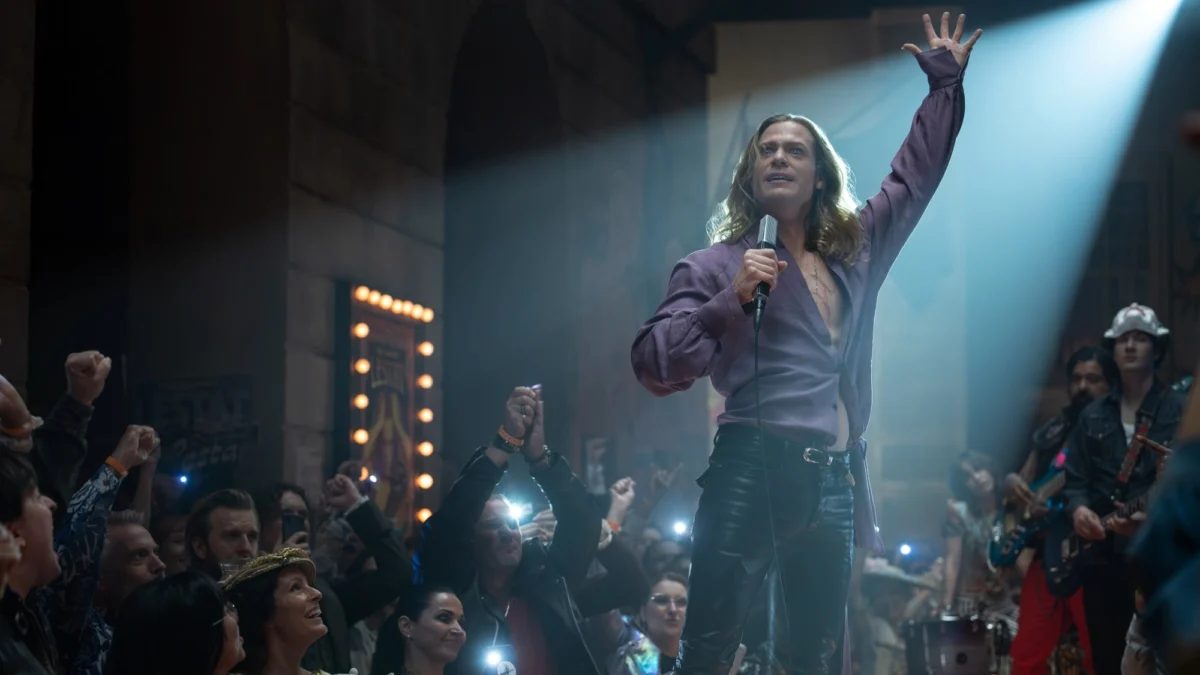
The first season of AMC’s "The Vampire Lestat" concluded with a surreal and psychologically dense finale that has prompted actor Sam Reid to clarify the complex narrative structures surrounding the "Failure Finders" and the protagonist’s deteriorating mental state. The episode, titled "The Failures," marks a pivotal shift in the network’s expanding Immortal Universe, moving away from the more grounded gothic romance of previous seasons into a hallucinatory exploration of guilt, memory, and supernatural consequence. As the titular vampire faces a literal and metaphorical decapitation, the series introduces a "long table" sequence that serves as a tribunal for his centuries of perceived transgressions.
Central to the finale’s impact is the presence of the "Failure Finders," a group of figures from Lestat de Lioncourt’s past who assemble to confront him during his most vulnerable moment. This assembly includes his maker, the ancient and malevolent Magnus, played by Damien Atkins, alongside several of Lestat’s fledglings and former companions. The sequence has sparked intense debate among viewers regarding the nature of these entities—whether they are literal ghosts, psychic projections, or a manifestation of the "savage garden" philosophy that permeates Anne Rice’s literary works.
Reid, who has portrayed the "Brat Prince" since the inception of AMC’s "Interview with the Vampire," noted that the entire first season was architected to lead toward this confrontation at the long table. The actor indicated that the narrative has dropped subtle clues since the premiere, referencing warnings from characters like Baby Jenks and Magnus himself regarding a coming reckoning for Lestat’s soul. This structural choice highlights a significant departure from traditional linear storytelling, reflecting the chaotic and often contradictory nature of Lestat’s own memory as he narrates his history through a series of recordings.
The Composition of the Failure Finders at the Long Table
The "Failure Finders" represent a curated history of Lestat’s most significant failures in interpersonal relationships and moral stewardship. Sitting at the head of the table is Magnus, the vampire who transformed Lestat and subsequently committed suicide by fire, leaving his heir with a legacy of trauma and immense wealth. Surrounding him are figures such as Nicolas "Nicki" de Lenfent, Lestat’s first great love; Gabriella, his mother and fledgling; Antoinette; and his bandmate TC. Notably, the character of Louis de Pointe du Lac appears in a heightened, antagonistic form, while Claudia is conspicuously absent from the gathering.

Reid suggested that the absence of certain characters and the presence of others speaks to the specific nature of Lestat’s guilt. The Failure Finders are not necessarily the actual souls of the deceased or the living individuals themselves, but rather "heightened" versions of these people as they exist within Lestat’s psyche. They serve as a persistent internal monologue that characterizes Lestat as a failure, challenging his carefully constructed persona of aristocratic indifference and artistic vanity.
The inclusion of characters who are still technically alive in the show’s timeline, such as Louis, suggests that the long table exists in a liminal space between the physical world and the supernatural afterlife. Reid described this as a "supernatural space" where a being of Lestat’s age and power must confront the weight of his existence. The actor emphasized that for a character who has spent centuries brushing off trauma and refusing to engage with his own psychological pain, the Failure Finders represent a breaking point where deflection is no longer possible.
Psychological Deflection and the Narrative Structure of ‘The Vampire Lestat’
Throughout the debut season of "The Vampire Lestat," the show has utilized a frenetic, often "assaultive" editing style and a non-linear timeline. This aesthetic choice was intentional, designed to mirror the protagonist’s own refusal to investigate the darker corners of his history. Reid observed that the episodes often feel like an assault because Lestat himself was not fully investigating the events as they occurred, choosing instead to rage, laugh, or provoke his way through various crises.
The finale forces a reconciliation between these disparate memories. By acknowledging the Failure Finders, Lestat is finally forced to admit his responsibility for the destruction he has caused. The season’s framing device—Lestat recording his story for an unknown listener or an auction winner—adds another layer of complexity. These recordings, which he collectively titles "The Failures," serve as a confession of his internal state during the moments he felt most powerless.
Industry analysts have noted that this approach to character development is rare in the horror-fantasy genre, as it prioritizes psychological deconstruction over traditional plot progression. By framing the season as a series of failures, the showrunners have successfully transitioned the character from a charismatic antagonist in "Interview with the Vampire" to a deeply flawed and self-loathing protagonist in his own right.

The Reveal of the Ravaged World and ‘The Failures’ Album
The climax of the finale extends beyond the internal tribunal of the long table, revealing the physical state of the world from which Lestat is broadcasting his recordings. The show depicts a ravaged, near-apocalyptic landscape, a stark contrast to the lush, historical settings of previous episodes. This revelation suggests that Lestat’s personal failures have had global consequences, leading to what he perceives as the destruction of the world.
Reid hinted that the subsequent decisions Lestat makes after acknowledging this destruction will form the backbone of future seasons. The recording of the album "The Failures" is not merely a musical endeavor but a desperate attempt to communicate his culpability to a specific individual. This narrative thread aligns with the source material’s themes of the vampire as a rock star, yet it grounds the flamboyant performance in a sense of genuine despair and environmental or social ruin.
The transition from the 18th-century "Brat Prince" to a modern-day harbinger of doom reflects the series’ ambition to modernize Anne Rice’s "The Vampire Chronicles" while maintaining the philosophical depth of the original novels. The "ravaged world" serves as a physical manifestation of the "Savage Garden," a concept Rice used to describe a world that is beautiful but indifferent to suffering, where the only law is survival.
Impact on the AMC Immortal Universe and Fan Reception
The shift in tone and the introduction of the Failure Finders have solidified AMC’s commitment to a more experimental form of genre television. Following the critical success of "Interview with the Vampire," "The Vampire Lestat" has pushed the boundaries of how supernatural stories are told on screen. The audience reaction to the finale has been largely positive, with fans praising Sam Reid’s performance for its ability to balance Lestat’s inherent theatricality with moments of raw, unshielded vulnerability.
The "The Vampire Lestat" finale also sets the stage for further crossovers within the Immortal Universe, including potential links to "Mayfair Witches" and the upcoming "Talamasca" series. By establishing the existence of a "soul" and a supernatural realm where the past can literally haunt the present, the showrunners have expanded the mechanical rules of their universe. This allows for a wider range of storytelling possibilities, where death is not necessarily the end of a character’s influence on the plot.

Critics have pointed out that the show’s willingness to portray its lead character as a "failure" is a bold move that subverts the "power fantasy" often associated with vampire media. Instead of focusing on the strengths and predatory advantages of the vampire, "The Vampire Lestat" examines the emotional and moral debt that accumulates over centuries of immortality.
Future Implications for Season 2 and Beyond
As the production moves toward a second season, the consequences of the "Failure Finders" sequence are expected to resonate throughout the narrative. Lestat’s acknowledgement of his role in the world’s destruction suggests a potential redemption arc, or perhaps a further descent into madness as he attempts to "fix" what he has broken. The mystery of the auction and the identity of the person Lestat is recording for remain central questions that will likely drive the next chapter of the series.
The creative team, led by showrunner Rolin Jones, has indicated that the series will continue to explore the "Savage Garden" and the evolution of the vampire soul. With Sam Reid’s insights into the character’s psyche, the show appears poised to delve even deeper into the lore established by Anne Rice, while carving out a unique identity in the crowded landscape of prestige television.
The finale of "The Vampire Lestat" has successfully redefined the character for a new generation, moving beyond the "villain" archetype to something far more complex. By facing his Failure Finders at the long table, Lestat has begun a process of self-reckoning that promises to be as destructive as it is revelatory. The "Brat Prince" may have found his era of "finding out," but the fallout of those discoveries is only just beginning to be felt across the Immortal Universe.