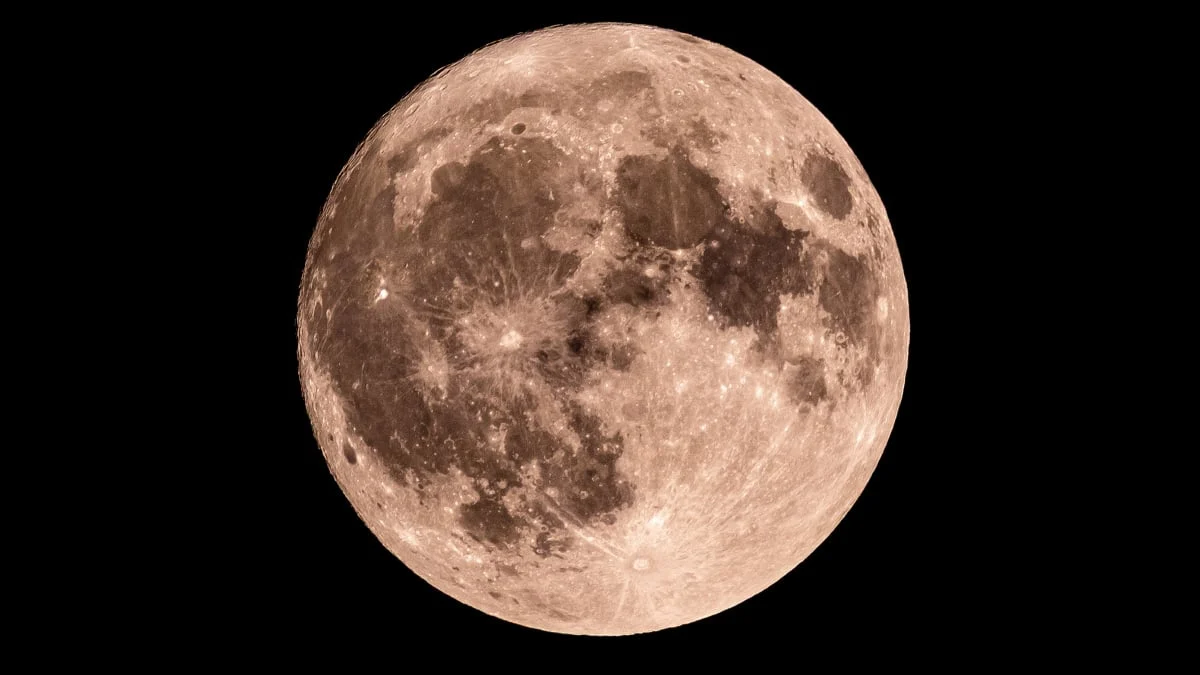
The lunar surface will reach approximately 90% illumination on the night of July 26, 2026, as the Moon enters the final stages of its waxing gibbous phase. Astronomers and casual observers across the Northern Hemisphere will witness a near-complete lunar disk, serving as a bright prelude to the full "Buck Moon" scheduled to occur just three days later.
Data provided by NASA’s Daily Moon Guide indicates that the Moon will be prominently positioned in the night sky, offering high visibility for both naked-eye observation and telescopic study. During this specific window in the lunar cycle, the "terminator"—the line dividing the shadowed and illuminated portions of the Moon—moves across the western edge of the lunar face, creating long shadows that highlight topographical features.
This phase is characterized by its distinct "humpbacked" appearance, derived from the Latin word gibbus. Because the Moon is nearing its peak illumination, it will rise in the late afternoon and remain visible for the majority of the night, reaching its highest point in the sky after sunset.
Scientific Mechanics of the Waxing Gibbous Phase
The waxing gibbous phase represents the period of the lunar cycle between the First Quarter and the Full Moon. During this time, the Moon’s position in its 29.5-day orbit around the Earth allows an increasing amount of sunlight to reflect off the lunar regolith toward terrestrial observers.
On July 26, 2026, the Moon will have completed roughly three-quarters of its journey from the New Moon phase. The 90% illumination level ensures that the Moon will be the dominant light source in the night sky, potentially washing out fainter constellations and deep-sky objects like nebulae and distant galaxies.
Astronomers note that the "waxing" descriptor refers to the growing nature of the illuminated area. Following this date, the Moon will continue to broaden its visible surface by several percentage points each night until it reaches 100% illumination on July 29.
A Guide for Terrestrial Observers: Craters and Mountains
The high level of brightness on July 26 provides a unique opportunity to identify major lunar landmarks without the need for high-end equipment. For those observing with the naked eye, the lunar "Maria"—large, dark basaltic plains formed by ancient volcanic eruptions—will be clearly defined.
Observers can easily spot the Mare Fecunditatis (Sea of Fertility), Mare Serenitatis (Sea of Serenity), and Mare Tranquillitatis (Sea of Tranquility). These regions appear darker than the surrounding lunar highlands due to their high iron content and smoother surfaces, which reflect less sunlight.
For enthusiasts using standard 10×50 binoculars, the level of detail increases significantly. The Alps Mountains (Montes Alpes), a rugged range located in the northern part of the Moon, will be visible near the Mare Imbrium. Additionally, the Archimedes Crater and the Gassendi Crater will stand out, particularly near the terminator line where the contrast between light and shadow is most pronounced.
Those utilizing hobbyist or professional-grade telescopes will have access to even more intricate features. The Schiller Crater, notable for its unusual elongated, shoe-like shape, will be a primary target for lunar photographers. The Caucasus Mountains (Montes Caucasus) will also provide a dramatic landscape of peaks and shadows along the lunar northeast.
The Historical Significance of the Apollo 12 Landing Site
One of the most compelling aspects of the Moon phase today explained for July 26, 2026, is the visibility of historical exploration sites. With a telescope of moderate power, observers can pinpoint the general region of the Apollo 12 landing site in the Oceanus Procellarum (Ocean of Storms).
Apollo 12, the second crewed mission to land on the Moon in November 1969, targeted a site near the Surveyor 3 spacecraft. While the hardware itself is too small to be seen from Earth-based telescopes, the flat, expansive plains of the landing zone are well-lit during the 90% waxing gibbous phase.
The ability to locate these sites serves as a reminder of the human legacy on the lunar surface, especially as international space agencies prepare for a renewed era of crewed exploration. By July 2026, NASA’s Artemis program is expected to be in high gear, with the goal of returning humans to the lunar south pole.
The 2026 Astronomical Calendar: A Prelude to the Total Solar Eclipse
The lunar activity on July 26, 2026, is part of a broader, highly anticipated summer for astronomy. The waxing gibbous moon serves as a countdown to the total solar eclipse occurring on August 12, 2026. This eclipse will be the first total solar eclipse visible from the European continent in decades, passing over Iceland, Spain, and Portugal.
Because the solar eclipse requires a New Moon phase to occur, the July 26 waxing gibbous marks the beginning of the final two-week countdown to that event. As the Moon moves from its full phase on July 29 toward its new phase in mid-August, it will eventually align perfectly between the Earth and the Sun.
This alignment makes the study of the Moon phase today explained particularly relevant for educators and scientists who use these cycles to predict and explain orbital mechanics to the public. The July 26 phase provides a "bright" baseline for understanding how the Moon’s position changes relative to the Earth and Sun over a short period.
Understanding the Eight Phases of the Lunar Cycle
The progression of the Moon on July 26 is one of eight distinct stages recognized by NASA and the international scientific community. These phases are a result of the Moon’s synchronous rotation, meaning it always shows the same face to Earth while the Sun illuminates different portions of that face.
The cycle begins with the New Moon, where the Moon is positioned between the Earth and the Sun, rendering it invisible. This is followed by the Waxing Crescent, where a sliver of light appears on the right side in the Northern Hemisphere. After the First Quarter (a half-moon appearance), the Moon enters the Waxing Gibbous phase seen on July 26.
Following the Full Moon on July 29, the cycle reverses into "waning" phases. The Waning Gibbous, Third Quarter, and Waning Crescent phases see the illuminated portion shrink from the right side, eventually returning to a New Moon to begin the 29.5-day synodic month once again.
Public Impact and the Growing Interest in Astrotourism
The clarity and brightness of the 90% illuminated Moon on July 26, 2026, are expected to drive significant public interest in "astrotourism." In recent years, dark-sky preserves and national parks have seen a surge in visitors who travel specifically to view celestial events away from urban light pollution.
Even in suburban areas, the waxing gibbous moon is bright enough to be enjoyed despite moderate light pollution. Local astronomy clubs often host "star parties" during this phase because the Moon is high in the sky during convenient evening hours, making it an ideal subject for educational outreach.
The 2026 date also coincides with a period of increased solar activity, known as the solar maximum. While the Moon itself is not affected by solar flares, the combination of a bright lunar disk and the potential for auroras at lower latitudes creates a unique atmosphere for night-sky photography and observation.
Looking Ahead: The July 29 Full Moon
As the Moon continues its transit following July 26, the illumination will increase by approximately 3% to 5% each night. By the evening of July 29, the Moon will reach 100% illumination, officially becoming a Full Moon.
In many cultures, the July Full Moon is known as the "Buck Moon," signifying the time of year when young male deer begin to grow their new antlers. It is also referred to as the Thunder Moon in some regions due to the frequency of summer storms.
The transition from the 90% waxing gibbous on July 26 to the Full Moon on July 29 represents the peak of lunar brightness for the month. This period is often used by maritime industries to predict higher "spring tides," which occur when the gravitational pull of the Sun and Moon align, leading to a greater range between high and low water levels.