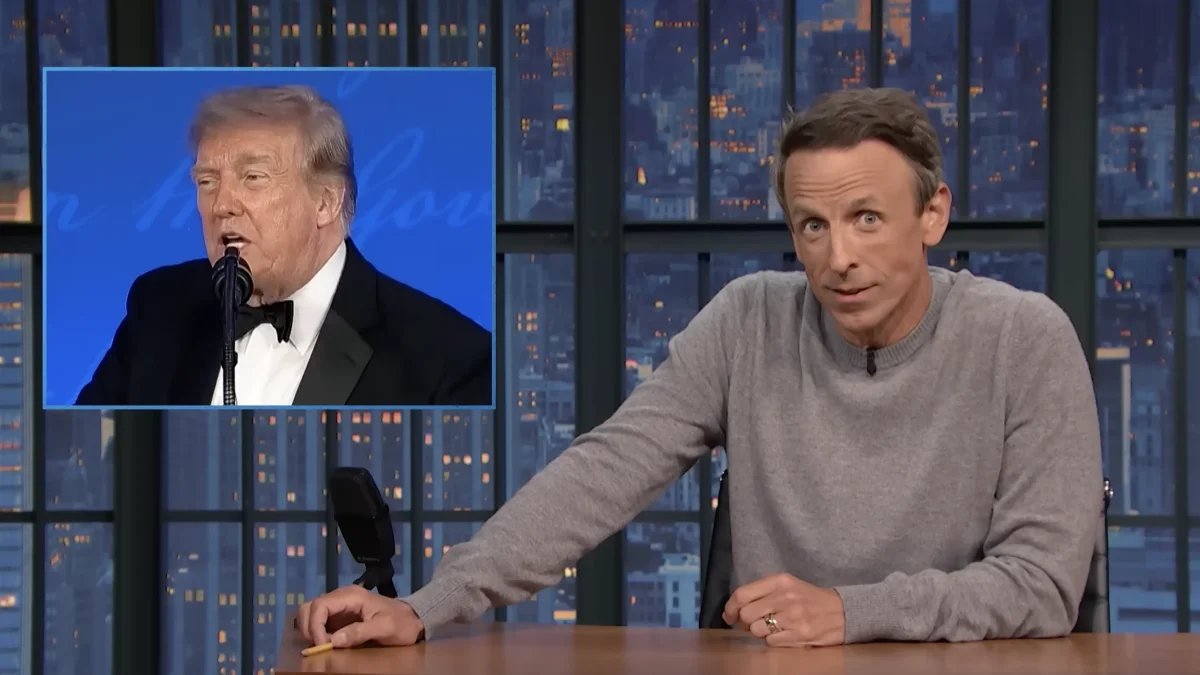
Late-night host Seth Meyers dedicated a significant portion of his recent broadcast to dissecting former President Donald Trump’s appearance at the White House Correspondents’ Dinner, focusing on a performance that many observers described as uncomfortably silent. The comedian’s monologue highlighted the stark contrast between Trump’s attempts at humor and the muted reception from the gathered audience of journalists, politicians, and celebrities. Meyers specifically targeted the former president’s lengthy digression regarding a controversial $400 million ballroom project at the White House, a topic that reportedly left the room in a state of visible bewilderment.
The annual event, traditionally a venue for lighthearted ribbing between the executive branch and the press corps, became a focal point for late-night commentary following Trump’s decision to headline the gala. While the dinner is intended to celebrate the First Amendment and raise scholarship funds, the atmosphere this year was characterized by a palpable tension that Meyers and other commentators were quick to exploit for comedic effect. The "Late Night" host noted that the lack of laughter was so profound it created an auditory vacuum, making every minor movement in the room audible to those watching the telecast.
The Anatomy of a Muted Performance
During his segment, Meyers utilized several clips from the dinner to illustrate the disconnect between the podium and the audience. He remarked on the physical reactions of the attendees, suggesting that the discomfort was almost universal across the various tables in the Washington Hilton ballroom. "You could both hear a pin drop and see people who looked like they’d just sat on a pin," Meyers told his viewers, emphasizing the awkwardness that permeated the event. The comedian suggested that the silence was not merely a lack of appreciation for the jokes, but a reflection of the strained relationship between the speaker and the press.
Meyers’ reaction to Trump’s White House Correspondents’ Dinner roast also touched upon the technical aspects of the delivery. He joked that the silence was so heavy he initially questioned if the audio feed had been cut or if the audience was separated from the stage by soundproof glass. This observation served to underscore the narrative that the former president’s brand of humor may not have translated effectively to a room filled with the very individuals who have spent years scrutinizing his administration and personal business dealings.
The $400 Million Ballroom Controversy
A central theme in Meyers’ critique was Trump’s focus on the proposed $400 million White House ballroom, a project that has drawn significant fire from fiscal conservatives and political opponents alike. According to reports, Trump spent a considerable portion of his time at the podium defending the necessity and grandeur of the project, a move that Meyers found particularly ill-suited for a comedy-focused event. The host mocked the specificity of the defense, suggesting that the audience had likely checked out mentally long before the former president finished his remarks on the architectural merits of the structure.
"Oh my God, that room is so quiet," Meyers exclaimed after playing a clip of the ballroom segment. He further hypothesized that the audience might have actually vacated the premises during the speech to inspect the site of the proposed ballroom themselves. The focus on such a high-priced and controversial infrastructure project during a night meant for levity provided Meyers with ample material to question the former president’s situational awareness and his priorities regarding public perception.
Comparative Reactions from Late-Night Peers
Seth Meyers was not the only late-night personality to find humor in the dinner’s shortcomings. Jon Stewart, returning to "The Daily Show," also provided a scathing breakdown of the evening, focusing on the broader implications of Trump’s return to the event he had famously snubbed during his four years in office. Stewart and Meyers both reached similar conclusions regarding the evening’s efficacy, suggesting that the event served more as a reminder of political divisions than a moment of national unity or professional camaraderie.
While Stewart’s analysis leaned more toward the systemic issues within the media-political complex, Meyers focused on the visceral experience of the "roast" itself. By comparing the reactions of the two hosts, media analysts suggest a unified front among late-night satirists in framing the dinner as a failure for the former president. This collective response reinforces the idea that late-night television remains a primary vehicle for shaping public sentiment following major political social events.

Historical Context of the White House Correspondents’ Dinner
To understand why Seth Meyers gleefully reacts to Trump’s White House Correspondents’ Dinner roast with such intensity, one must look back at the history between the two men. In 2011, Meyers served as the headliner for the same dinner, during which he famously mocked Trump, who was then a private citizen and a vocal proponent of the "birther" movement. That night is often cited by political historians as a pivotal moment that may have fueled Trump’s eventual run for the presidency.
The 2011 dinner established a long-standing rivalry, making Meyers’ current commentary part of a decade-long narrative. For Meyers, the 2026 dinner represented a full-circle moment where he could once again use his platform to critique Trump’s performance in the same room where their public animosity first reached a fever pitch. This historical backdrop adds a layer of personal stakes to Meyers’ professional critique, as both men have used the forum of the Correspondents’ Dinner to challenge one another’s legitimacy and public standing.
The Cultural and Political Impact of Late-Night Commentary
The reaction to the dinner highlights the enduring influence of late-night hosts in the American political landscape. While the dinner itself is attended by a few thousand people, the clips and commentary generated by hosts like Meyers reach millions of viewers through social media and digital platforms. This secondary audience often views the event entirely through the lens of the comedian’s perspective, which can have a more lasting impact than the actual speech delivered at the podium.
In the days following the dinner, social media was flooded with clips of Meyers’ monologue, with the "pin drop" quote becoming a viral shorthand for the event’s perceived failure. Political strategists note that this type of cultural saturation can be damaging to a politician’s image, as it reduces complex interactions to a series of punchlines. For Trump, the goal of appearing at the dinner was likely to show a more approachable, humorous side; however, the consensus among late-night commentators suggests that the effort may have backfired.
Public and Media Industry Reactions
Within the journalism community, the reaction to the dinner has been mixed. Some members of the White House Correspondents’ Association expressed concern that the event has become too polarized and that the presence of high-profile political figures like Trump turns a professional gathering into a partisan spectacle. Others argued that the dinner is an essential tradition that should persist regardless of the friction between the press and the presidency.
The industry’s internal debate mirrors the broader public reaction. Supporters of the former president viewed the silence of the room as evidence of the media’s bias and their inability to take a joke, while critics saw it as a justified response to a speaker they view as hostile to their profession. Meyers’ commentary tapped directly into this divide, providing a cathartic outlet for those who felt the former president’s presence at the dinner was inappropriate or whose performance was genuinely lacking in comedic merit.
Consequences for Future Correspondents’ Dinners
The fallout from this year’s event has sparked discussions about the future format of the White House Correspondents’ Dinner. If the goal is to foster a night of mutual respect and humor, some organizers are questioning whether invited speakers should be limited to professional comedians rather than political figures themselves. The awkwardness highlighted by Meyers has become a cautionary tale for future administrations regarding the risks of participating in a high-stakes roast where the audience may not be inclined to laugh.
As the political cycle continues, the imagery of the silent ballroom and the "people who looked like they’d just sat on a pin" will likely persist in the public consciousness. For Seth Meyers, the event provided a wealth of content that reinforces his show’s position as a leading voice in political satire. The gleeful nature of his reaction serves as a reminder that in the world of political theater, the audience’s silence can be just as loud as their applause, and for a comedian, that silence is often the most valuable material of all.