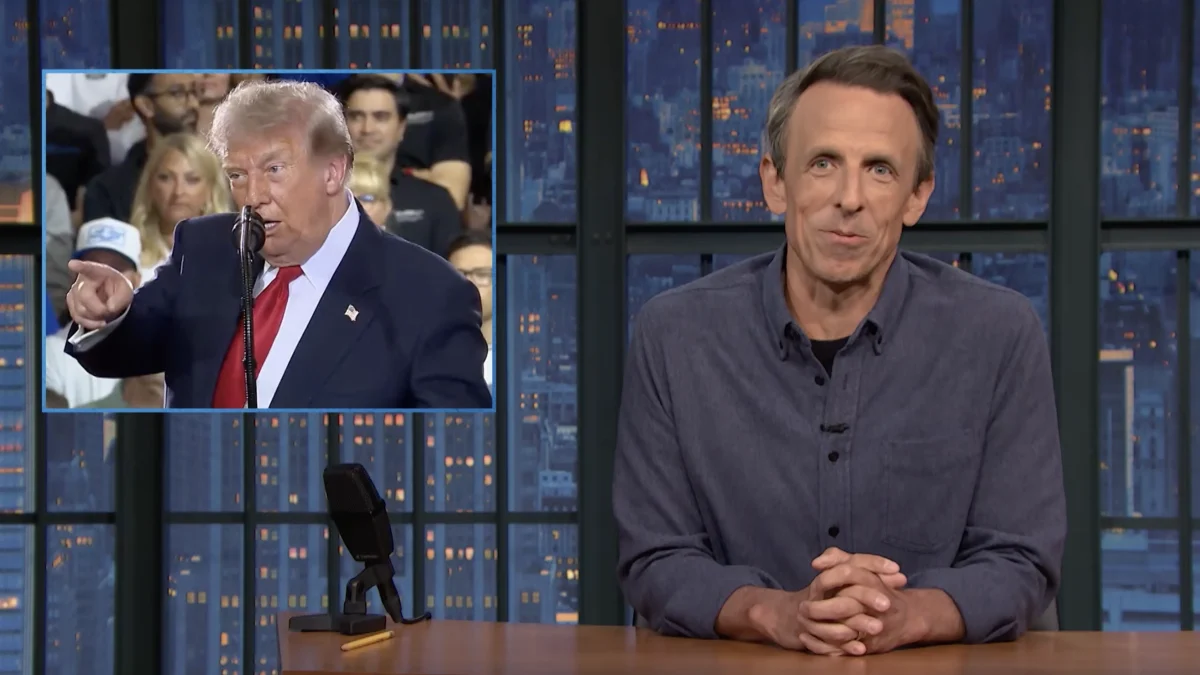
During the latest broadcast of NBC’s "Late Night," host Seth Meyers dedicated a significant portion of his "A Closer Look" segment to analyzing Donald Trump’s recent public appearances and the escalating rhetoric surrounding his campaign. The segment specifically focused on a viral moment from a recent rally where a protester labeled Trump a "pedophile protector," an incident that Meyers used to highlight the enduring nature of the controversies surrounding the former president’s past relationship with Jeffrey Epstein.
The heckling incident occurred as Trump was addressing a crowd of supporters, only to be interrupted by a demonstrator who shouted the inflammatory accusation. Trump’s immediate response was to label the protester a "communist," a rebuttal that Meyers found ideologically mismatched and logically flawed. The exchange has since sparked a wider conversation about the effectiveness of Trump’s counter-rhetoric and the persistent shadow of the Epstein investigation over his political career.
Meyers noted that the "pedophile protector" label is becoming a recurring theme at Trump’s public events, suggesting that the former president is struggling to distance himself from his past social ties to Epstein. The comedian argued that calling a critic a "communist" does little to address the specific nature of the allegations being leveled by protesters. Meyers’ analysis suggested that the use of broad political labels as a defense against specific personal accusations is a hallmark of Trump’s current defensive strategy.
The Anatomy of a Heckle: Analyzing the "Pedophile Protector" Label
The phrase "pedophile protector" has emerged as a potent weapon for anti-Trump demonstrators, specifically referencing the years during which Donald Trump and Jeffrey Epstein moved in the same social circles in New York and Florida. While Trump has repeatedly denied any knowledge of Epstein’s criminal activities and has noted that he had a falling out with the financier years before his arrest, the association remains a focal point for political opponents.
In his segment, Meyers dissected the logic of Trump’s response to the heckler. The comedian mocked the idea that an accusation of covering for sex traffickers could be countered by an accusation of supporting collective ownership of the means of production. "If someone calls you a ‘pedophile protector,’ calling them a communist is not a great comeback," Meyers told his audience. He went on to parody the exchange, suggesting that the ideological leap made by the former president was nonsensical in the context of the specific insult.
The segment highlighted how these interactions are not isolated incidents but part of a broader trend of "confrontational politics" that has come to define the 2024-2026 political landscape. Meyers’ critique centered on the idea that Trump’s reliance on his "greatest hits" of insults—such as labeling opponents as communists or socialists—is failing to resonate when applied to the specific, and often darker, allegations involving Epstein.
Seth Meyers Reacts to Trump Being Called a ‘Pedophile Protector’ and the Epstein Coin Satire
A centerpiece of the "A Closer Look" segment was Meyers’ commentary on a new piece of political merchandise: a commemorative Trump coin. Meyers used the release of the coin to pivot back to the Epstein connection, showing a photoshopped image of the currency that featured an engraving of Trump and Epstein together. The joke was intended to emphasize how inextricably linked the two figures remain in the public imagination, despite Trump’s efforts to move past the narrative.
"Trump just can’t get away from this Epstein thing," Meyers remarked, pointing to the frequency with which the topic arises during rallies, press conferences, and even high-profile social events. The host suggested that the imagery of the two men together has become an indelible part of Trump’s public record, one that satire and political commentary will continue to exploit as long as the former president remains in the spotlight.
The "Trump coin" joke also served as a broader commentary on the commercialization of the Trump campaign. By linking a piece of campaign merchandise to one of Trump’s most significant social liabilities, Meyers highlighted the tension between the former president’s brand as a successful businessman and the controversies that threaten to undermine that image.
Political Rebuttals and the Strategy of Diversion
The "communist" label used by Trump at the rally is a tactic that political analysts have observed with increasing frequency. By pivoting to a broad ideological attack, Trump often seeks to delegitimize the critic rather than address the substance of the criticism. However, as Meyers pointed out, this strategy may be reaching a point of diminishing returns when the criticism involves sensitive topics like child safety and sex trafficking.
Meyers’ reaction underscored a growing sentiment among media critics that Trump’s defensive maneuvers are becoming more predictable and less effective at neutralizing specific scandals. The comedian’s breakdown of the "ya burnt" logic was a direct jab at the perceived weakness of Trump’s current rhetorical toolkit. This loss of "comedic or rhetorical edge" is a theme Meyers has returned to frequently as the political cycle progresses.

Furthermore, the segment touched upon Trump’s appearance at the White House Correspondents’ Dinner, where he was forced to sit through a series of press awards and satirical speeches. Meyers noted that the environment of the dinner, which celebrates the First Amendment and the role of the free press, stood in stark contrast to the controlled environment of a Trump rally where hecklers are routinely ejected.
The Persistent Shadow of the Jeffrey Epstein Connection
The historical context of the Trump-Epstein relationship is a complex web of social interactions dating back to the early 1990s. Media reports have frequently cited a 2002 interview in which Trump described Epstein as a "terrific guy" who liked beautiful women "on the younger side." While Trump later stated that he had not spoken to Epstein in fifteen years prior to the latter’s 2019 arrest, the early quotes and photographs of the two men together continue to provide fodder for critics and comedians alike.
Meyers’ segment tapped into the public’s ongoing fascination and discomfort with the Epstein case, particularly as new documents and testimonies have been unsealed in recent years. By focusing on the "pedophile protector" heckle, Meyers positioned the issue not as a fringe conspiracy theory, but as a mainstream political liability that Trump has failed to adequately address or silence.
The impact of this persistent narrative on the electorate remains a subject of intense debate. For Trump’s base, such heckles are often dismissed as "fake news" or orchestrated attacks by the left. For his detractors, they are reminders of a character-based argument against his fitness for office. Meyers, through his satirical lens, bridges these two worlds by highlighting the absurdity of the defensive rhetoric used to counter the claims.
Satire as a Tool for Political Accountability in Late Night
Seth Meyers’ "A Closer Look" has evolved into a significant platform for political accountability, often functioning as a nightly "fact-check" delivered with a comedic twist. The segment on Trump being called a "pedophile protector" is indicative of how late-night television has moved beyond simple jokes to provide a more detailed analysis of political discourse and media narratives.
By focusing on the specific wording of both the heckle and the response, Meyers provides his audience with a framework for understanding the power dynamics at play during a political rally. The host’s ability to weave together disparate events—from the White House Correspondents’ Dinner to the memorial of Senator Lindsey Graham—creates a cohesive narrative of a political figure under pressure.
The mention of the Lindsey Graham memorial was particularly notable. Meyers reacted to Trump’s "unusual remarks" during the service, where the former president reportedly veered off-script to discuss personal grievances and political victories. Meyers used this to illustrate a broader point: that Trump’s inability to remain focused on the gravity of an occasion often leads him into rhetorical traps, such as the one set by the "pedophile protector" heckler.
Broader Implications for the Campaign and Public Perception
As the political landscape continues to shift, the frequency of such confrontations is expected to increase. The "pedophile protector" incident serves as a bellwether for the types of personal attacks that will likely dominate the airwaves. Seth Meyers reacts to Trump being called a ‘pedophile protector’ not just as a comedian looking for a laugh, but as a commentator observing the degradation of political decorum and the sharpening of partisan knives.
The public reaction to the segment has been divided along predictable lines, yet the viral nature of the clip suggests that the Epstein connection remains a highly salient issue for the American public. Whether this will have a measurable impact on polling or voter behavior is unclear, but it undeniably shapes the media environment in which the campaign operates.
In the final minutes of his segment, Meyers emphasized that the Epstein "thing" is a ghost that continues to haunt Trump’s political aspirations. Regardless of the former president’s attempts to pivot to other topics—such as the economy, border security, or "communist" threats—the specter of his past associations remains a primary target for those looking to disrupt his momentum.
The segment concluded without a traditional punchline, instead leaving the audience with the image of a political figure caught in a cycle of his own making. By refusing to let the Epstein narrative fade, Meyers and other late-night hosts ensure that the questions surrounding Trump’s past remain a central part of the national conversation, forcing the campaign to constantly recalibrate its defense against an increasingly aggressive opposition.